
The world of organic search (SEO) can be complex and intimidating, especially for beginners. However, a regularly conducted SEO audit can greatly help you understand your website’s current position in search engines, identify weaknesses that may be hurting your performance, and build an improvement strategy.
In this article, we’ll walk you through an SEO audit example with a PDF and a template you can download and use as a starting point for your own audit.
What is an SEO audit?
Before diving into the details, let’s start with a brief explanation of what an SEO audit is. It is a detailed examination of the current optimization state of your website, including technical analyses, content review and backlink analysis. The goal is to identify the problems that may be affecting your site’s performance in search engines, then propose recommendations to resolve them and improve your ranking.
SEO Audit Example
Here is an SEO audit example outlining the main elements such an audit should include:
- Technical analysis: This section examines the website’s structure, loading speed, responsive design, correct use of HTML tags, 404 errors, etc.
- Content analysis: This section reviews the quality and relevance of your site’s content, including keyword usage, content structure, and duplicate content.
- Backlink analysis: This part examines the backlinks pointing to your site — their quality, relevance and authority — and identifies potentially harmful links.
- Competitive analysis: This section compares your site to your main competitors on key SEO dimensions. It helps identify areas where you lag behind and areas where you excel.
- Recommendations: Based on the audit findings, this section presents a list of actions to take to improve your site’s SEO.
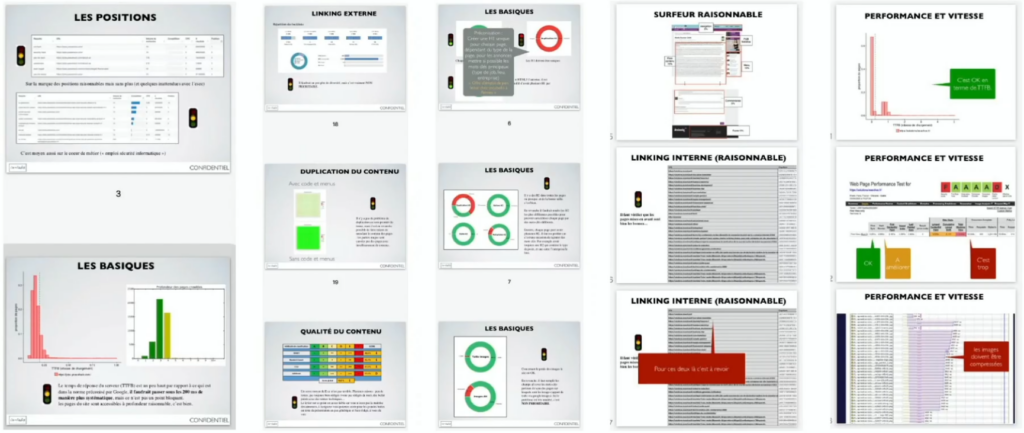
Visually, here are some good (and successful) SEO audit examples:
As you’ll see in the “How to succeed at your SEO audit” section, this one checks several boxes:

and:

Here is another good SEO audit screenshot:
SEO Audit PDF and Template
To help you conduct your own SEO audit, we have prepared a PDF and a template you can download and use as a guide. The template covers all the elements mentioned above and provides you with a clear framework for your audit.
Remember that an SEO audit is not a one-off action, but an ongoing process. Search engines constantly evolve, as do SEO best practices. A regular SEO audit allows you to adapt to these changes and ensure your site is always search-engine optimized.
If you need help conducting an SEO audit, or if you’d prefer a professional to handle it for you, don’t hesitate to contact me. As a freelance SEO consultant, I’m available to help you maximize your visibility in search engines and boost your organic traffic.
How to succeed at your SEO audit?
To conduct an effective SEO audit, it is essential to follow certain key principles:
- Focus on problems: During the audit, only target the aspects of the site that need improvement. This helps avoid information overload and gives you a clear view of what needs to be fixed.
- Prioritize SEO actions: Not all actions carry the same weight in terms of SEO impact. Rank them by importance (critical, important, medium, useful) to guide the optimization process.
- Establish a roadmap: Plan the actions to be taken by building a clear roadmap. This helps organize the work and ensures each task is accounted for.
- Involve all stakeholders: Get all relevant parties involved in executing the roadmap. Have them sign off to ensure they commit to completing their assigned tasks — this is particularly crucial if you’re not making the changes on the site yourself.
- Estimate the time required for each task: Giving an estimated time for each action can motivate the people involved to start and complete the tasks. It provides a more concrete sense of the commitment required.