
Natural search engine optimisation — also known as SEO — is something very unclear to the uninitiated. Indeed, it is a complex, long and difficult science, but I will try to keep it as simple as possible. You will discover everything you need to know in this beginner’s guide.
SEO Definition
The term SEO comes from the English acronym “Search Engine Optimization”, which translates into French as “Optimisation pour les moteurs de recherche” (search engine optimisation).
This concept could also be considered an optimisation of information retrieval, given that search engines are first and foremost information retrieval tools. In the jargon, it is also referred to as natural or organic search engine ranking.
SEO defines a set of optimisations for search engines such as Google or Bing in order to be visible in their search results, known as the SERP (Search Engine Results Page). These optimisation techniques are diverse and varied, and there is no defined number of optimisations. It remains a science based on tests by SEO practitioners, since no search engine has ever accurately communicated its ranking algorithms. Google claims that its search engines have more than 200 of them.
To summarise, SEO is a set of search engine optimisation techniques to indicate to them that a site is more relevant than another to be displayed.
What Is SEO For?
Google processes 8.5 million daily searches in France. Effective natural search engine ranking guarantees constant visibility, without recurring advertising costs.
The user already expresses a purchase intent in their search, unlike with advertising. Result: a higher conversion rate and better lead generation.
Presence in natural results also reinforces the credibility of your business.
The Difference Between SEA and SEO
SEO and SEA are two strategies used to increase the visibility of a website on search engines like Google, but they work in different ways.
SEO (Search Engine Optimization) is a technique aimed at optimising a website so that it appears naturally or organically in search results. It is a long-term process that involves optimising the structure of the site, improving content quality, using relevant keywords, obtaining quality inbound links, among other things. SEO results appear in unpaid search result listings.
SEA (Search Engine Advertising), on the other hand, is a paid strategy for positioning a website at the top of search results. These are paid advertisements, most often in the form of PPC (Pay Per Click) or CPC (Cost Per Click). With SEA, businesses pay for advertisements that appear at the top or on the side of natural search results.

Why Do SEO Instead of SEA?
There are several reasons why a business may choose to focus on SEO rather than SEA, although both can also be used together for a complete online marketing strategy.
Here are some reasons for choosing SEO:
- Sustainability: SEO tends to have more lasting effects. Once your website is well ranked thanks to SEO, it can maintain that position for an extended period, even if you reduce your SEO efforts. With SEA, on the other hand, your ads disappear as soon as you stop paying.
- Cost: SEO can be less expensive in the long term. SEA generally involves paying each time a user clicks on your ad. Depending on the industry and the keywords you target, this can prove expensive.
- Credibility: Users tend to trust organic results more than ads. Appearing at the top of search results through SEO can therefore help reinforce your brand’s credibility.
- Organic traffic: SEO tends to attract better-quality traffic. People who click on organic results are generally looking for specific information, and if they find what they are looking for on your site, they are more likely to convert into customers.
However, it is important to note that SEO can take longer to produce results than SEA, as it requires ongoing efforts to optimise site content, obtain quality backlinks, etc. SEA can therefore be a good choice for obtaining more immediate results, while SEO is a better long-term strategy.
If you would like to know more, consult our dedicated article to understand why invest in SEO.
SEO is NOT Automatic!
SEO is not automatic — many people think the contrary, but if you do not optimise your site you can wait tens of years or hundreds; it will not make any difference.
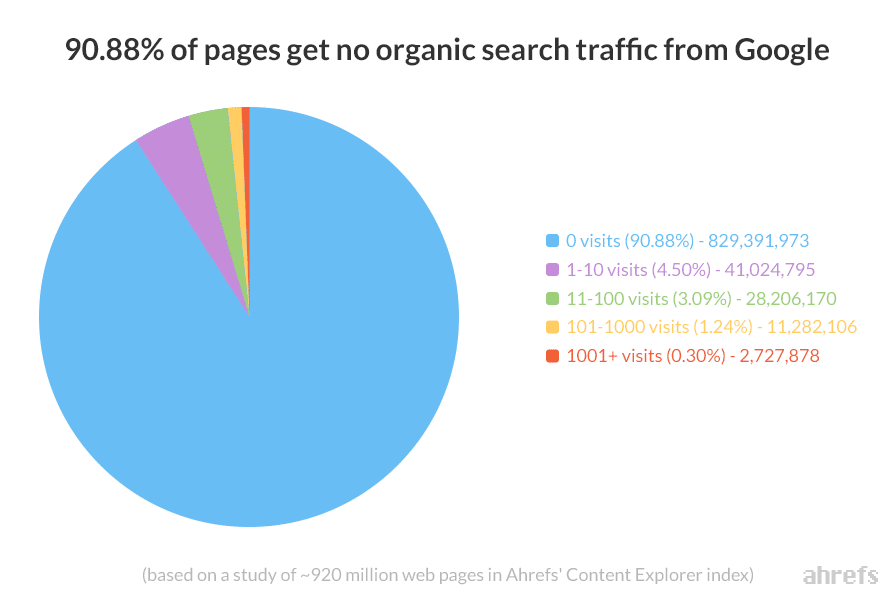
91% of pages attract no visits (0). And 7% of the remaining pages attract only fewer than 100 visits (approximately 1 sale per month).
The Basics for Optimising Your Search Ranking
There is no secret — to optimise your search ranking and be on the first page you need:
- Good content
- Good internal links
- Good external links
Content refers to the pages of a website, whether they are articles, online calculators… The more pages (relevant ones) a site has, the more powerful its ranking becomes.
As for internal links, we are talking about internal linking. This simply defines the links between all the pages of a site perfectly structured for SEO.
Finally, external links are called backlinks. A backlink is a link from an external site that redirects to your site, allowing you to gain authority.
They can be categorised into 3 distinct major families: on-page, off-page and technical optimisation.
These 3 major families encompass, among other things, the 3 elements cited above which are the most important and the most powerful.
One could imagine a pyramid describing the step-by-step priorities of SEO optimisations:

As you can see, the foundation of search ranking starts with ensuring that Google has discovered your site and its pages — this is called crawling — and so on.
- Your site must be accessible to crawl bots so that search engines can read your website and index you in their engines (crawl)
- A keyword analysis to avoid having a page that nobody searches for
- Apply the basics of search ranking such as H(n) heading tags
- Good content that respects the search intent of the internet user
- Internal linking, the grouping of all your correctly optimised pages semantically
- Having backlinks (external links) — this is also called netlinking or link building, which describes a strategy for generating backlinks in order to have very good authority.
- A good user experience (UX), including fast loading speed and at minimum correct core web vitals.
- Snippets / schema markup to stand out in the SERPs
You will find below all the articles for each distinct part explaining how to apply them.
How to Do SEO?
SEO (Search Engine Optimization) is essential for making your site visible on Google. With these steps, you will learn to optimise your site to attract more organic visitors.
Before being able to appear in search results, engines like Google must explore (crawl) and record (index) your site. If your site is not well configured, it risks not being visible. Discover the basics of crawling and indexation, as well as key techniques to avoid errors.
Also discover technical SEO.
Keywords are the terms your potential visitors type into Google. Identifying the right keywords is essential for having visitors. Learn how to analyse keywords with our guide on keyword analysis.
Understanding the intent behind a search is essential. Why does a user type a query? Learn how to create content adapted to these needs with our article on search intent.
Good SEO content is both useful for users and optimised for search engines. Discover how to write articles or pages that meet the needs of visitors and Google in our guide on SEO writing.
This step consists of optimising each page of your site: structuring headings, optimising tags and images, and adapting content. To go further, discover our tips on on-page optimisation.
Internal linking consists of linking your pages to each other to help Google and your visitors navigate easily. A good internal structure is essential for SEO. Learn the basics in our guide on internal linking.
Backlinks, or inbound links, show Google that your site is popular and credible. They are essential for reinforcing the authority of your site. Discover how to obtain effective backlinks in our article on netlinking.
Also discover off-page SEO.
To go even further, semantic search engine ranking allows you to optimise your content for more complex queries. This advanced method is ideal for boosting your visibility even further. Find out more in our article on semantic search engine ranking.
How Search Engine Algorithms Work
Understanding how Google works and Google’s algorithms is essential for optimising a website.
The general process of search engines involves discovering and storing the content of websites around the world through “crawlers” — computer programmes that follow hyperlinks and copy websites they encounter.
Search engine optimisation, or SEO, involves adapting your site to best match the criteria of these engines’ algorithms.
For Google, the process of incorporating your site into its search results comprises three key steps:
- Site crawl: Google’s robots browse and analyse billions of pages every day to detect new content.
- Indexation: Google copies the content of your site and indexes it in its database.
- Ranking: Google searches its index to find relevant answers to a search query. Its algorithms rank results based on various criteria.
As SEO experts, we know the subtleties of these algorithms and use this knowledge to optimise your website. However, far from being a secret, this information is accessible to everyone, and understanding how Google’s algorithms work is crucial for anyone wishing to improve the visibility of their site.
We therefore invite you to explore each of these algorithms in greater detail. By learning to navigate this complex universe, you will be able to make more informed choices about optimising your site, which can improve its visibility and significantly increase traffic.
Calling in an SEO Expert
Were you often told at school that after learning the lesson you had to do the exercises? It is the same in all fields, and this includes search engine ranking. It would probably be counterproductive to venture into SEO optimisation without calling on an expert — whether to carry out an entire project, or simply to ask for advice, questions and answers, to verify things, etc. An SEO expert, or SEO consultant will undoubtedly be able to save you a great deal of time and ultimately money, since you will not have to wait years to achieve ranking but only a few months.
Frequently Asked Questions on SEO
What Is an SEO?
An SEO is the acronym for Search Engine Optimizer. It refers to a person capable of optimising a website to make it appear in first position on search engines.
How to Learn SEO?
It is always difficult to learn SEO. But here are a few tips for learning: consult blogs — do not limit yourself to French-language content — follow quality newsletters — follow bootcamps — follow YouTube SEO videos — follow SEO training courses. And finally, cross-reference your resources, be open-minded and practise. This blog is a good way to learn natural search engine ranking step by step.
How to Become an SEO?
If you want to pursue a career in SEO, whether as a consultant or an employee in a company, the best-known approach is self-study and SEO training. You can also study at a digital marketing school with an SEO specialisation.
How to Succeed in Your SEO Strategy?
Creating a well-defined SEO strategy is essential for achieving good search engine ranking. Before you begin, define your objectives and carry out a thorough analysis in order to structure and prioritise your efforts effectively.
What Is the Quickest Way to Activate Your SEO?
There is no quick way to activate your SEO effectively and sustainably. SEO is a process that takes time and requires patience and perseverance. However, I have put together a complete practical and simple SEO guide for beginners with the main SEO recommendations if that can help.
What Are Google’s Ranking Factors?
Google’s ranking factors encompass several aspects, both on-page, off-page and technical. The most important are the authority of the site (number of sites linking to you), internal linking (the links you create between your own pages), quality content and a good user experience (UX).