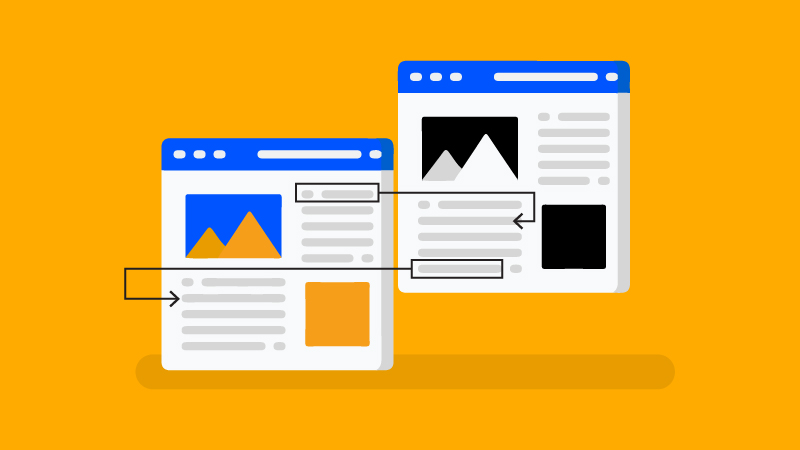
As Ahrefs so aptly puts it, internal linking is to backlinks what Robin is to Batman. They are essential for achieving natural SEO.
There is a big difference between a well-planned structure and a chaotic jumble of web pages — both for users and for Google.
In this article, you will discover some simple but effective actions for a good SEO foundation.
Why Is Internal Linking So Important?
It would probably be impossible to list all the reasons why internal linking is crucial, but here is the main one.
Internal links facilitate the distribution of PageRank, more commonly called link juice. The more internal links a page has, the higher its PageRank. The more pages a site has, the more PageRank it has (called a PR reservoir). It is not just about quantity either — the quality of links is also paramount.
To greatly simplify, here is what this looks like:
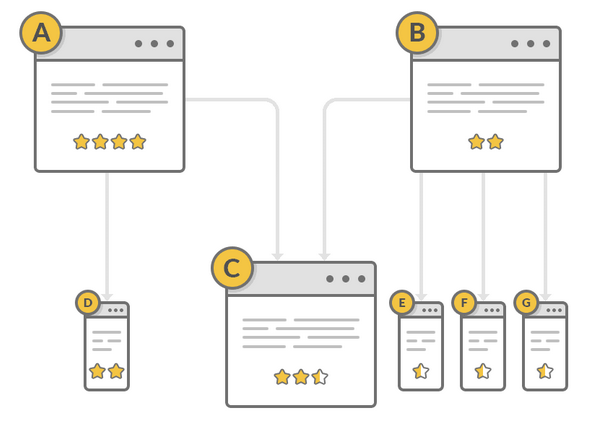
The more a page is linked, the more it grows in popularity, directly impacting the ranking factors for that page.
Note: if you want to know everything about PageRank, consult our article on Google algorithms that SEO professionals absolutely need to know.
Internal linking is an authority optimisation technique, intrinsically linked to netlinking.
We can also note the optimisation of user experience and the conversion funnel — which is moreover why the semantic cocoon was invented.
1. User Experience
When your site is correctly linked internally, you provide an optimal user experience for visitors. Indeed, when they can easily navigate between the different pages of your site by following an intelligent path, you increase the ergonomics, fluidity and simplicity of their experience.
It is also interesting to apply good internal linking optimisation to highlight the stages of your conversion funnel and have a site that converts more. We can also note the improvement in bounce rate, average visit time and the number of page views.
2. Natural SEO
You are probably here for this — and rightly so, since your site’s internal link structure is essential for optimising a website’s natural SEO. It is all very well to say that it improves SEO, but you need to understand why and how. Here are a few pointers:
- Distribution of popularity between your pages (backlink optimisation)
- Increasing the semantics and thematic relevance of your content to be more relevant
- Optimised crawling for search engines
The distribution of popularity allows you to optimise the PageRank of each of your pages.
3. Internal PageRank and SEO Juice
When talking about internal linking, it is important to understand the concept of PageRank. Every link has a transmittable power — which is why you need to use internal linking to optimise your site’s backlinks.
If you do not yet know what backlinks are: they are external sites that talk about you by inserting a link to your site. This increases the authority of your targeted page. It is impossible to rank without backlinks in a competitive niche.
The advantage of internal linking is therefore to reuse the power of external links and distribute them to the other pages of your site rather than needing hundreds of backlinks on every page. Moreover, you can easily observe during keyword and competitive analysis that certain pages have only a few backlinks, or even none at all, and yet rank on the first page in first position. This is possible because their domain name and other pages on their site contain many backlinks, and these have been distributed to that specific page through internal linking.
This is called PageRank circulation, or link juice circulation, SEO juice or link juice. In short, you optimise the power of your page by using the power of other pages which themselves optimise other pages in terms of popularity, authority and also semantics.
Internal Links and Semantics
You have no backlinks? If you have never done netlinking or link building, it is still very important to optimise your internal linking since it allows you to increase the relevance between your different pages. Some SEOs even advocate increased optimisation of internal linking through the power of thematic and semantic relevance, allowing you to do without backlinks. Obviously I advise you to adopt all practices. To clarify: internal links between your different pages increase the relevance of your pages to each other. Why? Because you become an expert on the subject when your internal link talks about the same theme, and so on.
You must make Google understand the semantics of your site and enrich each of your pages thematically, with a closely related subject that is as specific as possible. In this case, you enormously improve your SEO through your internal linking. Let us take an optimised example: if you have a “trousers” page, in that case you do not link to your “t-shirt” page, but to your “canvas trousers” page.
The Different Internal Linking Structures
Now that you know the main theory, let us get to the heart of the matter. Time for practice.
A website’s structure is the way all the pages of a website are organised and connected to each other, and how navigation between different pages is managed.
There are mainly two types of structure: linear linking and hierarchical linking.
Linear Linking
Linear linking is the structure that most websites use — illustrated:

This image describes the way the majority of sites link their pages. There is no depth, no structure and no coherence.
For example:
“How to repair a water leak” (https://plumber.com/repair-water-leak/)
links to a page
“Fitting sanitary appliances” (https://plumber.com/fit-sanitary-appliances/)
If this does not jump out at you, here is what you could do instead:
“Maintenance and repairs” (https://plumber.com/maintenance-repairs) → “How to repair a water leak” (https://plumber.com/maintenance-repairs/fit-sanitary-appliances/)
If the very structure of your URLs plays a role, the links within your content must serve the same logic.
Hierarchical Structure – Silo
The example described above represented an example of a hierarchical structure. To better visualise it, here is this structure represented simply in diagram form:
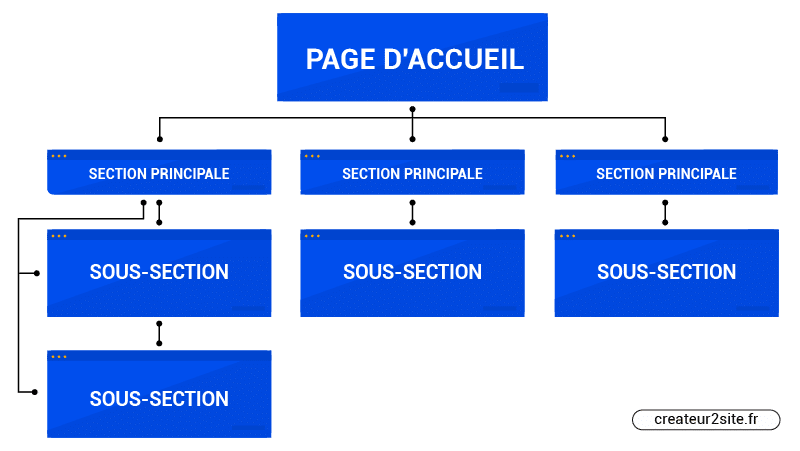
The lines represent the links that are created. This way, we avoid linking pages from different main sections. This improves coherence both for search engines and for users. This type of hierarchy is called a “silo” in SEO jargon.
If you have an e-commerce site selling clothes online, you should create silos — that is, categories like “shoes”, “trousers”, etc.
This way, you strategically link trousers to canvas trousers, trousers to jeans, etc. While having URLs following the same logic, such as “https://store.com/trousers/jeans/”.
Instead of having “https://store.com/jeans”; “https://store.com/t-shirt/”… You get the idea.
Here are the key concepts of a good silo:
- Watertightness (pages inside a silo do not link to the deeper pages of another silo)
- Pages must link to each other (reciprocal links)
- Create several different levels within a silo (sub-categories)
Bonus: Semantic Cocoon — The Ultimate Internal Linking Weapon
The semantic cocoon is a parent page that connects different semantically related silos. However, building a semantic cocoon goes much further — it is about meeting the user’s needs to organise the entire structure. This involves several stages such as creating personas, very thorough analysis of targeted keywords, etc. Moreover, it is important to mention that within the semantic cocoon principle, certain pages no longer have any ranking purpose — they are only there to boost the pages above them by optimising the parent page’s theme.
Nobody wants to create natural links to a page on a site selling a product or service. The advantage of also creating semantically close, long-tail adjacent pages is to encourage natural backlinks to these pages with good content, which through PageRank rebound, boost the parent page since all pages are linked back to it.
Having written several articles explaining how it works, I will not detail it here. But if it interests you, visit the article dedicated to the semantic cocoon!
How to Optimise Your Internal Linking?
Now that we have seen the different page architecture and therefore internal linking techniques, here are some additional tips to optimise your linking.
1. Link Anchors for Internal Links
An anchor is the title of your link — it is the piece of text that allows you to redirect to another page on your site.
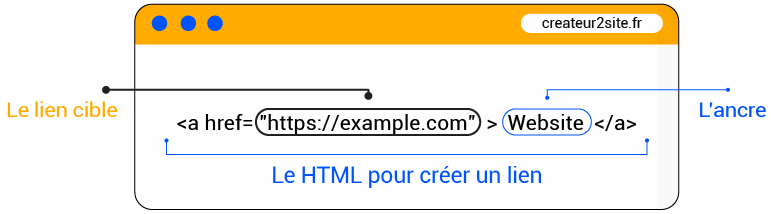
In the context of backlinks, the anchor of an external link is very powerful — too powerful when well optimised. That is why Google scrutinises this optimisation closely and it is very important not to abuse it. But… with internal linking you can do what you want! So no question of using anchors like “click here” or “find out more…”. The anchor must use the target keyword of your internal page and the underlying keywords.
If you have a page targeting the keyword “trousers”, when you mention “canvas trousers” and redirect this phrase to your canvas trousers page, your anchor should be “canvas trousers” or “cotton trousers”.
Note: an anchor transmits semantic power, so it is important to use an optimised anchor. This is due to thematic PageRank. Moreover, the anchor of a second link is no longer taken into account by Google if you link to the same URL again. This means you will always be able to create other less SEO-optimised but more conversion-optimised anchors.
2. Optimising Your Juice by Minimising Links
It is important not to place too many links on your pages — whether internal or external. Indeed, as we have seen, each page has a transmittable value, but if you place too many links the juice will be distributed across too many links and no page will truly benefit from the page’s power. Say your page has a PageRank of 100: if you place five links, each will gain 20 PageRank from the other page (to simplify). Think about it!
Nofollow, Dofollow…, Button and JavaScript
It is important to know the attributes that a link can have. When distributing your PageRank between your pages, you must not use the “NoFollow” attribute, otherwise the juice will not be taken into account by Google.
It is important to check that your theme or developer has not inserted bad links that will not be taken into account. In the same vein, it is also important to check whether your links are not JavaScript links, since Google only interprets links that use Href. To transfer SEO juice to an internal page, you must use the “Dofollow” attribute — it is moreover the default attribute, so if nothing is specified, do not worry.

You can use JavaScript links to sculpt the PageRank of your pages — for this, use link obfuscation.
3. Obfuscation: Getting Rid of Useless Links and Optimising Your Silos
Whether for a cocoon, a silo, topic clusters or whatever technical term describes your structure, it is important to obfuscate these links if you want to optimise your internal linking.
The advantage of obfuscation is that you lose no juice by using JavaScript links or a simple <button> for pages that are not meant to rank on Google. This is called sculpting PageRank.
For example, your footer always presents a link to your legal notices. Do you want your legal notices to always be boosted with juice when you have more legitimate pages to rank? Personally, I prefer not. In a simple diagram, this would look something like this:

Whether for pages like legal notices, to improve user experience, or to link a page that must be linked between 2 silos — using obfuscation resolves all these problems.
Consult our article dedicated to link obfuscation if it interests you! You will learn how to do it from A to Z.
That is all! Do not hesitate to contact me if you need help, and to share this article if you think it is worthwhile!