
Today, content strategy is at the heart of any SEO strategy and more broadly of digital marketing.
If you are interested in advanced SEO, you have certainly heard of the “semantic cluster” (cocon sémantique in French) — an impressive-sounding term nobody really understands. Intimately linked to the optimisation of a content strategy and an optimised internal linking structure, the concept remains nebulous.
The semantic cluster is a technique invented by Laurent Bourrelly. It is first and foremost about internal linking. Except that between siloing, silos, pillar pages, sister pages, topic clusters, thematic silos, semantic silos and much more, it is difficult to make sense of all these internal linking optimisations.
The semantic cluster is currently considered the ultimate weapon in SEO. Indeed, Google’s algorithms place great importance on content, but also on the coherence of the links that connect them. More specifically, the semantic cluster addresses semantic search engine ranking.
The semantic cluster is based on target customers, seasoned with user experience and pure marketing, allowing a marketing strategy to be adopted. All combined with the SEO strategy with the absolute goal of using a kind of perfect technique.
In other words, the semantic cluster is a catch-all.
Is the Semantic Cluster an Internal Linking SEO Technique?
Beginners often look for a simple answer to the concept of the semantic cluster. “The semantic cluster is optimised internal linking.” This is false. If the concept is difficult to understand, it is because the semantic cluster is a grouping of methodologies, concepts and techniques into a single term. And not only SEO but also UX and marketing!
While it is obviously a technique to increase a site’s search engine ranking, you do not start a semantic cluster thinking about SEO — you first think about personas, user needs, and therefore UX and marketing.
First, to build a semantic cluster you need to use techniques such as persona creation and creating a mindmap around your customer to reconcile supply and demand. For context, Laurent Bourrelly was first a marketer before focusing on search engine ranking. This partly explains the enormous ambiguity of this technique.
In a second step, you move to several different techniques and concepts of advanced SEO optimisation — including internal linking. Then comes link obfuscation — which I call white hat cloaking — to optimise an already optimised technique. Among other things.
Everything starts from the concept of “topic clusters” popularised in the States, then in France through Laurent Bourrelly’s semantic cluster. However, the semantic cluster is not just a simple rebranding of this term — it goes much further. It does partially encompass the concept of the thematic cluster and more specifically the silo. But within the silo itself, and more specifically within the semantic silo, the technique differs, as metamots and lexies are used for its construction.
In other words, the semantic cluster is a collection of techniques that resemble nothing else on the technical SEO side. So a topic cluster is not a semantic cluster, and a semantic cluster is not just internal linking — nor is it a thematic or semantic silo, well, almost. Yes, it is a jumble.
Do not worry — we are going to dive step by step into the semantic cluster and look closely at all the technical terms it encompasses (but not from too far away, so as not to lose you).
Note: internal linking is often considered as on-site; while that is true, bear in mind that the semantic cluster and advanced internal linking also reflect an advanced netlinking / link building strategy.
What Is Siloing (Semantic Silo)?
Laurent Bourrelly pushed the idea of siloing under the name of the semantic cluster.
The principle is simple: use siloing to push the parent page through sister child pages and granddaughters or little sisters, as a thematic cluster would.
In principle, this technique allows you to position yourself on a short-tail keyword thanks to long-tail keywords.
For example, your parent page targets the query “credit”, then the other pages talk about everything related to credit using increasingly specific long-tail keywords (e.g. “consumer credit”).
You then rise to the first page for your short-tail keyword “credit” while also ranking on long-tail keywords.
At a certain point — specifically from rank 4 (great-great-grandchild) — the page has no ranking purpose whatsoever and is only there to push the internal links above it.
Not all pages on a site have the same traffic potential, and one of the objectives of PageRank sculpting is to bring more links to a few targeted pages rather than distributing them evenly across all the site’s pages. It is therefore a matter of favouring a minority of pages and not a majority (Pareto’s 80-20 rule). Thus some pages will have no organic traffic goal whatsoever. They could indeed be lexies that have been developed, but all in good time.
Everything is a family story: a parent page whose purpose is to rank for the targeted keyword is pushed by its child pages. The parent talks about its children and the children talk about their parent page and their sister pages (you are building a family tree).
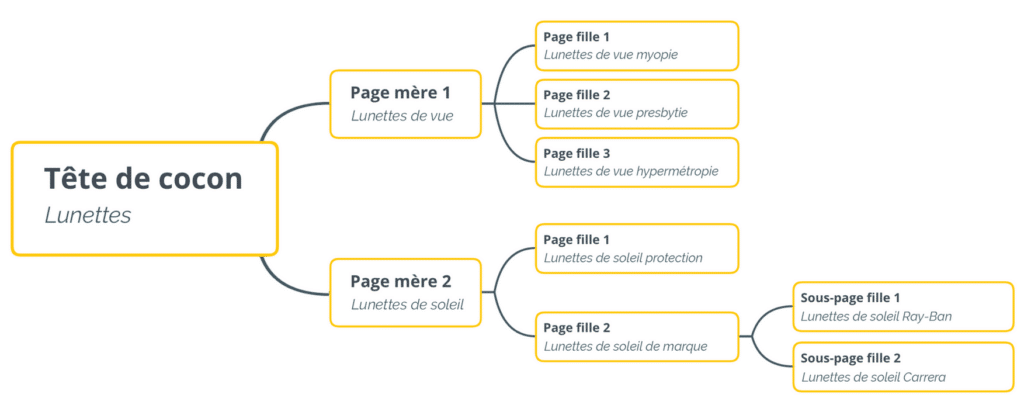
The whole thing is a semantic silo — and part of the concept of the semantic cluster.
PS: we will not distinguish between a thematic silo and a semantic silo or any other internal linking technique — let us avoid getting sidetracked.
Do not panic — we will see all this in detail when the time comes.
Metamots and Lexies: the Difference Between Siloing and the Siloing of a Semantic Cluster
While the semantic cluster is structurally a semantic silo, it is not simply a semantic silo either.
A semantic cluster in “active mode” is a semantic silo with metamots.
The metamot is a concept created by Christian Méline — a man who talks, for example, about “determining the thematic deviation rate”. A blog I invite you to read — immensely interesting.
I am not going to explain the metamot as Méline describes it, otherwise I will lose everyone.
Simply put, a metamot is a subject that encompasses a set of words called lexies.
More specifically, lexies are words that Google considers ideal to mention for a subject. If you want to simplify, they are occurrences — but technically that is not the case.
For example, the metamot “how to reduce water pollution” will have lexies such as: pollution, pesticides, purification, fertilisers…
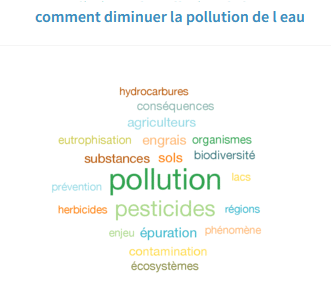
The difference between a lexie and a keyword occurrence is that a lexie is a word that itself encompasses a sub-topic that Google determines as good to discuss for the main subject (metamot). A lexie must be used to push the thematic of the metamot — thus of the main subject.
Metamots identify the same terms that Google has chosen to judge the relevance of content in relation to a search intent. Which gives a collection of words called lexies.
“Who is related to what and why?” I leave that here.
Impermeability & Obfuscation
In principle, a silo is entirely impermeable — while the techniques differ, this is the initial principle. For example, “branded sunglasses” will not send a link to “long-sighted spectacles”. Sometimes, a context for one reason or another will mean a link to another page on a site is logical and good for the user experience. In that case, link obfuscation is used.
Semantic clusters optimise your search engine ranking but also your conversion funnel, with a perfectly hierarchised structure for your visitors and for the crawler — all the more so thanks to link obfuscation.
A semantic cluster is an optimisation of search engine ranking, but also of user experience and the conversion funnel.
Obfuscation also allows PageRank to be sculpted by preventing juice from flowing to pages such as legal notices.
Is the Semantic Cluster a Myth?
All this time spent reading this article, only to be told it is a myth?
The complexity of implementing an “ideal” semantic cluster is pure fantasy. While I do not doubt that certain people can do it from start to finish, the majority of those who create them omit several parts to simplify the task. And the best semantic cluster expert SEO practitioners do not take all the rules into account simply to make it achievable.
While each individual process is fairly simple in itself, the problem is connecting user experience to marketing and SEO. All of this must also be linked to metamots, lexies and other things.
Different techniques collide with each other. It is simply impossible to create a semantic cluster exactly as it is conceived strictly speaking.
To give one example among many: sometimes, a sub-topic of a main topic has a higher search volume than the main topic itself. For example, “create a website” has a lower search volume than “wix”. “Wix” being a sub-topic of “create a website”, it still has a higher traffic volume. Yet the idea is to have progressively lower search volumes as you go deeper into the topic hierarchy. And this applies to many other things that will trip you up along the way.
The semantic cluster is a theory of a set of techniques as a perfect technique. In truth, nothing will be perfect despite your efforts.
But plot twist: that is not a reason not to try to do your best! After all, I am not telling you anything new by saying that perfection does not exist.
On the other hand, you will pull your hair out. And I would rather warn you.
Nothing prevents you from only implementing certain parts of the semantic cluster, or from implementing it fully but not perfectly (which you will not be able to do anyway). The further you go, the better the semantic cluster will be.
And to think that I already want to tell you about a smoothed semantic cluster, a boosted semantic cluster and a circular semantic cluster… I am addicted.
Why Create a Semantic Cluster?
Creating a semantic cluster is the ultimate weapon for SEO practitioners in 2022. By combining SEO with marketing, it allows a perfect strategy to be created.
Why do we do SEO? Well, to attract visitors, who can potentially become customers.
Simply put, a site that does not rank is useless — as would be a ranked site that does not convert.
A semantic cluster allows you to link supply and demand. And since you only have a small amount of potential traffic with your transactional pages, a semantic cluster allows you to attract more potential traffic, educate your readers, and then get them to take action through informational articles.
The Semantic Cluster for SEO Optimisation
If your internal linking groups correctly structured pages revolving around a topic, Google will indeed consider you relevant in your field.
This is the whole principle of a thematic cluster — an internal linking optimisation in “classic” SEO. A semantic cluster put simply is like a collection of thematic clusters pushing themes against each other.
Also, a semantic cluster will allow you to sculpt your PageRank — the authority of pages (the “juice”) obtained through your backlinks.
Semantics for Crawlers
You must make Google understand the exact semantics your site is taking.
Let us take an often-used example to explain this phenomenon:
The term “Jaguar”: will the crawler know whether we are talking about the car or the animal?
Now, suppose my text is indeed about the animal — so we find “jungle” in the text. Or I add the word “fuel” to my text — so we are talking about the car.
And if our sentence was:
“I did not have enough ‘fuel’ left to go and see the ‘jaguar’ in the ‘jungle’.” Will the crawler be able to understand the exact semantics of your text?
This example is intended to warn you that your content may be incomprehensible to crawlers — because you may have unconsciously sown such ambiguities throughout your texts. We are often convinced our text is not ambiguous when in fact the engine can do nothing with it.
A semantic cluster is therefore a completely defined and comprehensible semantics for crawlers — both inside your texts and between your other pages linked to each other with semantically exact relationships. I have a page that talks about SEO with a semantically correct text, and the other pages — linked to my first page — always talk about SEO with always semantically correct text. Google then perfectly understands our SEO semantic cluster where we talk about SEO.
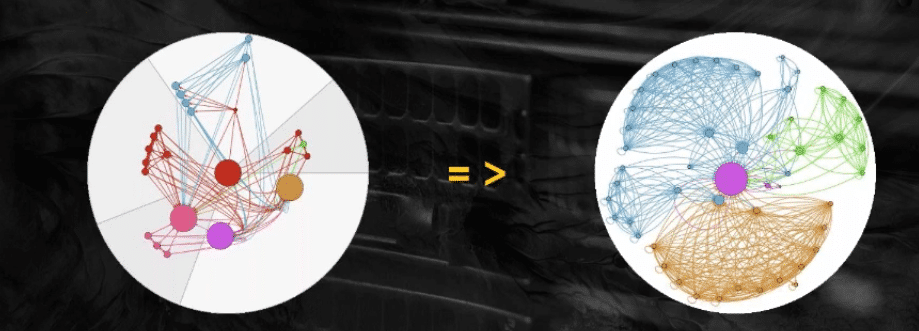
Without a semantic cluster, everything connects very quickly — the semantics not being correctly defined. This is less comprehensible for crawlers and therefore not optimised for search engine ranking: that is the first diagram. Then the second diagram (right) is semantically defined — we can clearly distinguish several semantic clusters (1 blue, 1 green, 1 brown). We can clearly see that everything is then perfectly hierarchised semantically.
Thanks to a perfect semantic structure, bots will then be able to understand what the term “site speed” placed within a semantic cluster on the “SEO” topic refers to.
Having a text with a correct percentage of semanticisation in addition to a perfectly semanticised semantic cluster is ideal.
Creating a Semantic Cluster from A to Z
Now that we know what a semantic cluster is — at least in its entirety — we will see in the upcoming articles how to put this beast in place step by step. We will have the opportunity from the very first chapter to introduce the marketing techniques connected to this “SEO technique”.
The marketing steps:
- Transform the mind map into SEO mode (search volume analysis)
- Metamots / lexies / fragrance
- Write your content
- Publish and link your semantic cluster
- Obfuscate the links
- Check your internal linking
To finish:
- Create new semantic clusters (if you have x topics you have x semantic clusters to create). The whole set of semantic clusters is called a multi-core semantic cluster. What about a multi-head semantic cluster?
See you soon!
Next chapter: part 1/4 — Create a semantic cluster: reconciling supply and demand