
The semantic cocoon is a technique that optimizes the power of a content strategy — ensuring your content marketing is as visible as possible, while also reconciling supply and demand.

To summarize, there are three major categories in a content marketing strategy:
- TOFU (Top of the Funnel)
- MOFU (Middle of the Funnel)
- BOFU (Bottom of the Funnel)
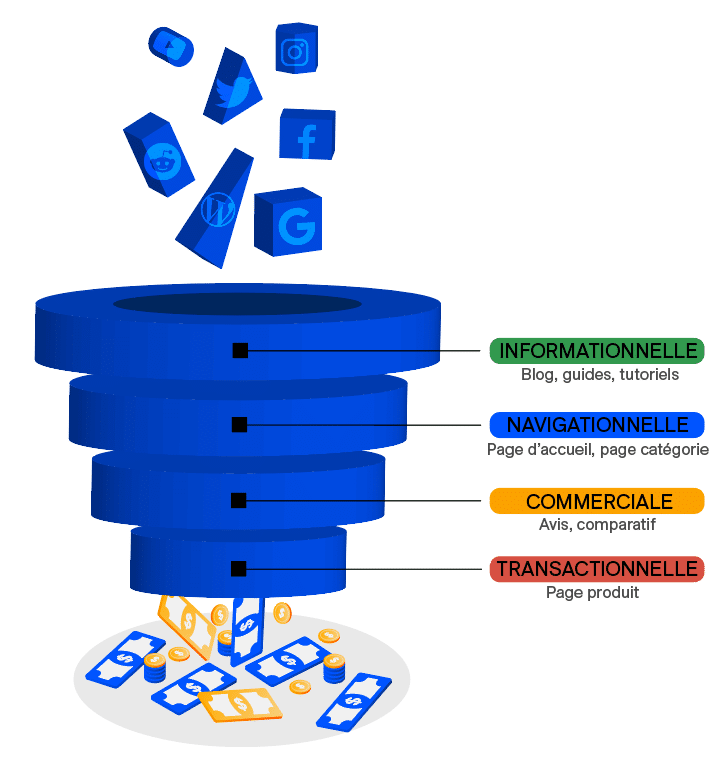
It makes perfect sense to map TOFU, MOFU and BOFU to the 4 search intents used in SEO: informational, navigational, commercial and transactional.
What is TOFU?
When a prospect enters the Top of the Funnel, they are at the very beginning of their thinking. Their Google query is therefore very broad and generic.
TOFU consists of a large volume of informational content that aims to inform the prospect about methods to address their need. But it goes further than that — TOFU is also where you must start convincing the lead that you are the perfect company to help them on their journey.
Do you see where the semantic cocoon comes in?
For example, the TOFU for a CBD website might be the query: “How to get better sleep?”
MOFU: The Selection Phase
Once the prospect has gathered all the information they need to solve their problem, they begin selecting a shortlist of potential providers. The goal? Find the one best suited to meet their needs — while sharing their values.
At this point, the lead also has access to content from your competitors. This is the stage where you must prove your expertise through:
- Landing pages
- White papers
- Case studies
- Expert testimonials
- Targeted lead nurturing campaigns
- Networking events
- Presence at trade shows
- Webinars
In our example, the MOFU for this CBD site could be the query: “Therapeutic CBD”
BOFU: The Conversion Stage
At this point, the prospect is clearly interested in your offer and has noticed that your company has many strengths. But are your services really the right fit for them? What does your business offer that others don’t?
This is the critical moment where you must convince them to choose YOU. At this stage, depending on your industry, the prospect has typically narrowed their shortlist to 2 or 3 potential providers. You therefore need to take a highly personalized approach toward this client.
BOFU is a joint effort between marketers and sales teams. It’s time for the marketing department to offer the prospect:
- Tutorials
- Demo videos
- A free trial offer
Depending on the lead’s reaction to this content, it’s up to the sales team to quickly propose:
- A meeting
- A live product demonstration
- A personalized offer
- A factory visit (for industrial businesses)
The BOFU keyword for our CBD site would be “CBD oil” — a purely transactional search intent. The user is ready to buy. This would typically be a product page, potentially including a demo video.
When Marketing Meets SEO
SEO is like a cornerstone. It makes as much sense to connect SEO professionals with UX specialists as it does to connect them with the marketing team. The foundational concepts of marketing — and more specifically the conversion funnel (TOFU, MOFU, BOFU) — are intimately tied to your keyword choices and content pieces, which represent the 4 main search intents.
That’s what the semantic cocoon is. It’s building a conversion funnel. Creating informational, navigational, commercial and transactional pages. Everything fits together perfectly, almost like magic.
Now that we’ve covered the introduction of marketing into SEO, in the next chapter we’ll begin building our semantic cocoon.
Next chapter: Creating buyer personas for your semantic cocoon