
This is where we create the mindmap while thinking about your buyer persona, their needs, their frustrations — all while imagining pages that could bring you clients. Always with the goal of building a semantic cocoon.
Building the Mindmap in Persona & UX Mode
In this step, you need to create a mental map (mindmap) by putting yourself in the shoes of your buyer persona. Here’s what this might look like:
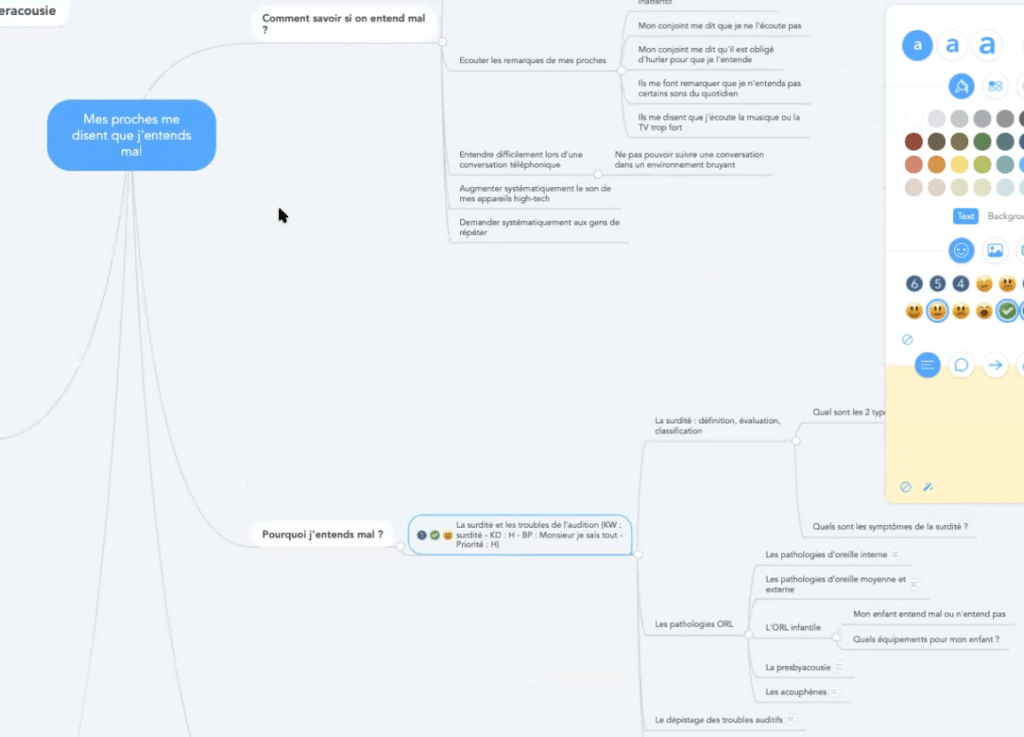
At this stage, we’re not thinking about SEO yet — we’re thinking about needs and problems, while keeping in mind that these are pages targeting your personas that will bring you potential clients.
At the very beginning, you need to define the head of your semantic cocoon — your homepage or cocoon head page. Here, the cocoon head is the problem “the people around me say I’m hard of hearing.” You need to define the #1 problem and the various problems your personas might have that gravitate around that “big problem.”
The more pages your semantic cocoon has, the better it will rank. At the very minimum, you need around 30 pages per head. It’s also important — and I can’t stress this enough — to have rank 4 or even rank 5 pages that aren’t meant to rank for any keyword, but simply to push the pages above them.
Getting Page Ideas
If you don’t know where to start or your brainstorming feels insufficient, there’s a tool on cocon.se called Eurêka to make your life easier.
Eurêka is an idea machine. What are you going to write about on your semantic cocoon pages? You’ll normally need at least 200 of them…
Eurêka helps you find topic ideas. For example, I suggested the global topic “shoe” to Eurêka — here are some examples of topics it returned:
- how to avoid foot pain in safety shoes
- how to clean light brown leather shoes (variant: how to clean moldy leather shoes)
- how to clean suede or nubuck shoes
- how to clean faux suede shoes
- … And thousands of other ideas, or perhaps a bit more
Eurêka is included with cocon.se, the tool used for internal linking. There’s also ezword (https://ezword.info/), a more powerful and different “unlocked” version.
Launching Eurêka
Eurêka exists in 3 modes:
- “Quick” mode — lets you check without spending that the keyword you’re thinking of generates interesting topics without being too generic.
- “Normal” mode — to find as many realistic-sounding topics as possible (verb required).
- “Subtitle” mode — integrated into “optimization” in the “Metamots” section. This very fast mode often generates a wealth of writing ideas.
In general, “Normal” mode finds 2 to 5 times more topics than “Quick” mode. Just go to cocon.se and calculate your Eurêkas.
How to Use Eurêka Properly
Your base keyword or key phrase is important because every generated topic includes it. Think carefully about what you submit and avoid overly generic topics — otherwise you’ll spend more time filtering than building your cocoon.
Example: if you type “shoe” into Eurêka hoping the software understands you’re an e-commerce seller — it won’t know that. It’ll suggest topics like “how to draw shoes from the front,” “how to draw manga shoes,” “what does shoe mean,” “are shoe stores open during lockdown,” etc.
It might suggest relevant topics like “convert shoe size to cm” — yes, that’s a valid article for a shoe e-commerce site. But the benefits won’t be worth the effort; you’ll spend too much time filtering. That said, nothing stops you from doing it if you’re stuck for ideas.
The point is: it’s better to type something like “shoe cleaning” if your site sells shoe cleaning products, rather than just “shoe.”
Note: When initialized, the software removes conjunctions, determiners, interjections, prepositions, pronouns, questions, and numbers. Two edge cases: the word “or” and letters of the alphabet (like “e commerce”). For these, use a hyphen: “gold-ring”, “e-commerce” — the software will understand you want to protect what it would otherwise remove.
Tip: Don’t hesitate to use “Quick” mode to reduce the number of words in your starting expression when looking for ideas.
Transform Your Persona Mindmap into TOFU / MOFU / BOFU
Before thinking about keywords, I recommend slightly adjusting the UX-oriented structure to create one or more conversion funnels using the TOFU / MOFU / BOFU marketing model. This will also help you better translate user needs into SEO keywords.
Before thinking about search volume and keywords for each section, start by reworking your mindmap with TOFU / MOFU / BOFU in mind — and if possible, segment them directly by search intent:
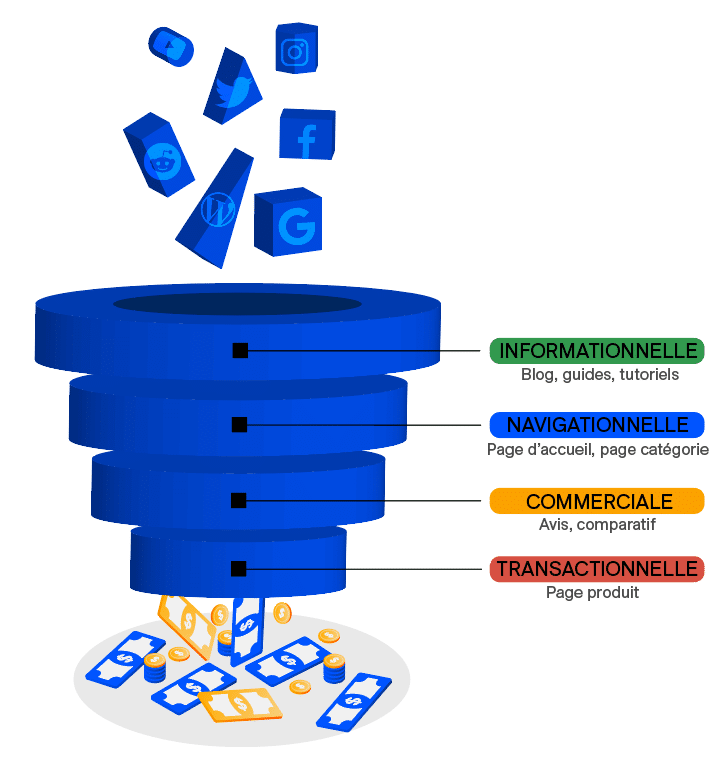
Start Prioritizing Pages
Once all of this is done, indicate on your mindmap which pages are your priorities in terms of linking.
Which pages are the most important for you?
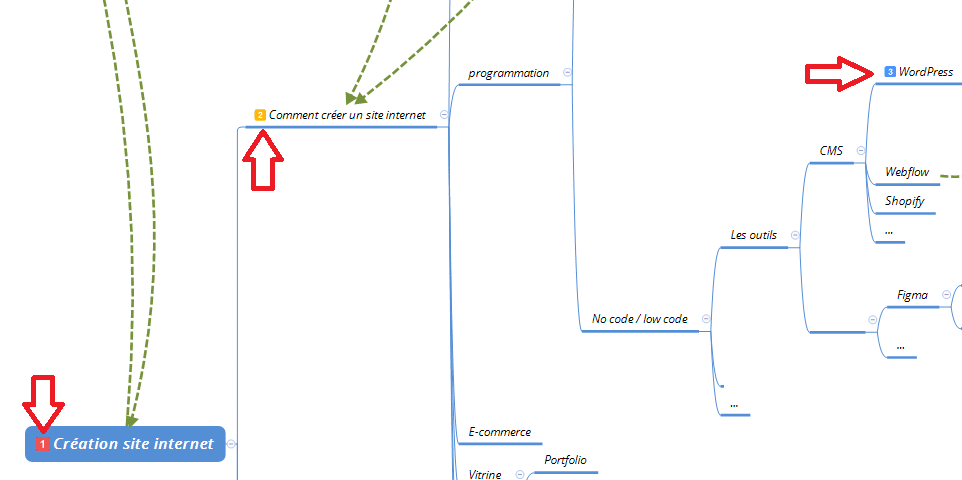
Add small numbers to your pages. Then, as we’ll see with the cocon.se tool, for both automatic and manual internal linking, you can link your most strategically important pages differently.
Next chapter: Building the Semantic Cocoon — the SEO Side