
Christian Méline, an SEO consultant and author of articles on semantic search, is the inventor of the metamot concept.
A member of the Cocon.se team, metamots can be calculated manually or using their SaaS tool.
Metamots are closely linked to Laurent Bourelly’s semantic cocoon concept — building on an already complex technique to push it further.
Often confused or simply misunderstood, metamots go beyond the concepts of co-occurrence or lexical field in order to improve the semantics of a piece of content.
Metamots are what Google has identified as words (lexies) that define a SERP. Also called semantic fingerprints, they reveal what lies behind each query.
Moreover, beyond helping you write semantically optimized texts, they will perfectly align with users’ actual search intents.
What is a co-occurrence?
A co-occurrence is a keyword added to a text in order to maximize Google’s understanding of the query. (It is more of a disambiguation than a true score.)
This stems from the BERT algorithm (Bidirectional Encoder Representations from Transformers), which uses what are called context vectors.
How co-occurrences work
Co-occurrences are simply words that help establish context. For example, the word “strawberry” refers to a fruit if the sentence contains “fruit” or “red”. But if the sentence contains “drill bit”, it refers to the drill attachment instead.

Co-occurrences are determined via a dataset relative to a target word (all of this processed through neural networks and artificial intelligence).
Originally, the algorithms for determining co-occurrences were based on FastText — a Facebook library for word embedding, built on neural networks and context vectors. You can even clone the repository and try it yourself if you’re curious.
The difference between co-occurrences and metamots
There are many limitations to datasets. They require constant updating. For example, “President of France” would equal “François Hollande” if the dataset is a few years old.
And we don’t have access to Google’s datasets. In other words, we cannot provide precise word data to add to pages in order to appear more relevant to Google.
That’s where the metamot takes a cleverer approach: using search results directly to determine the lexies (a kind of co-occurrence + lexical field blend) that reflect what Google has actually deemed relevant.

Moreover, this approach kills two birds with one stone — perfectly matching the search intent (provided it has been correctly identified).
Metamots can give you co-occurrences and words within the same lexical field if Google has determined those to be relevant.
Metamots in practice
Metamots are a set of words called lexies.
Here are examples of metamots for the query “choosing a good domain name”:
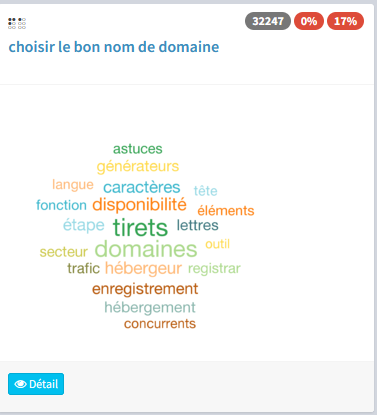
This is called a word cloud.
In detail, here is what Cocon.se recommends adding to your page:
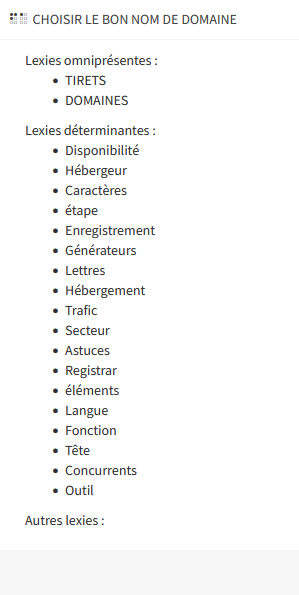
You can also type your text directly to check your SEO optimization score and SEO danger score:

For an extra layer of SEO optimization, you can also add co-occurrences alongside the metamots:

And to prevent Google from misunderstanding the semantics of your page, you’ll also see words to avoid:

It’s also possible to get semantic graph visualizations of your metamots to help you build a semantic cocoon:

In fact, metamots can also help you create pages based on individual lexies. They show Google that when you discuss a topic — and do so using relevant, semantically aligned words — you truly know what you’re talking about. So by having a page dedicated to words that you turn into a subject that Google has identified as relevant for the original query, this approach can become very powerful.
Simply put: target long-tail keywords with pages built around lexies that you’ve transformed into topics…
That is to say, in the semantic cocoon framework: turn lexies into topics for Tier 4 pages — pages that have no ambition to rank directly in search results. Well, “it depends”.
Metamots summary
A revelation of human language and needs, metamots allow you to increase the relevance of your pages — and your site more broadly — by aligning with what Google itself has determined as meaningful.