There are an infinite number of internal linking techniques. Most SEO practitioners do it their own way, and you should too.
You have certainly already heard the famous phrase from any SEO consultant — I am obviously talking about the famous “it depends”. And indeed, it depends.
Sometimes, sealing your internal linking, called a silo, makes more logical sense than creating a Hub that links between other hubs and vice versa.
I would like to tell you that one technique is better than another, but that is not possible. In any case, I will provide you here with all the internal linking techniques, their interests, their differences and their drawbacks.
How Are Internal Linking Techniques Composed?
All internal linking techniques are composed of three parts:
The pillar/parent page: this is the main content broadly covering the topic.
Child pages: these are detailed content covering one of the parts of the main topic.
Hyperlinks: these connect the parent page and the sub-pages (child pages). The parent page links to all sub-pages and each sub-page links back to the parent page. Also, the child pages link to each other, which is why we sometimes call child pages sister pages.
A small note on internal links: a hub, a silo or a pyramid structure always has a menu linking each piece of content together. In addition to this, when the context allows it, it is also necessary to place a link to the related article within the content itself.
Here is an example of a cluster menu:
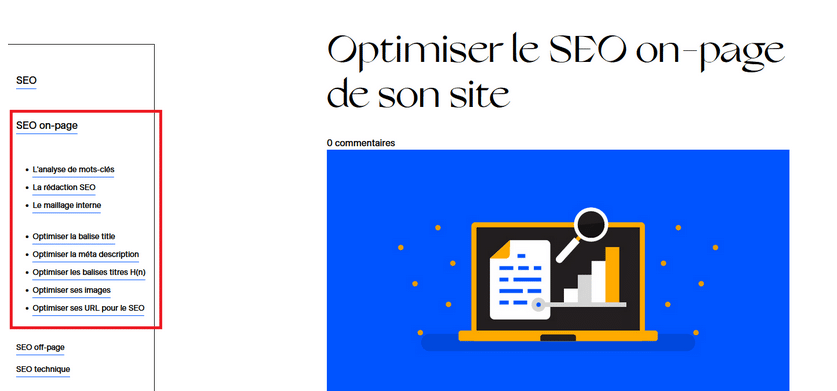
A pillar page, in this case “SEO on-page”, links to all other related articles on the topic of on-page SEO optimisation.
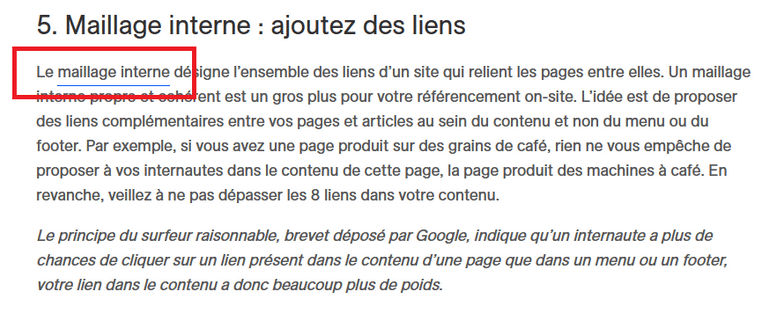
And, inside each of the main headings covering each point, we link to the complete content on the subject:
Last point, whatever the internal linking technique, it is preferable to link the coherence of internal links by using sub-folders at URL level.
For example: …/on-page/ -> …/on-page/internal-linking/
Obviously, it is not always possible to do this, as articles come progressively, but in a perfect optimisation, this is ideal. But not indispensable.
The Hub or Topic Cluster
Blog articles suffer from a lack of hierarchy because they are published in chronological order.
But good news, you can solve this problem by creating content hubs from related publications.
Content hubs are similar to silos in that they are interconnected collections of related content.
Here is what they generally look like:
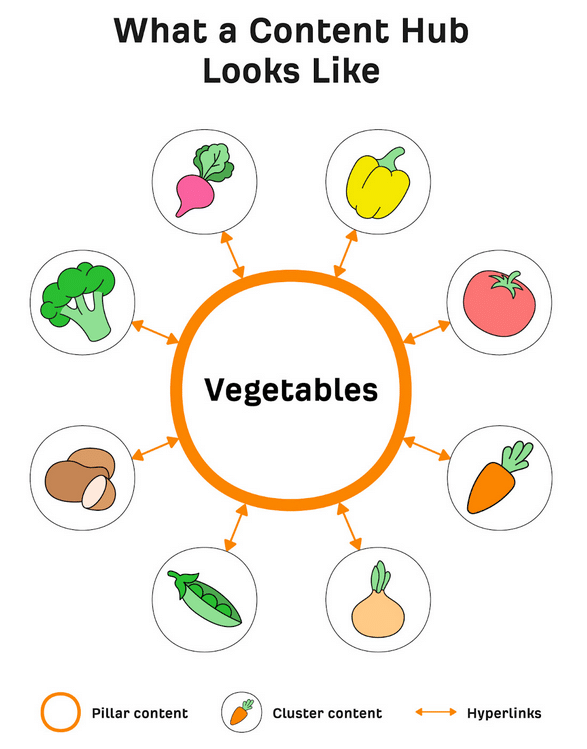
The difference between hubs and silos is that you are free to create links between content hubs.
For example, suppose we have two content hubs: one on fruits and another on vegetables. Given that it is a common misconception that tomatoes are vegetables, it may make perfectly good sense to create an internal link between the post on tomatoes and the hub page on vegetables.
Whereas in principle, in a silo, given that a tomato is a fruit, you should not link to vegetables since vegetables and fruits do not go together.
Silos
A silo is a thematic cluster that does not send links to other silos in the internal linking structure. That is what differentiates them.
When we optimise semantics for Google, it is sometimes even preferable, when optimising content with semantic tools like YourTextGuru or 1.fr, to remove words in addition to adding them. Why? Because sometimes using certain words can make things more complex for Google, as it is not always easy to draw a clear line. We do not intuitively realise it, but we sow ambiguities everywhere in our texts.
That is the whole principle of a silo: avoid all ambiguities for Google and define a logically semantic structure.
However, unless you have thousands of pages per silo and therefore sufficient internal links, having additional links, even if they redirect to other silos (making it a cluster), is the best idea. Provided, obviously, that they are connected in a logical way. If for you it is not very interesting because you are linking something of little relevance, do not do it.
The silo structure in SEO is a type of website architecture in which you group, isolate and connect content on a specific topic. This creates clean and distinct sections of related content on your website.
Here is roughly what SEO silos look like in practice:

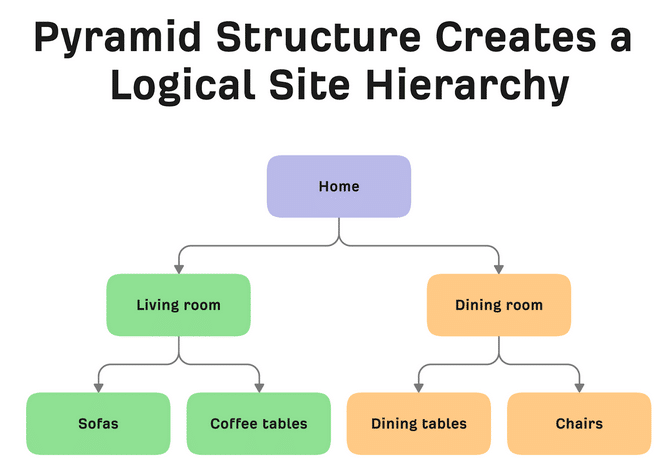
Pyramid Internal Linking
Pyramid internal linking consists of ensuring that the most important pages for your SEO are at the beginning of your structure, so that the deepest and least interesting pages end up at the bottom of the linking structure.
The Semantic Cocon
I cannot explain the semantic cocon here. But I can summarise it. I actually wrote 5 articles of several thousand words each to manage to explain the concept of the semantic cocon.
Nevertheless, here is how it differs from other techniques.
A cocon is always a set of silos that nest within each other. For example, a silo on on-page SEO optimisation, then inside this silo when we click on the child page ‘internal linking’ we find ourselves again in a silo that has child pages around internal linking. And so on.
But it also partly uses the pyramid concept, in the sense that from what we call level 4, we create pages that have no purpose of ranking on Google but only serve to increase the relevance of the pages above them.
And that, the semantic cocon is not just SEO.
And that, we use metamots.
And that, we perform link obfuscation, even if we sometimes link certain silos within the content itself we do not link via the menu and the footer.
Why Use a Page Grouping Technique?
Whatever name you give it, this is highly effective. It prevents links from being linear; in a cluster they are all semantically created in a logical manner and they all boost each other.
- It helps Google find your pages
- It improves rankings through semantics
- Better PageRank flow
- More contextual internal links
- It creates a good user experience
- You position yourself for countless keywords
How to Create a Page Group?
There are infinite possibilities for creating a page group, but here we will use the SEOQuantum tool because it is a tool aligned with semantics and it is easy to use and very practical.
Step 1: Verify That Your Main Keyword Has Search Volume
When you want to create a cluster of pages, you also want the topic to be massively searched on Google.
So that is where we will start.
Let us imagine that we want to sell surfboards.
Let us check if this keyword is searched:
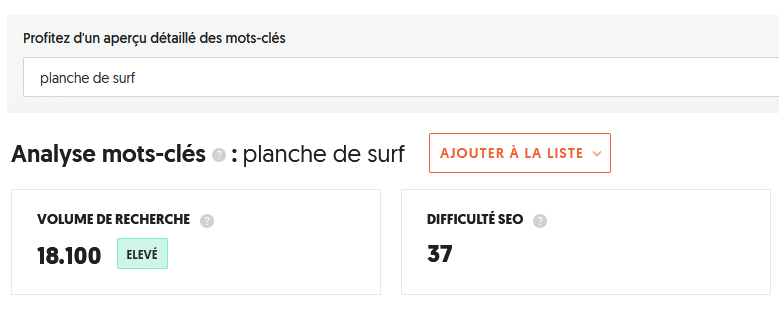
All good on that front.
Step 2: Semantic Analysis of a Keyword with SEOQuantum
Let us assume we want to rank for surfboards and we want to create a page group on that topic.
Here, I will use the semantic keyword analysis of “surfboard” with SEOQuantum:
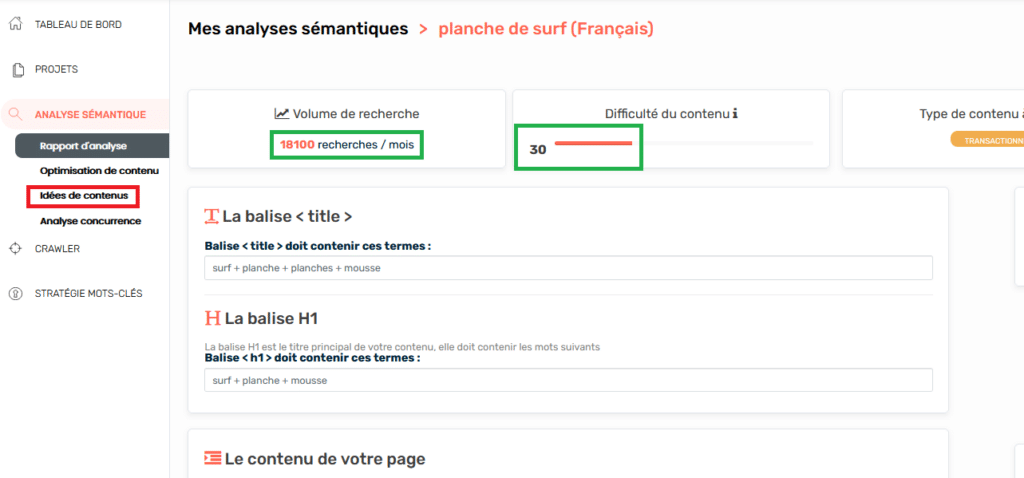
You can directly use SEOQuantum to analyse traffic volume and competition.
Once the keyword “surfboard” has been analysed, go to -> “content ideas”. (You are required to launch the analysis before getting a cluster).
Step 3: Discover Your Page Group
Once you have navigated to “content ideas”, you will be able to discover what they call a “semantic cocon”:

Tadaam! Your page group is right there!
You can also export it as a mindmap and manipulate it as you wish.
All you will need to do is create the articles, publish them and then link them as we have seen previously.
FAQ on Page Clusters
Here are the answers to some common questions you might have about topic groups:
Are “Topic Clusters”, “Hubs”, and “Pillar Pages” the Same Thing?
Whatever way you wish to refer to them, topic clusters, hubs and those who simply call them pillar pages are all the same thing: a single place to host content around a specific topic.
Difference Between Silo and Cluster
None, except that a silo does not send a link to another silo, whereas the cluster or topic cluster does.
Difference Between Cluster and Topic Cluster
A cluster and a topic cluster are identical.
Difference Between Silo and Semantic Silo (Siloing)
A silo or thematic silo is hierarchically structured in the same way as a siloing or semantic silo.
I could write an entire article on the difference between thematic silo and semantic silo, citing all the data at my disposal, but ultimately, it is the same thing.
We talk about semantic silo (siloing) when we talk about the silo structure of a semantic cocon.
And a semantic cocon is a siloing, because that is how it is structured, but is packed with a multitude of additional optimisations.
What Is a Cluster in SEO?
Google’s primary objective is to provide internet users with the most relevant answers to their search queries as quickly as possible. As an SEO practitioner, your objective should be the same.
Instead of considering an article as one focusing on a single keyword, consider keywords as topics. You want to try to cover everything Google expects to see on that topic in your content.
How Many Pages Should You Have in a Cluster?
There is no minimum or maximum number of pages you need to create per topic group.
What you need to do is create enough to fully cover the topic, but not to the point of potentially cannibalising your rankings.