
Creating a well-defined and focused SEO strategy is essential for achieving good search engine ranking. It would be counterproductive to dive in hastily without thinking it through beforehand — that would be pointless and you would be wasting your time. You must define objectives and carry out several analyses before even getting into the thick of things. Otherwise, it will be of little interest and will probably never work.
In 5 steps you will discover the key points for achieving a successful SEO strategy:
1. Define Your SEO Strategy
Why are you doing SEO? To get more customers, more sales, more money. What follows from that? To succeed in your SEO strategy, you must offer content — such as articles, for example — that directly ties in with what you offer.
I will give a simple example: if you sell children’s toys and you enjoy cooking, do not offer cooking recipe articles when you are selling toys. Instead, write articles about the best children’s toy brands by age category.
By clearly defining your objectives, you will put yourself in the best conditions to structure and prioritise your efforts effectively while always following the right direction.
You can classify several categories of pages as follows:
• Informational → Blog articles, interactive tools, calculators, etc.
• Commercial → Product pages, landing pages, etc.
We can also further segment the conversion funnel as follows:
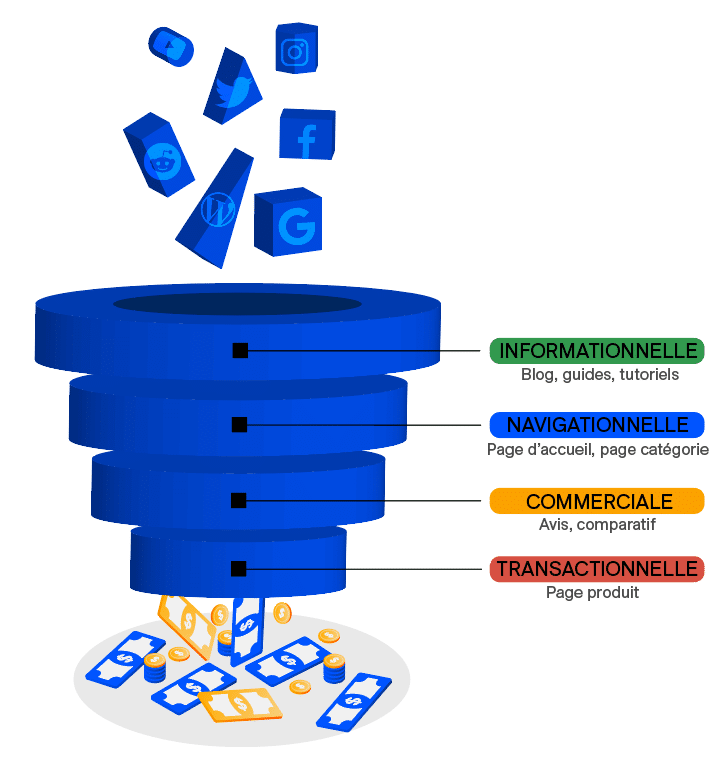
The best idea for defining a good strategy is to study your personas: who are your customers? What do they want? Etc.
2. Target the Right Keywords
After defining the topics you want to cover on your site, it is now important to go deeper and analyse the main keywords you will target for each piece of content. If you do not do this, you will potentially write content that nobody searches for. For this in-depth analysis step, I strongly advise you to use SemRush, which allows you to analyse keywords but also to get keyword ideas (and much more). This step is decisive for succeeding in your natural search engine ranking strategy.
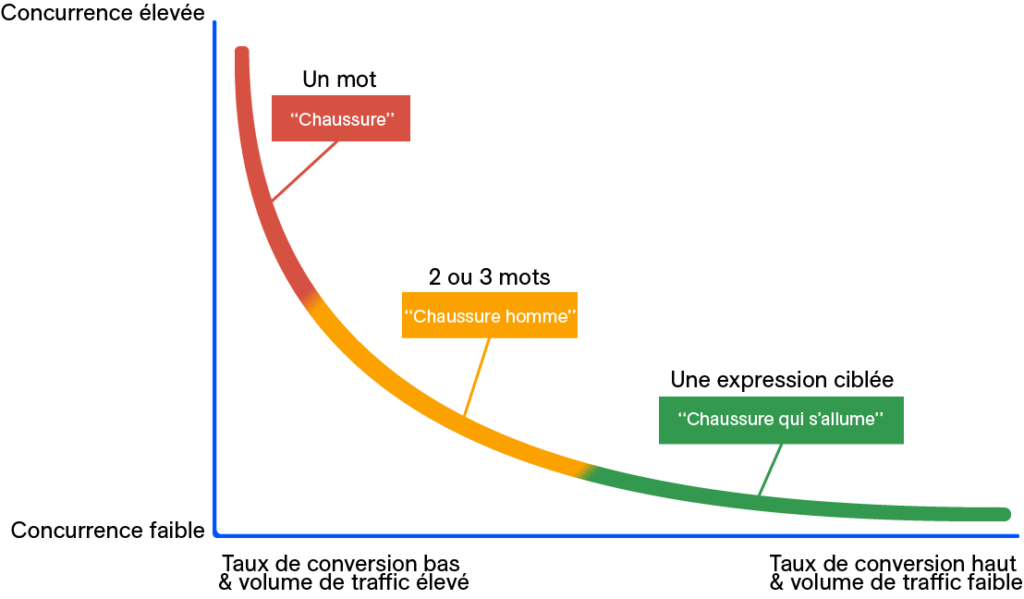
The Long Tail
A long-tail keyword is generally a long keyword — for example, “children’s toys” would be a short tail and one of the long-tail keywords could be “children’s toys age 8”. The search volume will be lower, but the competition will be more accessible. In the context of an effective SEO strategy, it is important to favour long-tail keywords, but you can also target short-tail keywords right from the start and enrich them with content targeting long-tail keywords. The second benefit of the long tail is conversion. As a general rule, even if the search volume is lower, the conversion rate for a long-tail keyword is much higher and even more “profitable”.
The Middleman (MIDM)
For those who know a little about cybersecurity, you have probably already heard of MITM. The principle of the “man in the middle” is the same, but let us not get side-tracked.
In the context of keyword research and SEO strategy, the middleman is the practice of placing yourself in the minds of users while keeping the seller mindset at the back of your mind. It often correlates with the short tail.
This method allows you to sell while worrying less about competition and favours conversion. For example, the keyword “children’s toy” is rated “Hard” in difficulty according to Ahrefs, and has to compete with sites like Joué Club — to the point where Ahrefs has detected this query as having “jouet club” as its parent topic. In short, it would certainly probably be smart to target this query to generate money, but that seems very complicated. You could just as well target a query like “best toy for an 8-year-old child” — you then create an article proposing the best toys for 8-year-old children while subtly featuring your own toys and shop. That is the middleman method.
The Silo
The silo is a technique for the content architecture of a site. It allows you to classify each topic on your site. It optimises your search engine ranking to the best possible extent — it is a crucial optimisation for perfect success. It also allows you to properly segment each part of your conversion funnel(s).
It is a strategy in every sense. For example, a parent page could be “toys” linking to two silos — one on “children’s toys” and another on “teen toys”. Each silo then handles the specific topic without connecting to the other.
It is important to mention this technique so that you can choose your keywords in line with this optimisation. Do not hesitate to familiarise yourself with this type of optimisation through our articles.
There are many simple, free mind-mapping tools that can help you generate each section of your site, thus allowing you to better think through and visualise your future architecture.
3. Know the Basic Principles of SEO
To succeed in your SEO strategy and conquer search results, you will need to know at minimum some good SEO basics in order to optimise the pages of your site.
Here is a list, though not exhaustive:
- Content is king
- Optimise your internal linking
- H(n) title tags
- Meta title and meta description
- Optimise your images: title, description, Alt tag
- …
- Netlinking
- Local SEO
- H(n) title tags
- SEO and social networks
- …
- Choose your preferred domain
- Canonical tag
- Add and configure your sitemap.xml
- Add and configure your robots.txt
- Add structured data to your website: Schema Markup & Rich Snippets
- Do you have a 404 page? A site in HTTPS?
- Speed up loading time & Core Web Vitals
- Think mobile first
- …
This is also the subject of one of our articles that comprehensively covers all these “standard” forms of SEO optimisation.
Google Search Console, Analytics, Business Profile…
A good SEO site is a site that uses Google’s tools — it is essential. One can mention in particular the most important one, Google Search Console, which allows you to measure, observe and improve your site’s search engine ranking.
Google Analytics, meanwhile, allows you to understand what is happening on your site. With the arrival of GA4, the tool can even measure the scroll percentage of a page and much more (enough to optimise UX).
Google My Business, for its part, allows you to develop your local SEO. It is essential for local search engine ranking and must be set up imperatively.
There are many others such as Bing Webmaster Tools, Data Studio, Google Tag Manager, etc.
4. Create Content (Intelligently)
Now that you know what to write about and how to write it while thinking about search engine ranking, you need to write on these famous topics. The best thing to do is to create epic content — both for the user experience and for Google. Writing a perfect blog article for your users will be perfect for Google. Offer either something different or something better. Google will have little interest in moving you to the first position if your content is worse than others or rehashes the same thing.
Still in line with this principle of creating content for users, it is important to know search intent (or search intent). You must above all avoid creating content that nobody wants to see.
For example, if you write an article like a good middleman on “best children’s toys to give as a Christmas gift”, you need to offer a concrete list of the best products and indicate where they can buy them. Nobody wants to see a page of tips and tricks for children’s Christmas toys without mentioning a specific product, for example. If you do not match what the internet user truly wants behind a keyword (search intent), it will be impossible for you to position yourself.
In any case, offer real added value in your articles — whether in terms of writing or visual aspect.
5. Netlinking / Link Building
Netlinking or link building refers to the generation of multiple backlinks. A backlink is a link contained in an external site that redirects to your site. It is said that this gives “votes” to your site and allows Google to be informed that you are relevant — you then become eligible to be displayed at the forefront.
This optimisation — known as off-site — is indispensable for any site hoping to reach the first page on a minimally competitive query. However, beware of agencies that create backlinks for €5 pointing to your site, or even more enticing ones, because if this unnatural practice is used, you will be exposing yourself to Google penalties. I would rather advise you to focus on natural link building if possible.
Summary of an SEO Strategy:
Think about your internal linking combined with a conversion funnel of keywords with traffic, with a well-built site for search engine ranking (technical SEO). Then write the articles, thinking about search engine ranking and user experience. Then carry out a netlinking strategy.
Next, it would be rather wise to optimise the user experience and convert all your monthly visits into leads. This involves several things, such as optimising your conversion funnels, measuring the estimated impact of your pages relative to current revenue, potentially adding CTAs (calls to action), analysing Google Analytics data to improve… And finally, use Hotjar.