
SEO, or Search Engine Optimisation, is the art and science of optimising your website to make it more visible on search engines like Google. If you have already dug into the complex world of SEO, you have probably come across the terms “Black Hat SEO” and “White Hat SEO”. These terms come from the old Western film terminology, where the villains often wore black hats and the heroes wore white hats.
In the context of SEO, White Hat SEO refers to techniques that respect search engine guidelines and emphasise the creation of quality content and user experience. Conversely, Black Hat SEO refers to practices that seek to deceive search algorithms to obtain better rankings.
This article examines Black Hat SEO approaches and techniques up close.
What Is Black Hat SEO?
Google’s guidelines are clear on this subject: any deliberate manipulation of an algorithm to improve its ranking is considered black hat.
From the moment one seeks to manipulate an algorithm to improve its ranking, one is attempting to manipulate it. As soon as one seeks to optimise — whether with semantic optimisation tools (keywords) — it is black hat.
Let us take, for example, the directive that prohibits automatic content generation. Many major news sites, which rank very well, use precisely this practice — consider tools such as GPT-4. The same applies to the artificial generation of links, a very widespread technique even though it is prohibited.
It is all a matter of degree…
Understanding Black Hat SEO
The term black hat SEO describes optimisation tactics that deliberately violate Google’s guidelines.
In the complex world of referencing, the line between respecting the rules and transgressing them can often seem blurred. Indeed, many websites on the first page of Google search results have, at one point or another, used optimisation techniques that were not entirely compliant with Google’s guidelines.
Is Black Hat SEO Dangerous for Your Site?
The question deserves reflection. The fact that the majority of web players resort to these practices might lead one to believe they are harmless. However, as with everything, the devil is in the details.
The extent and manner in which these techniques are used can make the difference between grey hat SEO — a grey area between full compliance with the rules (white hat SEO) and their transgression (black hat SEO) — and full-blown black hat SEO.
Link Building
Unnatural link building is one of the most widespread black hat SEO techniques. It is a strategy that involves creating links, called backlinks, to your own website from other websites.
The number of sites pointing to yours via links increases your authority in the eyes of search engines, thereby improving your ranking. The challenge lies in the fact that you do not normally have direct control over this optimisation, unlike on-page optimisations where you can modify the content of your site to include specific keywords.
Black Hat Link Building
Buying links without mentioning that they are sponsored is a common black hat or grey hat link building practice, despite Google’s past attempts to combat these methods.
Today, if Google detects a fraudulent link, it simply ignores the authority of that link without penalising the site in question, hence the proliferation of link building platforms.
PBNs and Black Hat Link Building
The PBN (Private Blog Network) is another commonly used black hat link building technique to deceive Google’s algorithms. A PBN is a network of private websites created for the sole purpose of generating links to a main website, with the aim of improving its ranking in search results.
A PBN acts somewhat like a “link farm”, another black hat SEO jargon term, where a group of websites is created to link to each other in order to artificially inflate the number of backlinks. However, while link farms are generally made up of low-quality sites and are easily spotted, a PBN is often composed of higher-quality sites and harder for Google to detect.
However, despite their relative sophistication, PBNs are considered a black hat practice by Google and can result in sanctions.
Examples of Black Hat SEO Techniques
Rather than revisiting obsolete techniques such as content spinning, this section will focus on more sophisticated black hat tactics that are still in use, without revisiting the classic unnatural link building.
Cloaking
Cloaking is a technique that involves presenting different content to humans and to indexing robots.
For example, you might consider optimising a page more for robots and less for humans. Optimising your internal linking for robots, and optimising it differently for humans. Although this practice is increasingly difficult to implement, it remains possible and effective.
Link Obfuscation
Obfuscation, also known as link obscuring or sometimes incorrectly called cloaking, aims to hide one or more links on a web page from Google’s view. This practice is motivated by the paramount importance of internal linking in a site’s referencing. By hiding a link, it is possible to optimise the distribution of PageRank within one’s internal link network.
For example, obfuscating the link to the “legal notices” page to sculpt PageRank in order to prioritise more important pages.
Link Building
We have seen link building via paid platforms.
I was so taken aback when I heard about this technique that I feel compelled to tell you about it.
There are many different ways to create unnatural links, such as at an aperitif between slightly inebriated SEO practitioners who all send each other reciprocal links.
But there are far more unsavoury techniques that do not respect Google’s precise guidelines.
During the crawl, Google’s robots take into account the extension of your domain name (.fr, .com, .xyz, etc.). If your site uses an extension statistically more associated with spam, Google will apply its anti-spam filters. Conversely, if it encounters a .gov or .edu domain, it will apply few or no filters. Indeed, government sites are generally reputed for their reliability.
And there is no way for you to obtain a .gov extension.
But now imagine. Imagine that a government site allows you to upload a PDF, and has not blocked the indexing of these files. You can then upload your PDF, optimised with a link to your site. Once indexed by the site, Google spots it and there you have it — you obtain a powerful backlink from a .gov domain.
“site:.gov filetype:pdf” is a query to try on Google to uncover opportunities of this kind. But this is purely for educational purposes (genuinely).
While browsing the web, you can even find ready-made lists: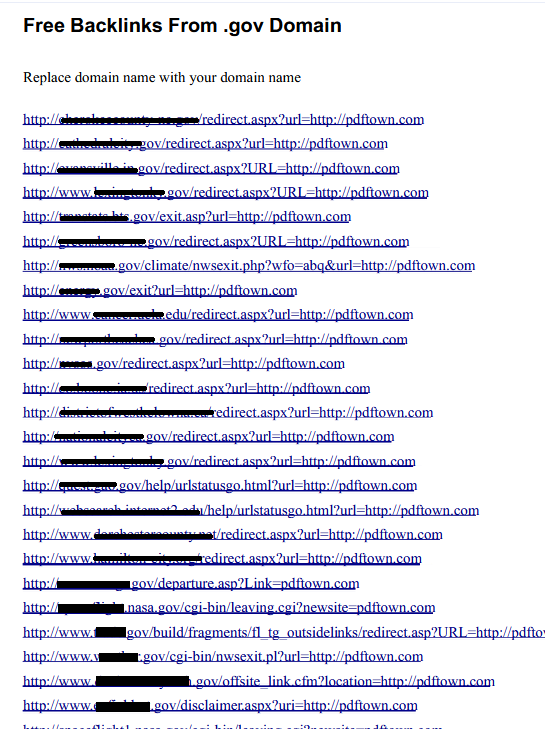
Link Building for Your Competitors (Negative SEO)
Known as negative SEO, this practice involves creating links from numerous spammy sites and PBNs to your competitor. Why? This technique allows you to make Google believe your competitor is a black hat SEO practitioner when they are not. You thus hope that Google penalises your competitor in the search results.
This method is becoming increasingly less effective, in particular because Google has put in place a tool to disavow backlinks. Indeed, if you manage to identify the negative links and report them to Google, they will no longer be considered.
Another method, more insidious, would be to create very powerful links for your competitor, then remove them after they have been taken into account by Google. This technique, although controversial, can cause significant disruption to your competitor’s positioning.
Keyword Stuffing
Keyword Stuffing is another very well-known technique in the black hat SEO universe. It consists of overloading a web page with keywords, to the point where the content becomes almost unreadable. The objective of this technique is to manipulate Google’s algorithm in order to improve the site’s positioning in search results.
This can be done in several ways: for example, by filling the meta tags, the alt attributes of images, or simply by including an overabundance of keywords in the content itself. However, this technique is strongly discouraged as it harms user experience and goes against Google’s guidelines.
Despite this, some keyword optimisation tools such as YourTextGuru attempt to find a balance by helping you include relevant keywords in your content without resorting to stuffing. These tools use semantic analyses to determine which keywords are most relevant for your content and target audience. They can be useful for improving your SEO, as long as you use them ethically and “reasonably respectfully” of Google’s guidelines. In general, content optimisation tools provide an indication of the SEO danger of over-optimisation. It is up to you to assess and decide on the level of risk you are prepared to assume in your SEO strategy.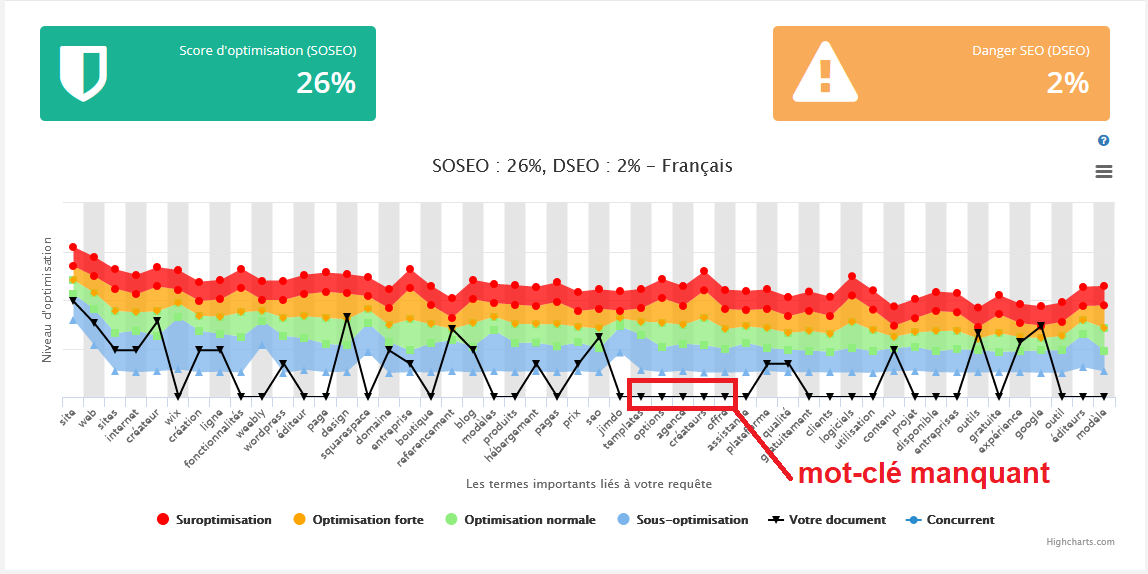
Exploring Other Black Hat SEO Techniques
Beyond the Black Hat SEO methods already discussed, there exists a diverse set of techniques that also fall into this category.
One of these techniques is the duplication of entire sites, often called “mirroring”. It consists of copying a website in its entirety with the aim of outranking it in search engine rankings.
Another tactic consists of manipulating the click-through rate (CTR) of your pages to improve your positioning. This method can prove particularly effective for algorithms such as RankBrain or Learning to Rank.
Blog spam with links in comments is another common Black Hat technique, although a poorly profitable one. Google has become very adept at spotting this type of link. Moreover, most content management systems (CMS) mark these links with the “ugc” attribute, indicating to Google that the link was generated by a user and not by the site owner, which limits the spread of “link juice”.
Another stratagème used in the world of Black Hat SEO is the use of white font. This technique consists of filling a web page with relevant keywords written in white on a white background. Users cannot see these keywords due to their lack of contrast with the background, but search engine robots can read them during page indexing. However, this tactic is widely considered obsolete and risky. Search engines, particularly Google, have improved their algorithms to detect and penalise this type of behaviour.
Finally, satellite pages represent another Black Hat technique. These are pages optimised for one or more specific keywords that then redirect the user to content adapted to those keywords, often located on the homepage of the site. These pages are primarily created to deceive search engines and improve a website’s SEO ranking.
Conclusion on Black Hat
There are many other techniques considered to be black hat, but they are so widely used that it is difficult to draw a clear line between black and white hat.
However, it is essential to emphasise that some of these techniques, especially those of the “deep black hat”, are not only contrary to Google’s guidelines, but can also be illegal — as would be the hacking of a website. Thus, even if these techniques can generate short-term profits, they risk leading to harmful consequences in the long term.