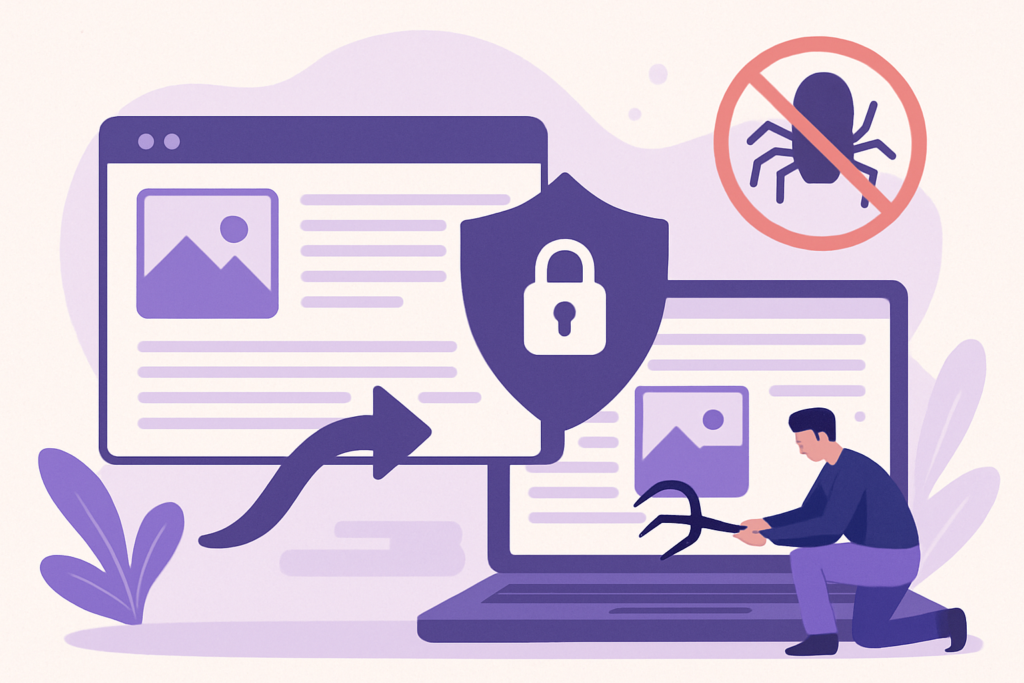
Scraper sites are websites that automatically copy large amounts of content from other sites without authorization, often using automated scripts known as scraping bots.
While some forms of scraping can be legitimate, many are considered abusive practices and can have negative consequences for the sites involved.
It is a form of Black Hat SEO.
What is a Scraper Site?
A scraper site is a website that extracts or “scrapes” content from other websites without the original owner’s permission. This is often done using bots or software that browse the web, copy content from web pages, and paste it onto the scraper site. These sites may copy all of a site’s content or only certain parts, such as blog articles, product descriptions or comments.
Why is Scraping Problematic?
There are several reasons why content scraping is problematic. On the one hand, it can violate copyright law and the terms of service of the original sites.
On the other hand, it can lead to a loss of traffic for the original site, as users may end up visiting the scraper site instead of the original source.
Finally, it can also cause a dilution of search engine rankings, as duplicated content can be penalized by search engines like Google.
How to Prevent Scraping?
There are several measures you can take to protect your site against scraping:
1. Implementing CAPTCHAs: CAPTCHAs are systems designed to determine whether a user is a human or a bot. By adding a CAPTCHA to your pages, you can prevent scraping bots from copying your content. Services like Google reCAPTCHA make this easier to implement.
2. Bot behavior detection: Bots often behave differently from human users. For example, they may visit many pages in a short period of time or access pages at a regular, mechanical rate. You can set up systems to detect these behaviors and automatically block suspicious IP addresses.
3. Using protection services: There are third-party services like Cloudflare (the simplest option) that can help protect your site against scraping. These services can detect and block malicious bots while still allowing legitimate bots (such as search engine crawlers) to access your site.
4. Legal action: If you discover that someone is abusively scraping your site, you may want to consider legal action. In many countries, unauthorized scraping can be considered a copyright violation or a breach of terms of service.
5. Using the robots.txt file: Finally, it is possible to use the robots.txt file to prevent certain bots from using your content. This file, serving only as a directive, will be ineffective against illegal scraping sites. However, if you want to protect yourself against AI scraping — notably from GPT-4 or Bing’s AI-powered search engine based on OpenAI — you can use the following directives:
UserAgent: ChatGPT-User
Disallow: /
and
UserAgent: CCBot
Disallow: /
Please note that these measures do not guarantee complete protection against scraping, but they can make the task significantly more difficult for scraping bots. If you want a specific legal bot not to scrape your content, research the appropriate methods to block it — including via the robots.txt file.
Ultimately, the best defense against scraping is to regularly monitor activity on your site and be proactive in implementing protective measures.
Conclusion
While content scraping can be a source of frustration for website owners, there are measures you can take to protect your site. By staying vigilant and taking proactive steps, you can protect your content and maintain the quality and integrity of your website.