
A doorway page (also called a “satellite page”) is a web page created exclusively for search engine crawlers, with the sole purpose of improving a website’s SEO ranking. It is invisible to human visitors but picked up by Google’s crawl bot. In simple terms, it is a Black Hat SEO technique that was used to manipulate a website’s position in search engine results.
The Origins of Doorway Pages
About a decade ago, major newspapers — including The New York Times — reported on companies using “dirty tricks” such as doorway pages to manipulate search engine rankings. Even large companies like BMW had lost all their rankings after using this technique.
How Does a Doorway Page Work?
A doorway page is typically stuffed with keywords (keyword stuffing) and links. Its sole objective is to seduce Google’s algorithms. Such pages are therefore highly optimized and appear at the top of search results. But when a user clicks on this result, they don’t actually land on the doorway page itself — they are automatically redirected to the homepage or another page of the website, or even to a completely different site.
Some site creators used this technique to associate a doorway page with an image-heavy page, since sites consisting only of images or videos are not indexed by search engines. Others used it to associate a doorway page stuffed with sensitive keywords to another related page — in cases of heavy code that could cause rendering errors, or to promote a landing page aimed purely at generating ad clicks.
Doorway Page Example
In BMW’s case, their German websites used doorway pages to optimize their visibility in search engines. With JavaScript enabled in your browser, you saw a clean and pleasant interface — although somewhat light on content.
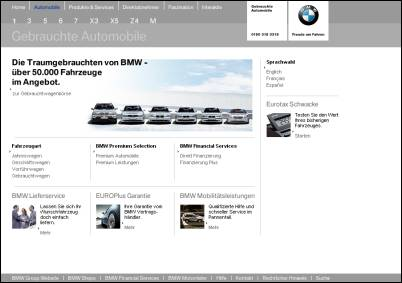
However, with JavaScript disabled, a completely different version of the page appeared — revealing excessive use of the word “Gebrauchtwagen,” which means “used car” in German.

These doorway pages, while effective at boosting search rankings in the short term, were widely criticized for manipulating search results and for their deceptive approach to SEO. BMW’s approach also made their main site inaccessible without JavaScript, which made it difficult for Googlebot to crawl. It is important to note that since then, Google’s algorithms have evolved to penalize such techniques, and companies have had to adapt accordingly.
The Risks of Doorway Pages
Fortunately, the use of doorway pages is increasingly rare today. These pages are now considered an abusive SEO method and are penalized by Google. Sites using this technique risk being downranked or blacklisted by the search engine. Moreover, Google has evolved so much that it is now far too sophisticated to be fooled by doorway pages — no matter how well you try to hide them.
Conclusion on Doorway Pages
Doorway pages are an old Black Hat SEO technique. Their use is completely inadvisable today. Some Black Hat SEOs may still use them to a limited extent. In all cases, using such techniques can result in severe penalties, up to and including de-indexation of a website. This is clearly undesirable for any business or individual seeking to build a lasting, quality presence on the internet.