Increasing the popularity of your site — also known as off-site or off-page SEO optimisation — is indispensable for the natural SEO of a site. It allows you to give “votes” to your site and your pages. These “votes” are called “juice” in technical jargon. If sites talk about your site with links, you gain this famous juice and become relevant to Google. It then reassesses your position in the search results at your next crawl.
To date, on any topic, it will be impossible to place yourself in the top search results without these “votes”. The authority of your site therefore plays an indispensable role in ranking your site on search engines.
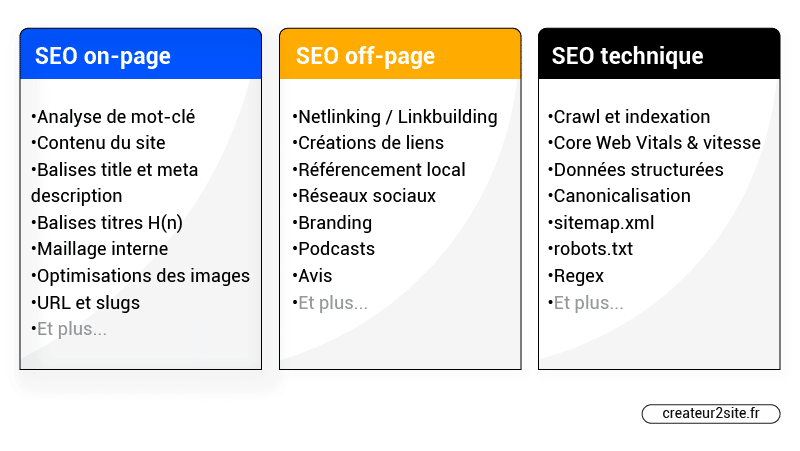
SEO can be divided into three categories: on-site (or on-page) SEO, off-page (or off-site) SEO, and technical SEO, sometimes confused with on-page SEO.
Many see off-page SEO as synonymous with link building — but is that really the case?
What Is Off-Page SEO?
Off-page or off-site SEO refers to all efforts made “outside the website” to improve its search engine ranking.
Link building is a large part of off-site SEO work, but it goes far beyond that. We can notably mention social media, local SEO, and much more.
We can enumerate a wide range of possible off-page optimisation techniques such as:
- Link building
- Local SEO
- Social media
- Podcasts
- …
Off-Page SEO vs On-Page SEO vs Technical SEO
On-site SEO is something over which you have total control, whereas that is not always the case for off-site SEO.
For example, if you are doing natural link building, you will almost always need to ask someone to create a link pointing to you (off-page SEO). You will clearly understand here that you are not dependent on the success of your off-site SEO, or at least not entirely.
Conversely, if you improve the speed of your site, add co-occurrences and whatnot, that is on-page SEO because you can make that change directly on your website.
If you ever do not know which category an SEO tactic falls into, ask yourself whether it is entirely within your control. If the answer is no, it is probably an off-page SEO tactic. Probably, because in reality you have total control over certain off-site factors such as managing your Google My Business for your local SEO (although its optimisation is not necessarily entirely within your control).
Technical SEO is often integrated into on-site SEO. This category includes all the technical aspects of on-page SEO. For example, optimising search intent will be in the non-technical aspect whereas integrating structured data markup (schema markup) or optimising the crawlability of pages will be in the technical aspect.
Off-Page SEO Is Important
As seen previously, optimising off-page SEO is indispensable to rank on Google. Link building is the most important part of off-site SEO.
You can incorporate every possible technical SEO element, have thousands of pieces of content — if your niche is even minimally competitive it will be impossible to rank in the search results (SERP) without links (called backlinks).
Moreover, while it is impossible to rank in a minimally competitive niche using only other strategies, having hundreds of good links without technical SEO and with only a single page on your site can still push you to the first page for several keywords. What you need to understand here is that a site’s authority, the famous juice transmitted to your site thanks to links (backlinks), plays the most decisive role in ranking.
Note: be careful — if you see few backlinks yet a site ranks on the first page, it is probably because the domain authority is filled with backlinks. And since juice is passed on, the main page that sends a link to another page on their site transfers its popularity (without losing any).
The 5 Pillars of Off-Site SEO
Discover the 5 pillars of off-site SEO — from link building and branding to local SEO and social media. It is time to optimise your site’s SEO outside of it!
1. Netlinking / Link Building
Link building or netlinking is a strategy for generating backlinks. A backlink is simply a link contained in a page that redirects to a page on your site. If you have not yet grasped this, it is the backbone of off-page SEO.
This allows you to gain the famous SEO juice and therefore obtain votes for your pages in order to be ranked.
It is possible to buy links on platforms, or to create links naturally. Here is a (non-exhaustive) list of ideas for obtaining backlinks:
- Create a blog (linkbaiting)
- Contact blogs that link to your competitors
- Link building through resource pages
- Creating guest articles, also known as guest blogging
- The skyscraper technique
- Create beautiful images so they get reused
- Turn your mentions into links
- Find obsolete backlinks
- Share your articles
- Automate — the key to obtaining links
2. Build a Brand Image
This strategy is one of the most important in off-page SEO. Beyond creating links that redirect to pages on your site, branding is one of the best tools for your site’s SEO.
One of the strongest indicators that you are indeed building your brand is perhaps an increase in brand searches.
Brand building efforts help Google understand your credibility. That is why it has become such an important off-site tactic. When you build a brand, you will find that you naturally gain links and mentions on the web.
Note: Moreover, while a link is much more powerful than a simple mention, a mention is still important. According to Moz, citation signals are one of the main off-site ranking factors for local search.
To monitor your brand search traffic, you can use the free Google Trends tool.
3. Social Media
Even if it is not a direct factor, social media are undoubtedly very good for your indirect off-page. Let me explain. In fact, there is no doubt that social media has a positive influence on rankings, even if it is indirect.
Why? Because genuine shares on social networks lead to more readers on your page, and more readers lead to more links, mentions, and all those other off-page SEO factors that do have a direct effect on rankings.
4. Forum, Webinar / Event, Podcast
It is entirely normal that this strategy is relatively connected to the others, and it is important to clarify that. This will increase your brand identity and your audience. Everything you do outside your site can be beneficial for your site. Because just like social networks or brand searches, participating in forum discussions, creating webinars, or even white papers will allow you to acquire new audiences, increase your credibility, and therefore improve your natural SEO.
To date, webinars and podcasts are the best off-site SEO strategies, not counting direct link building.
5. Local SEO and Google My Business
Google My Business allows you to display your site in Google’s local search results. It is the easiest optimisation among the local SEO optimisations.
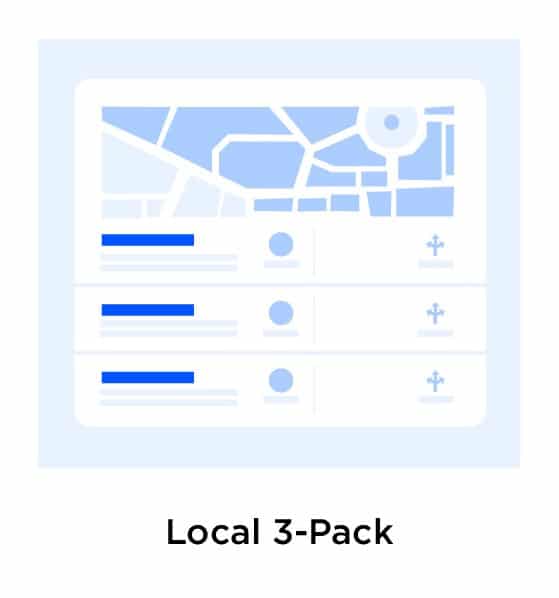
This allows your site to appear for local keywords. While this technique does not increase your site’s authority, it is still part of off-site SEO optimisations. In order to maximise your presence on Google My Business, here is a list of ideas to have more chances of appearing in results:
- Complete as many things as possible on your listing to improve your performance
- Respond to reviews posted by your customers as quickly as possible, whether negative or positive! Moreover, encourage your customers to post reviews.
- Add a profile picture — cover photo — shared images (as many as possible)
- Create and publish posts, add products if you have them
- Keep your information up to date
Note: There is also Bing Places, the equivalent of Google My Business but for the Bing search engine. There are also others for other search engines, so do not hesitate to create a listing on each of them!