Google always geolocates your mobile or computer to determine the best results to display — even if you haven’t enabled location services. That’s why, when you search for something that could remotely relate to a local business, Google may suggest nearby companies via a carousel. This applies whether you’re looking for a plumber, a design agency (even when location doesn’t matter) or anything else.
Important note: If you’re tracking your SEO rankings and think you’ve reached the first page for a keyword, make sure to use a private browser — or more reliably, a VPN or an SEO tool like Semrush — to verify what other users actually see. Your exact local proximity, cookies and search history all influence what Google shows you personally.
Local search on Google
Local search is mainly divided into two parts:
- Classic organic search results
- The “Local Pack” — powered by Google Business Profile (formerly Google My Business)
- (Users may also search directly via Google Maps).

Local SEO therefore encompasses both website optimization for organic search and optimization for Google Business Profile — both are closely linked and correlated. An organic result appearing below the local pack carousels is also influenced by your local proximity to those sites.
Local search by the numbers
Local search is now essential for any business with a physical location — whether an office, shop or restaurant — and it is extremely important to leverage it. Local search on Google in numbers:
- 46% of Google searches are intended to find a local business. (SEO Expert Brad)
- 12% of consumers perform a local business search daily. (BrightLocal)
- 97% of consumers will search online first when looking for a local business. (Hubspot)
- 86% of consumers use Google Maps to find a business location. (Hubspot)
- 76% of users who conduct a local search visit the business in person the same day. (Google)
- 28% of local searches result in an immediate purchase. (Google)
- During holiday periods, 76% of consumers prefer physical shopping over online shopping. (Geo Marketing Report)
And many other statistics that are probably even more impactful. Ready to optimize your local SEO? You should be!
Optimizing your local SEO
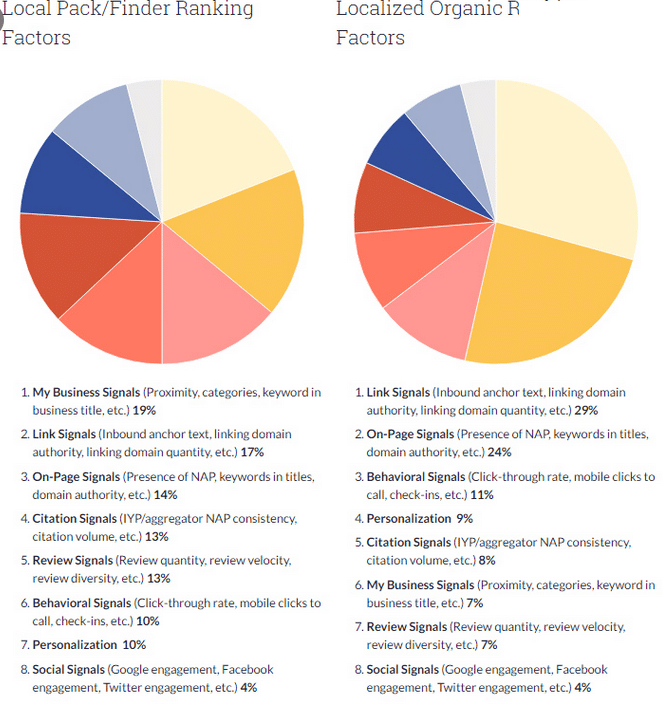
Let’s cut straight to it and look at the ranking factors for optimizing your local SEO:
Ranking factors for “local pack” results
//
Ranking factors for localized organic search results:
The 7 biggest local ranking factors
To summarize and simplify, here are the 7 most important criteria for strong local SEO:
- Having a Google Business Profile (proximity, categories, keyword in business name, etc.)
- Citations (NAP, citation volume, etc.)
- On-page (NAP presence, keywords in headings, domain authority, etc.)
- Links — backlinks (anchor text, domain authority, quantity and quality, etc.)
- Reviews (quantity, velocity, diversity, etc.)
- Social signals (Facebook engagement, Twitter, etc.)
- Behavioral signals (click-through rate, click-to-call, etc.)
Definition: NAP is a citation of your business that includes the Name / Address / Phone Number. A citation is not necessarily a link — it can simply be a website that lists your restaurant among the best Italian restaurants in a given city, including the name, address and phone number without necessarily linking to your site. (Many local businesses don’t have a website at all.)
Discover how to optimize your NAP citations here.
Also: be present on the right platforms!
One of the best pieces of advice — and one that’s fairly quick and easy to act on — is to register on the platforms that list your type of business. This isn’t about old-school directories. Beyond the fact that users may visit those platforms directly, Google typically displays them as a top result, often before the local pack carousels. Google can also pull reviews from these platforms to display on your Business Profile alongside Google reviews.
Not only will you gain more visibility, but you’ll also benefit from better overall off-site SEO — and most importantly, more pixel real estate in search results.
If you’re a restaurant or hotel, register on TripAdvisor!
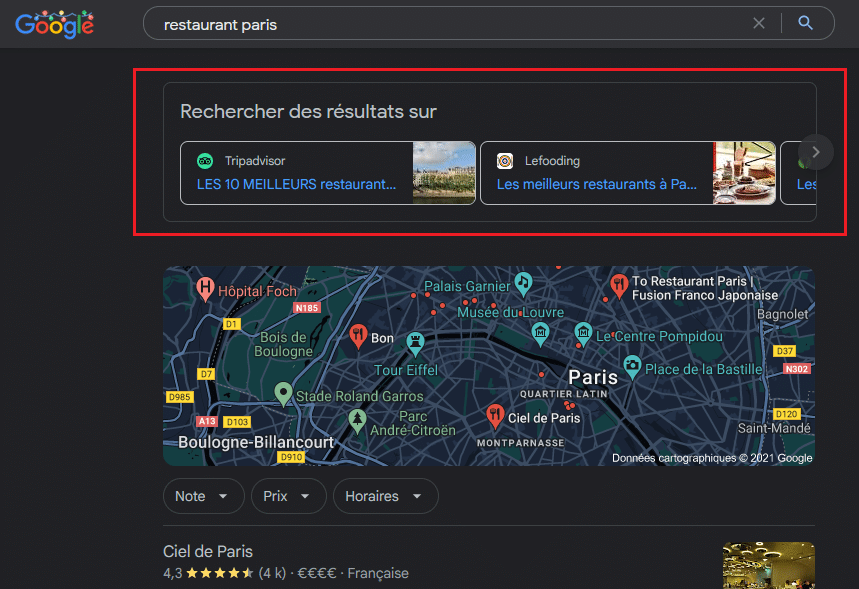
But there are many others — choose the ones that fit your business. When I was still active on the codeur.com platform, reviews left by my clients were displayed on my business profile in addition to Google reviews. What I’m saying is: this generally works for any type of business.
You can even go further and add specialized review platforms like Trustpilot. That’s not a negative move at all — quite the opposite. Google loves reviews.