
An SEO audit is an essential practice for SEO and therefore for helping your site achieve its visibility, traffic and conversion goals. By scrutinising every detail of your site with a critical eye, you can identify the issues and opportunities that have an impact on your SEO performance. In this article, we will examine in depth the different stages of an SEO audit, from technical aspects to content analysis, including backlinks and performance.
But before we dive into the details of the SEO audit, let us look at why it is so important and which tools can help us carry it out.
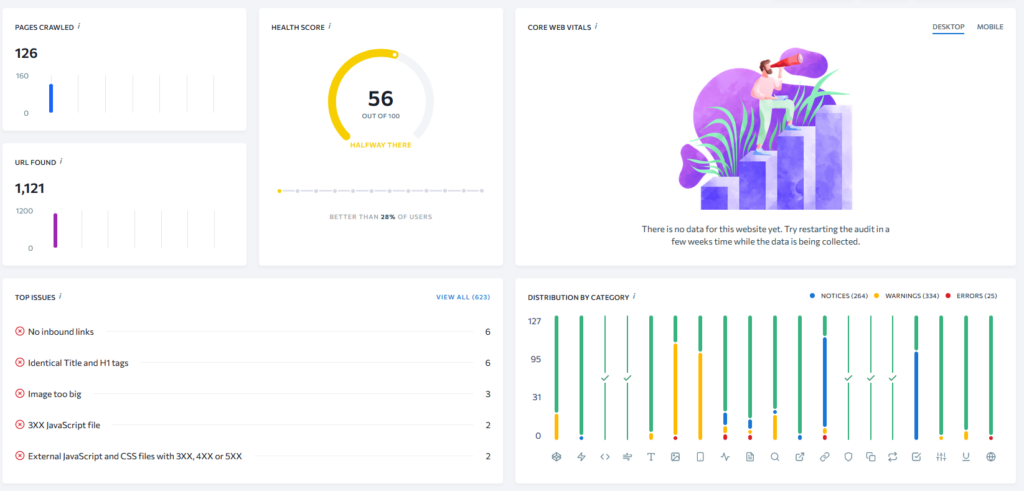
Why do an SEO Audit?
Doing an SEO audit is essential for several reasons. First, it gives you a clear picture of the health of your site. You can identify technical issues that prevent your site from being properly indexed by search engines, or discover duplicate content that could hurt your ranking.
Next, an SEO audit gives you an overview of your current performance. You can see which keywords are generating traffic to your site, which backlinks bring the greatest value, and how you compare to your competitors.
Finally, an SEO audit can help you plan your future strategies. By identifying keyword opportunities, analysing trends in your sector and evaluating user behaviour, you can develop content, backlink and technical strategies that will maximise your SEO results.
SEO Audit Tools
An effective SEO audit requires the use of several SEO audit tools to analyse different parts of your site. Here are some of the most popular and useful tools:
- Google Search Console: This free Google tool gives you valuable information on how Google views and indexes your site. It reports indexing errors, mobility issues, security problems, and more.
- Google Analytics: It allows you to track your organic traffic, see which keywords generate visits and understand your users’ behaviour.
- Ahrefs, SEMRush, or Moz: These paid tools offer in-depth analyses of your backlinks, keyword performance, the technical health of your site, and more.
- Screaming Frog SEO Spider: This is a crawl tool that can analyse your site to find technical issues, such as broken links, missing or duplicate titles, redirect problems, etc.
- Siteliner: This tool helps you discover duplicate content on your site.
With these tools at your disposal, you are ready to begin your SEO audit. Let us now examine each step in detail.
How to do an SEO audit?
Search engine optimisation, or SEO, is a crucial component of any successful online strategy. Carrying out an SEO audit of your website is an essential step in understanding where you stand and identifying possible improvements. But how do you conduct this audit? In this section, we will explain how to carry out an SEO audit step by step, using the tools mentioned above. This will allow you to evaluate the effectiveness of your website and implement corrective actions where necessary.
Step 1: Technical Analysis
The first step of our detailed SEO audit is the technical SEO audit. This phase involves exploring the fundamental aspects of your site that have a direct impact on how search engines interact with it. We will examine aspects such as site accessibility, site structure, page loading speed and mobile-friendliness. The objective is to ensure that the site is configured optimally for search engines, in order to maximise the effectiveness of our other SEO efforts.:
Website accessibility
Checking the robots.txt file serves to ensure that all essential pages are accessible to search engine robots. If some pages are blocked in this file, they will not be indexed. You can access this file by adding “/robots.txt” to the end of your site’s URL. “Disallow” directives tell search engines not to index the specified pages or folders.
Site structure
Your site’s structure must be simple and logical. The URLs of your pages must be clear and readable, and they should contain relevant keywords. For example, a URL like “www.mysite.com/article1” is not as effective as “www.mysite.com/complete-seo-audit-guide“. In addition, clear navigation with an easy-to-use main menu helps users and search engines find what they are looking for.
Site loading speed / Core Web Vitals
Check the key indicators of user experience on your site, including loading speed, interactivity, and visual stability.
Crawl and Indexation
Make sure your site is easily accessible and indexable by search engines. This involves, for example, checking the sitemap, the robots.txt file, and the use of indexation directives.
Mobile-friendliness
To check whether your site is mobile-friendly, use Google’s Mobile-Friendly Test. If your site is not optimised for mobiles, consider switching to a responsive design that adapts to all screen sizes.
Schema Markup
Examine the use of schema markup to help search engines understand your site’s content.
Step 2: Content Audit
Once the technical infrastructure of our site has been examined and optimised, it is time to focus on content. The quality, relevance and optimisation of our site’s content can make an enormous difference to our SEO performance. That is why the second step of our audit is an in-depth examination of our site’s content. We will seek to identify areas such as content quality, keyword optimisation and duplicate content issues. Our goal is to ensure that our site’s content is not only attractive to our visitors, but also to search engines.
Content quality and relevance
Each page of your site must have a clear objective and respond to a specific user question or need. Content must be unique and offer added value compared to what is already available on the web. You must also check grammar and spelling to guarantee high quality.
Keyword optimisation
Use keyword research tools to identify the terms your target audience uses to search for your products or services. Integrate these keywords naturally in your titles, sub-headings, product descriptions, blog articles, etc.
Content duplication
Content duplication can occur within your site (identical or similar content on multiple pages) or between different sites. Use tools such as Siteliner to find duplicate content on your site and consider rewriting or removing it.
SEO tags
Checking tags is crucial for an SEO audit. This includes optimising the title tag, meta description, Hn tags (H1, H2, H3, etc.), image optimisation (including alt attributes), URL optimisation for SEO, and appropriate use of Open Graph tags.
Internal linking
Examining internal linking can help identify opportunities to improve the site’s SEO. This involves creating links between different pages of your website to facilitate user navigation and help search engines understand your site’s structure.
Step 3: Backlinks Audit
The third step of our SEO audit is the backlinks audit. Backlinks, or inbound links to our site from other websites, are one of the most important factors in Google’s ranking algorithm. In this phase of the audit, we will analyse the quality and quantity of our backlinks to identify valuable links and those that could harm our SEO performance. We will also look for opportunities to generate additional quality backlinks. Our goal is to obtain a strong, high-quality backlink profile to improve our site’s ranking.
Backlink profile
Using tools such as Ahrefs or SEMrush allows you to get an overview of your backlinks. You can see the total number of backlinks, the number of unique referring domains, the authority of sites linking to you, etc. You can also identify toxic or poor-quality backlinks that could harm your SEO and consider disavowing them.
Backlink opportunities
An effective strategy for obtaining quality backlinks is “link building”. This can involve writing guest posts on other sites, sharing your content on social networks, creating high-quality content that will be naturally shared, etc.
Step 4: SEO Performance Audit
Google Search Console is a valuable tool for SEO performance auditing. It allows you to see which keywords generate traffic to your site, which pages have the most visits, how your site appears in the SERPs, and much more. In addition, it reports indexing errors, mobility issues, security problems, and more.
I hope this additional information will help you understand in greater detail what an SEO audit entails. Do not hesitate if you have any other questions or if you would like me to expand further on certain points.
Conclusion
An SEO audit is an in-depth process that requires technical understanding, detailed content analysis, and an evaluation of backlinks and SEO performance. By following these steps, you can identify and resolve issues that could hinder your site’s performance. A well-conducted SEO audit will help you increase your site’s visibility, attract more traffic, and improve your conversions.
Frequently asked questions about SEO Auditing:
SEO auditing can seem complex and full of technical jargon. That is why we have gathered below the most frequently asked questions on this subject. Our goal is to make SEO auditing more understandable and accessible, so that you can optimise your site in the best possible way. So let us go ahead and explore these common questions about SEO auditing.
What is an SEO audit?
An SEO audit is an exhaustive process that aims to evaluate the overall health of a website by identifying its strengths and weaknesses. It serves to rethink and optimise the digital marketing strategy in order to improve the site’s visibility and performance in search engines.
How long does an SEO audit take?
The duration of an SEO audit can vary depending on the size and complexity of the website. A complete audit for a medium-sized site can take between one week and one month.
What are the main elements of an SEO audit?
An SEO audit is generally divided into three main parts: a technical analysis, a content audit and a backlinks audit. The technical analysis evaluates the accessibility and optimisation of the site for search engines. The content audit evaluates the quality, relevance and optimisation of content for keywords. The backlinks audit evaluates the quality and quantity of inbound links to the site.
How much does an SEO audit cost?
The cost of an SEO audit can vary depending on many factors, including the size and complexity of the site, the depth of the audit and the expertise of the SEO auditor. Some professionals charge by the hour, while others offer a flat rate for the complete audit. For small sites, €300 is sufficient, for dense sites, several thousand euros.
How often should I carry out an SEO audit?
It is recommended to carry out a complete SEO audit at least once a year. However, for large sites or those in highly competitive sectors, it may be beneficial to carry out more frequent audits or regular checks of certain parts of the site.
Can I do an SEO audit myself?
Yes, it is possible to carry out an SEO audit yourself, especially if you have a good knowledge of SEO practices. However, an SEO audit is a detailed and complex process that requires SEO expertise. If you do not have the necessary experience or skills, it may be preferable to call on a professional.
Which KPI is most important during an SEO audit?
During an SEO audit, several KPIs (key performance indicators) are examined to evaluate the website’s performance. The choice of the most important KPI depends on the specific objectives of the audit. However, during an audit, particular importance is often attached to the site’s visibility in search engines, organic click-through rates, keyword rankings, page loading speed, bounce rate and the number and quality of backlinks. These indicators provide valuable information on the site’s performance and help identify improvement opportunities.
What is the best tool for carrying out an SEO audit?
There are many effective tools for carrying out an SEO audit, and the choice of the best tool depends on your specific needs. Among the most widely used tools, we find Google Search Console and Google Analytics, which offer valuable insights into the performance of your site in the SERPs and user behaviour. Paid tools such as SEMrush, Ahrefs and Moz can provide more in-depth keyword analyses, backlink audits and technical analyses. Finally, Screaming Frog SEO Spider is widely used for technical auditing, allowing you to crawl the site to identify errors and optimisation issues.
How do you succeed at your SEO audit?
A successful SEO audit requires a tailored approach, centred on the specific capabilities and needs of your business. SEO audits are not a ready-made formula — they must be designed to reflect your business objectives, your budget and your resources. Once the recommendations are received, it is crucial to implement them and constantly evaluate their effectiveness.
Particular attention must be paid to identifying the keywords that actually convert. These keywords are not simply those that generate traffic, but those that attract visitors who are ready to engage, buy or carry out any other action that is profitable for your business. Optimising for these keywords can lead to a significant improvement in conversions and return on investment.
It is also important to focus and prioritise efforts. Not all aspects of SEO are equally important for all businesses, so it is necessary to determine which aspects are most relevant for yours and to concentrate your efforts on these aspects to maximise the effectiveness of the SEO audit.