
If you cannot rank for a keyword, perfectly matching search intent is an invaluable SEO optimisation. Search intent describes what the internet user wants to find after a Google search. There are many ways to optimise and exploit it, and fortunately for you, few people actually do.
The four types of search intent
To begin, let us explore the different possible search intents together. There are many types of search intent in reality, but we will look at the most common ones.
1. Informational
The user is looking for information — a simple and effective answer. This could be a query such as “who is the French president?”. For this keyword, Google displays what is called a featured snippet:

Note: In this case, if your article covers the topic “Role and powers of the President of the Republic”, it will be difficult to rank for it — you are not matching the search intent. You must always put yourself in the shoes of an ordinary internet user. Besides, targeting a query of this type is not very relevant since the user will find their answer directly on Google without clicking on your site.
2. Branded search, also called navigational search
Here, the searcher wants to find a specific website. They already know where they want to go; they use search results because it is faster and easier than typing the full URL into the address bar. They may also be unsure of the exact URL.
Examples of navigational searches:
- « Instagram »
- « Nike shoe »
- « createur2site SEO guide »
3. Transactional
The searcher wants to make a purchase. They are in buying mode. They already know what they want to buy and are looking for the right place to do it.
Examples of transactional searches:
- « Buy a computer »
- « nordvpn coupon »
- « cheap iPhone »
4. Commercial investigation
The person is looking for a specific product or service but has not yet made a final decision. They are looking for reviews and comparisons.
Examples of commercial investigation searches:
- « Which CMS to choose »
- « WordPress vs Webflow »
- « Best restaurant Paris »
This last example is very interesting — many local searches have a commercial investigation intent. If you are targeting a commercial investigation keyword, write an article such as “the 10 best restaurants in Paris” including your restaurant, rather than trying to rank your homepage for it.
How to deduce search intent?
Search intent is often obvious from the query itself.
For example, take the keyword “Nike shoe”. It is almost obvious that the searcher wants to buy a Nike shoe rather than information about what they are made of (transactional search intent).
Keyword “modifiers” generally indicate a certain type of search intent, such as “buy”. Here the user will almost certainly want to purchase a product. However, search intent is not always obvious, especially since users do not always phrase their query perfectly.
It is very easy to be caught out. Take the example of “creating a website for dummies”. This query gets 144 clicks per month. It would surely be interesting to write a guide for creating a website for dummies.
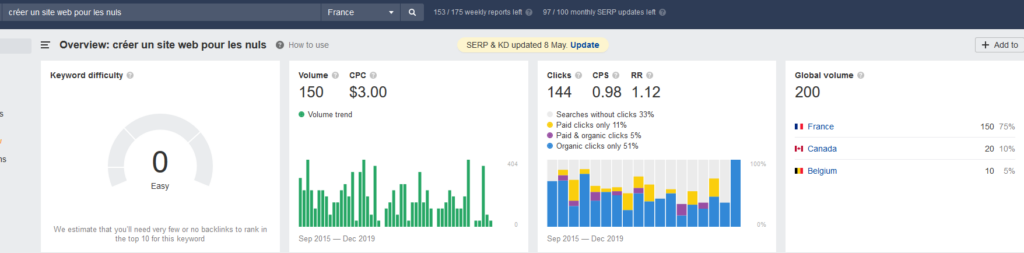
In reality, when we look at the results for this keyword in the search results, we realise that users are looking for a book rather than an article:

Ahrefs also indicates that 33% of users do not click on the proposed results, which is not actually very high. This means that this query is indeed aimed at a book and that the search intent is clear. It would therefore not be relevant to try to rank for it.
Note: Search intent is not always binary — many SERPs have a mixed search intent.
Analysing search intent
Search intent should dictate the type of content you create.
If the keyword has an informational intent, write a blog post. If it has a transactional intent, create a product page, etc.
However, things are not that simple.
Although it makes sense to align your content with the search intent, it is not certain that analysing the SERP will tell you what type of content the searcher actually wants to find.
In order to optimise for search intent, you need to analyse the SERPs and deepen your keyword analysis.
Here is how to proceed, step by step:
1. Check whether the SERP is viable:
Before analysing the content that is proposed for the keyword, there is no point wasting time if the results may be incorrect. You do not want to build a response based on the SERP’s current intent if it is likely to change in the future.
You therefore need to check the history of pages ranked for your keyword.
Take the example of “notre dame”. Following the recent incident, the query became very turbulent and Google struggled to determine what users were actually looking for. Relying on the content already present is pointless since it could vary from one day to the next:
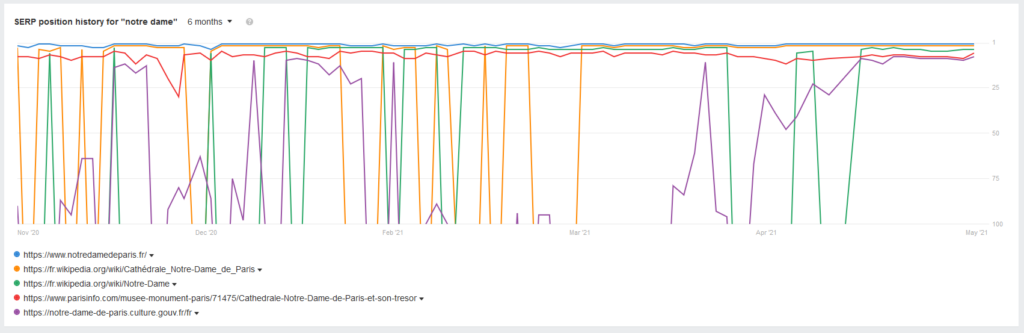
As you can see on this graph, Google is desperately trying to find pages that could match the search intent by ranking different sites within a very short timeframe.
For comparison, the keyword “shoe” appears to have been perfectly determined for search intent:

Only after analysing the SERP’s viability with a tool like Ahrefs can you trust the search results.
Note: If the position history is not consistent, a good idea would be to propose content that will finally match the intent so as to rank very easily. However, if you do not know with certainty what users are looking for, targeting such a keyword is a very bad idea. If you decide to propose the same type of response currently displayed on a query where Google cannot correctly describe the search intent, it is very likely that your page will only achieve a short-term ranking.
2. Analyse the SERP and ensure your content matches it
Now that you know your keyword is viable and the search intent is clear, you need to analyse the search results to make sure you match the right intent.
1. Content type
This refers to the “type” of content in the search results, and generally corresponds to these content types:
- Blog post
- Product page
- Category page
- Landing page
Analyse the main search results to determine whether they are all blog posts or whether the query is mixed. If the query is mixed, you should ideally propose the type that is most prominently featured.
Let us say the results consist of four blog posts followed by a product page. Now that you have determined you need to create an article after analysing the position history, analyse the content of the articles themselves to best match the intent.
2. Content format
Top-ranking pages inevitably follow a standard format. Common formats are:
- Guides
- Informational
- Review
- List
- Comparison
- …
There are countless different formats, but this can give you a good idea of what to look for in the SERP.
For example if your keyword is “how to be productive”, we mainly see guides of tips and tricks rather than step-by-step lists (there is only one). This means that if you were planning to create a to-do list to be productive, you are probably overcomplicating things for little benefit.

When creating your SEO content, it makes more sense to follow the crowd. Although it is possible to propose different content, you will likely never get results. If you think the search intent will be better served differently, you can propose different content, but it is unlikely to work in your favour. This query has over 40,000 results. I would not be at all surprised if many step-by-step “productivity” lists are among those results. They simply do not rank on the first page because that is not what users are actually looking for (they want tips).
3. Content angle
The content angle is relatively linked to the content format itself. Indeed, for the query “how to be productive”, the content consists of guides of tips and tricks. Tips and tricks are therefore the content angle, and the guide is the content format.
However, let us take an interesting query: “shoe”. The page content consists of product pages for shoes, but the angle focuses heavily on women — the search intent for “shoe” is therefore mainly aimed at women, which is not obvious to guess at first glance:
Out of 7 results, you get 3 results for “everyone” (women, men and families) and the other 4 are exclusively for women’s shoes. This means that if you want to rank for “shoes” you should not exclude women!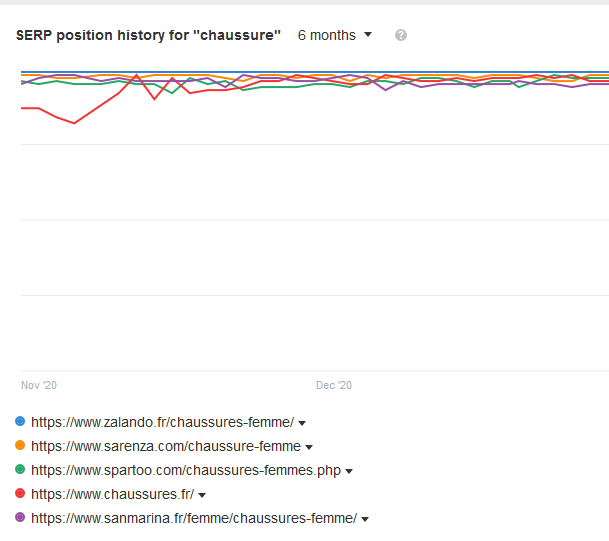
Moreover, by analysing the history of ranked pages, we can clearly see that Google identifies this intent as stable. You therefore definitely need to include women’s shoes for this keyword or include everyone.
Note: To quickly evaluate the overall search intent, you can analyse the different sections below your query:

Here we can see that people are searching for images of the famous garment and also to buy it, which is perfectly logical (sometimes it is not).
Optimising search intent
Now that you know what users are looking for in relation to your query, you will probably want to optimise for it to the maximum. Let us go!
1. Optimise the page content
After analysing your various competitors, the main idea is to gather the gaps of each to be as relevant as possible, then add your own experience. If one page does not mention a tip that its competitor does, and vice versa, combine the tips.
But it does not stop there. For example, if you are writing a tips article for “succeeding in business”, to improve the search intent you could add a paid training course “to succeed”. In addition to this, you will add links in your content on the same topic such as “Discover how our company generated €1M in revenue”. This is SEO-optimised writing.
Not only do you become an authority on the subject for Google, but you also offer the user additional articles to help them succeed and a product they may want to seek out. Then for this query you can also add an explanatory video and images in your content where you discuss the key points for success. So look at the query to understand:

In other words, if your content matches the search intent — by its type and format, with the right angle while also optimising the other intents of the query — Google will inevitably love you.
2. Questions that users ask
To be even more relevant, you can also answer PAA (People Also Ask) questions in your content:
If you also answer the questions asked in your content, you become much more relevant. Furthermore, this will allow you to increase your number of organic visits.
3. Making life simple and easy for users.
You can further optimise your ranking by giving your visitors an exact answer with absolute simplicity. From that point on, word count and keyword density in your content becomes irrelevant, regardless of the query.
You do not believe me? Let us take the query “mortgage”, a query that I think everyone will agree is competitive.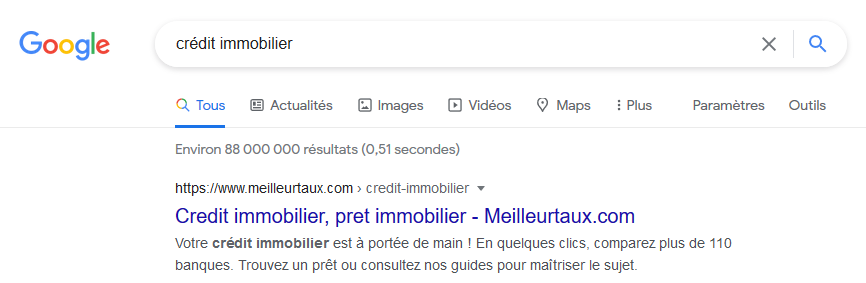
The first result on the SERP is meilleurtaux.com. When we visit it, the only text content present on the page is this:
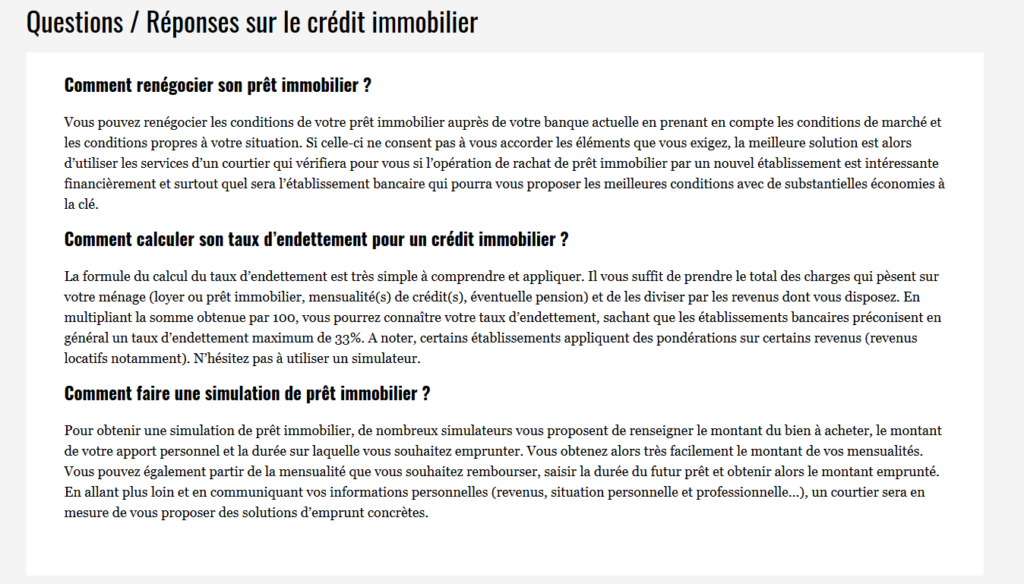
How does it rank? By offering quality content to the visitor right at the start of its page: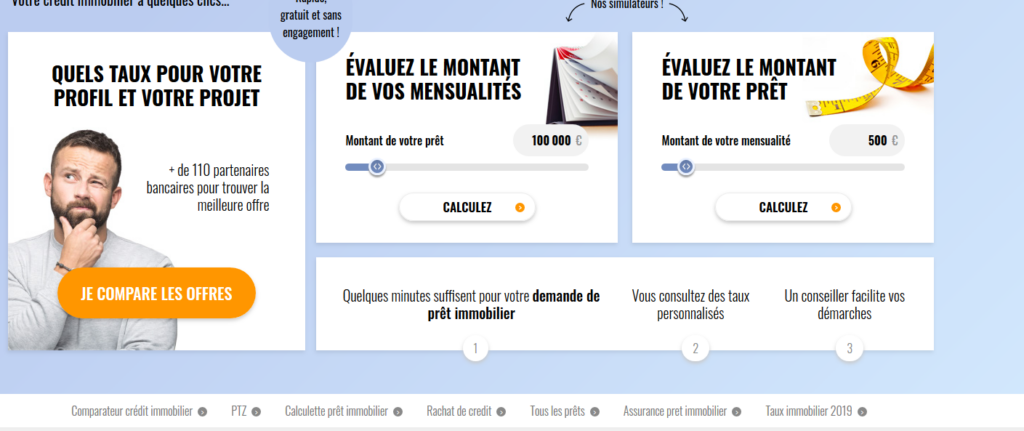
Is that not wonderful? You can directly calculate your mortgage based on your personal situation and needs. What use would text be when this interactive response is so much better?
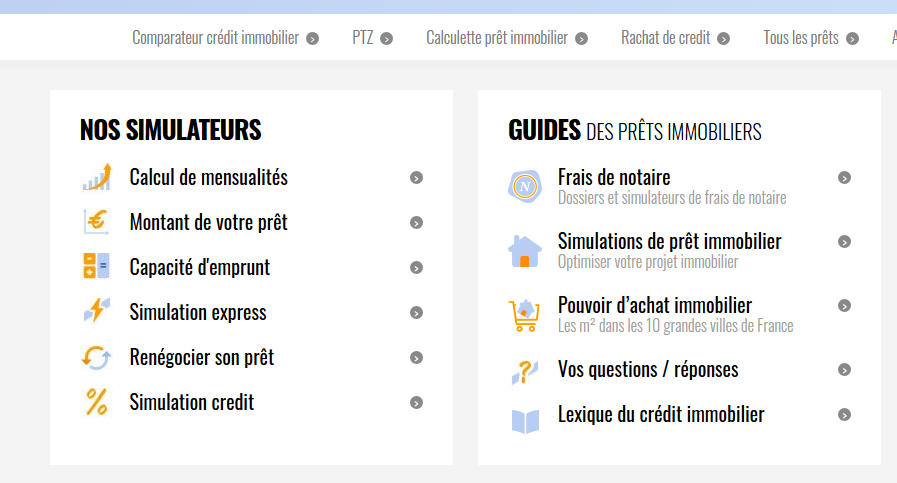
They have also optimised their internal linking. This way, any user can find additional help in the site’s complementary links.
The second search result is empruntis.com. This page has four times more text and also offers a simulator. However, the simulator can only be found by scrolling past text that users certainly would not want to read. Furthermore, it redirects to an external page instead of offering the simulator directly within the page content itself:
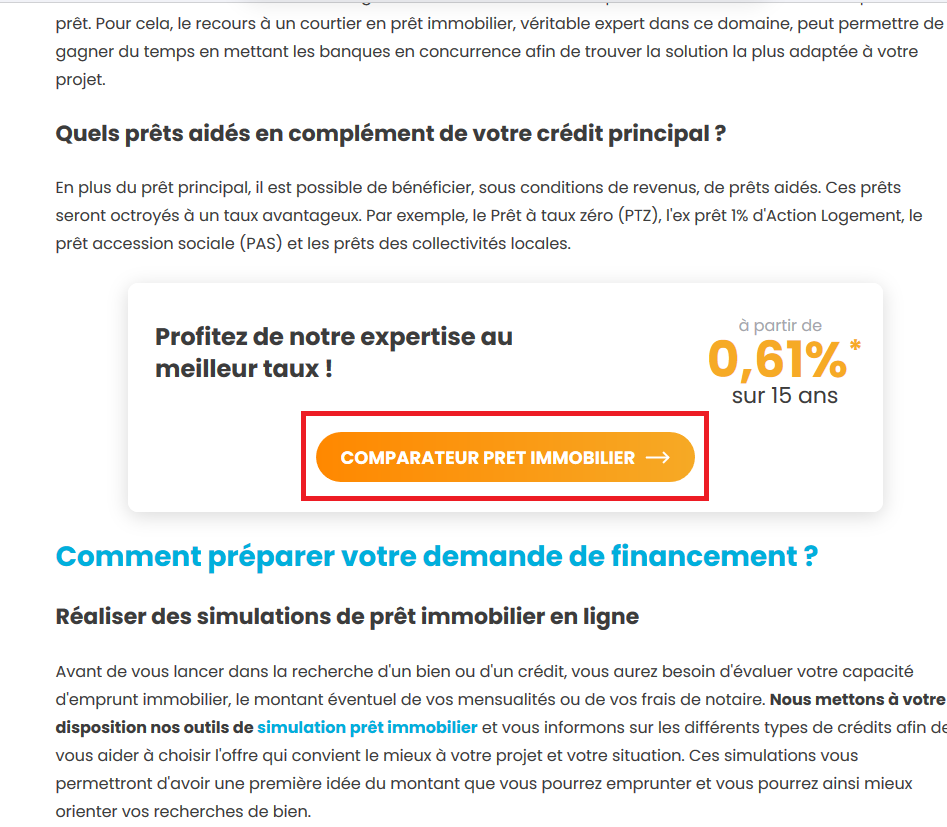
We are roughly at 20% of the total scroll of the page, so users do not have access to a quick and easy answer. Moreover, only the button refers to the comparison tool — not even the call-to-action title.
What I am trying to demonstrate here is that the ranking difference is very logical between the first and second result. Meilleurtaux.com has clearly done a much better job of helping the user compared to its competitors. They optimised the search intent.
However, do not think this is the ultimate answer. The query “mortgage” is very generic and should probably be kept simple for the average user, but if the query were “everything you need to know about mortgages” — the person probably wants to read more text than to have a mortgage calculator.
Note:
This reminds me that Ahrefs wrote a case study on their own experiences. They had created content that matched the search intent, for the query “backlink checker tool”.
They had therefore written a comprehensive article in addition to offering their paid tool for checking backlinks.
However, they seemed to be stuck in positions 6 to 10, while the fourth had 150 backlinks. Ahrefs had 25,000 backlinks and better overall SEO.
The only difference between Ahrefs and the others was that they did not offer a simple search bar to analyse backlinks right at the top of the page where you could directly insert and test your URL.
As you have guessed, Ahrefs placed a free backlink checker tool at the very top of the page and jumped straight to first position.

In summary:
On a moderately competitive query, if you do not match the search intent behind the keyword you are targeting, it will be impossible to rank for it. Building your content without first analysing the current search intent — and also the search intent relative to the position history — is very bad practice.
The goal of a search engine is to display the most relevant result possible. If your content has every possible keyword, hundreds of thousands of backlinks but does not match what users are looking for, it is useless. Moreover, understanding the search intent of a query is only a tiny part of the work as you will have understood. You should, if possible, then answer all possible intent variations — such as displaying a detailed guide plus a video, explanatory images, your paid training course and internal links on the same topic. In that case, Google can only idolise you. If you also add an interactive tool to your page rather than a boring landing page, the ranking belongs to you definitively.
Note: obviously, if you do not have a minimum level of backlinks, Google will not pay attention to you. Furthermore, you must also include “basic” SEO optimisations. Finally, if you are in a very competitive niche, your competitors will almost certainly end up optimising their search intent too, and if they have built more links than you, you will probably end up disappearing.
If you enjoyed this article, you will also love the SEO services we provide at createur2site! Feel free to share your thoughts in the comments!