
Automatic text generation and, more broadly, AI-assisted writing is becoming an increasingly common practice for SEO specialists.
Indeed, these very easy-to-use tools provide very good texts and allow you to gain productivity and ideas for SEO writing.
Moreover, some tools integrate SEO optimisation and not just an AI that generates text for humans.
Comparative tables of AI solutions for SEO:
htmlCopy
| Tool | SEO Spec. | Auto. | Key Strengths | Price |
|---|---|---|---|---|
| Claude.ai | ❌ | Partial | Editorial quality superior to GPT, excellent contextual understanding, original content | €20/month |
| Surfer SEO | ✅ | Partial | Article outline creation, WordPress integration, API available | $119/month |
| ChatGPT | ❌ | Partial | Content generation, keyword research | €20/month |
| YourTextGuru | ✅ | Partial | Semantic score, intent analysis, semantic cocoons | €99/month |
1. Claude.ai
Claude AI stands out as a particularly effective SEO tool thanks to its deep understanding of natural language and its ability to produce high-quality content. Unlike GPT, Claude excels at writing optimised texts, with a better mastery of context and greater precision in the choice of relevant keywords.
For SEO, Claude can analyse search intent, structure content optimally, and generate texts that precisely address user queries. Its ability to produce original, informative, and natural content contributes to better positioning in search results.
The tool also helps with creating compelling meta descriptions, optimising titles and subheadings, while ensuring appropriate keyword density without compromising editorial quality. This versatility makes it a valuable ally for any effective SEO strategy.
Advantages:
- Very powerful
- Very competitive pricing
Disadvantages:
- Tool not specifically dedicated to SEO
2. Surfer SEO
The AI dedicated solely to automatic content generation, exclusively for SEO. But not fully automatic.
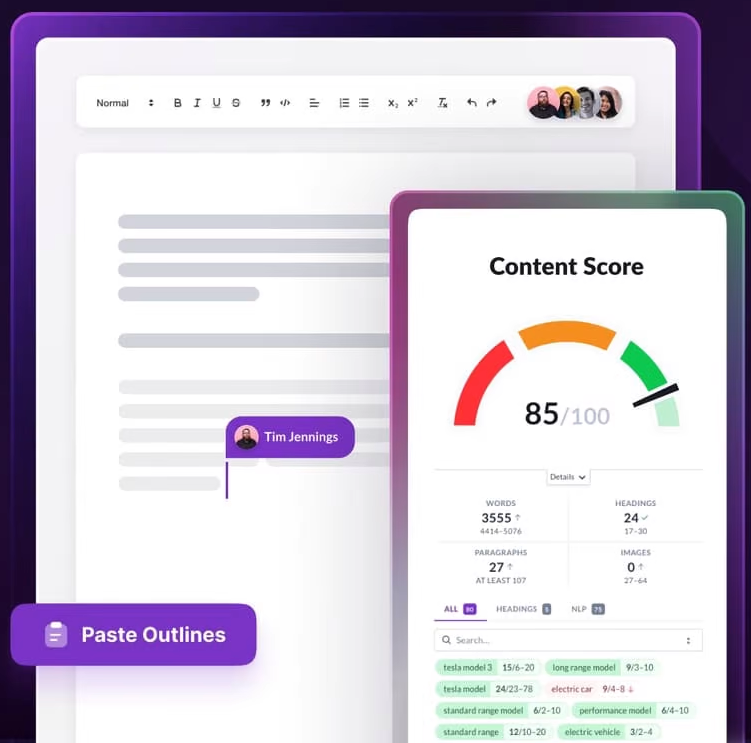
Surfer can help you with:
- Creating content
- Building the article outline in a few minutes
- Getting content suggestions that will improve your ranking
Moreover, Surfer allows the integration of tools to improve your efficiency:
- Share instantly with Google Docs
- Push optimised content directly to Google Docs for rapid collaboration.
- Publish in minutes on WordPress
- Easy integration with the Surfer API — Effortlessly integrate your product or internal workflow with Surfer’s API and benefit from major AI-based data gains.
Advantages:
- Very powerful
- Competitive pricing
- SEO specialist tool
3. ChatGPT
ChatGPT can be used to improve natural SEO strategies by generating quality content for websites. By using ChatGPT’s linguistic and contextual knowledge, SEO specialists can produce search-engine-optimised content that is also interesting and useful for readers. In addition, ChatGPT can also help identify relevant keywords for a given web page, and much more. Do not hesitate to consult the guide on the best ChatGPT prompts for SEO.
Advantages:
- Powerful
- Very competitive pricing
Disadvantages:
- Tool not specifically dedicated to SEO
4. YourTextGuru
Originally YTG is a tool that analyses the relevance of content by calculating a semantic score based on the number of occurrences of one or more targeted keywords. In short, a tool that tells you which words to add to appear more relevant to Google’s eyes in order to improve your SEO content.
While indicating dangers and a detailed graph:
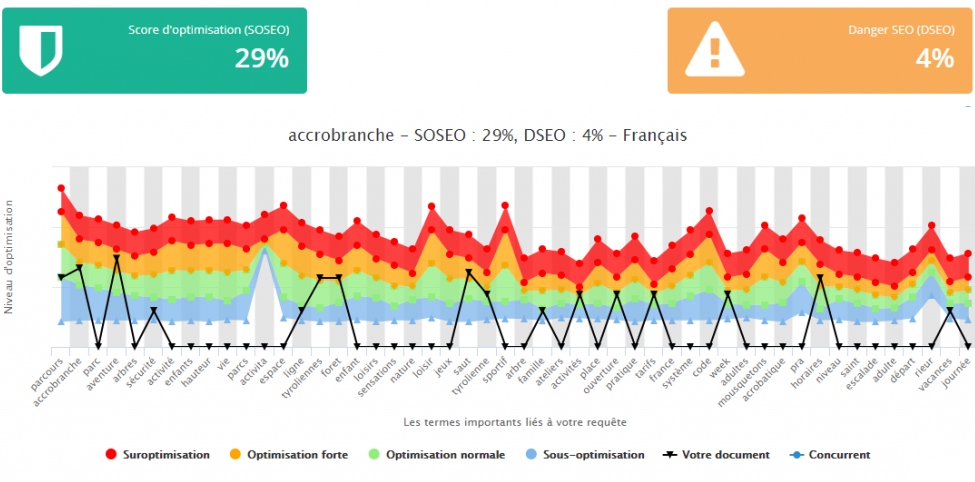
Incredibly powerful, this tool now allows automatic content writing called SEO-TXL while producing optimised texts with their semantic optimisation algorithms.
Note: the YTG tool also allows you to analyse the search intent of a query, analyse competition, find content ideas, build semantic cocoons, find compatible entities, or suggest PAA (People Also Ask).
Advantages:
- Powerful
- Tool specifically dedicated to SEO
- Competitive pricing
Disadvantages:
- Laborious content generation