
Google’s success lies in displaying relevant results when you suggest a query to it. You know what follows from that? Content is king — you must offer the best content for internet users, because ultimately pleasing internet users means pleasing Google. But be careful: it is not enough to create good content, you must also optimise your SEO content.
What Is SEO-Optimised Writing?
SEO-optimised writing allows an article to rank in search engine results such as Google’s, thereby generating traffic for one or more keywords.
This involves several criteria, such as well-thought-out and well-structured creation and the use of tools — both upstream and downstream. However, do not believe that writing must only be constructed to impress Google — the article must be perfectly coherent in the eyes of internet users and natural.
How to Write an SEO-Optimised Article?
SEO writing consists of analysing and integrating search engine ranking before the content is even created — otherwise there is no point. Or you are simply not writing articles to have them ranked.
You must first analyse the keywords you would like to target so as not to write content that nobody searches for. You must then analyse your competitors and define search intent so as not to write an article that nobody wants to read.
Then you must write accordingly.
Here is the step-by-step list for writing a perfectly SEO-optimised article:
- Keyword analysis / competitive analysis
- Understand search intent → Analyse search results
- Define your meta title and meta description
- Structure your articles with keywords in H1, H2, H3… tags
- Write your content with internal linking in mind
- Add images, videos, PDFs
1. Choose a Keyword and Stick to It
When writing an SEO-optimised article, it is important to choose the keyword you are targeting and stick to it. However, it is important to analyse a keyword and not follow one at random.
Just because a keyword you type into Google displays results corresponding to your query does not mean that keyword is searched for. In fact, if you do not analyse the volume potential of a keyword you have chosen, it is highly likely that you are writing content for nobody.
2. Choosing Your Keyword Well
To find the right keyword, it is essential to thoroughly analyse the different search volumes relative to competition. If the keyword is searched for a lot but your site does not have authority on Google, it is pointless to try to position yourself on a competitive keyword since you will not be able to get above your competitors.
You have 2 excellent tools for consulting these metrics:
SemRush keyword overview — the keyword analysis tool by SemRush:
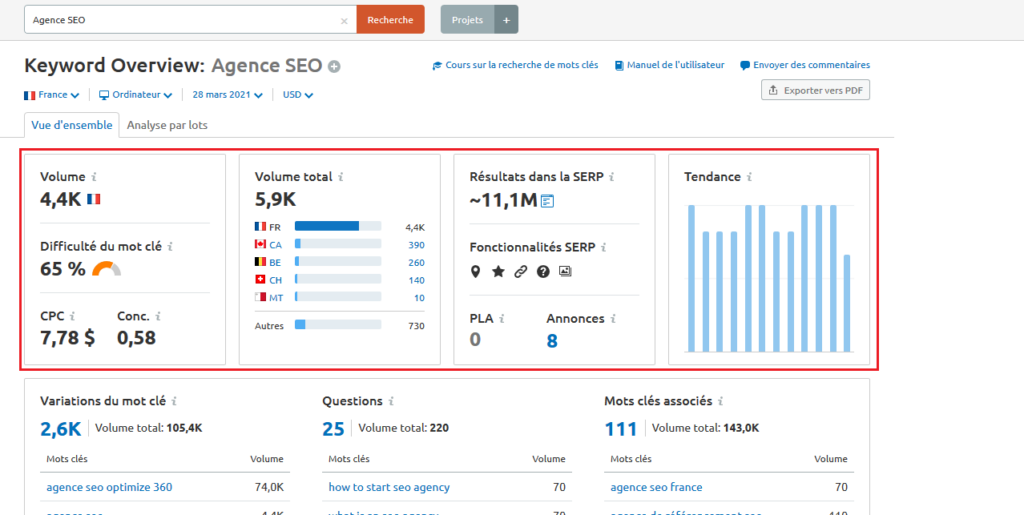
SemRush is surely the best tool for analysing a keyword and finding the right ones, with keyword ideas, questions, trends etc. in addition. However, you will need to create a SemRush account and the number of searches will be limited if you do not move to a paid plan.
Otherwise, the less powerful but less constraining alternative is Ubersuggest. The tool also has a paid version but no registration is required and you will quickly be able to see whether your keyword has good potential:

3. Writing with SEO Tools
Let us get to the heart of the matter. The most enticing aspect is undoubtedly the use of tools to enhance the relevance of your content, as they are very interesting. The general purpose of these tools is to add synonym keywords of your starting keyword to increase your ranking chances. This also avoids redundancy and enriches your text semantically — something Google greatly appreciates. I am going to present SEOQuantum, which is ideal for writing articles and very easy to use. The tool is primarily free; we will not go in depth into its paid version.
SEOQuantum
SEOQuantum is a tool dedicated to writing. It is packed with very interesting features such as:
- Understanding “basic” search intent
- The keywords to include in the title tag and the H1 tag
- The complete content structure, even suggesting your other heading tags
- The top keywords to include on the page
- The questions internet users ask for your keyword.
- The average content length for the query.
- Verbs, entities to incorporate in your text
- …
These data points should be taken into account before even creating the first words of your articles.
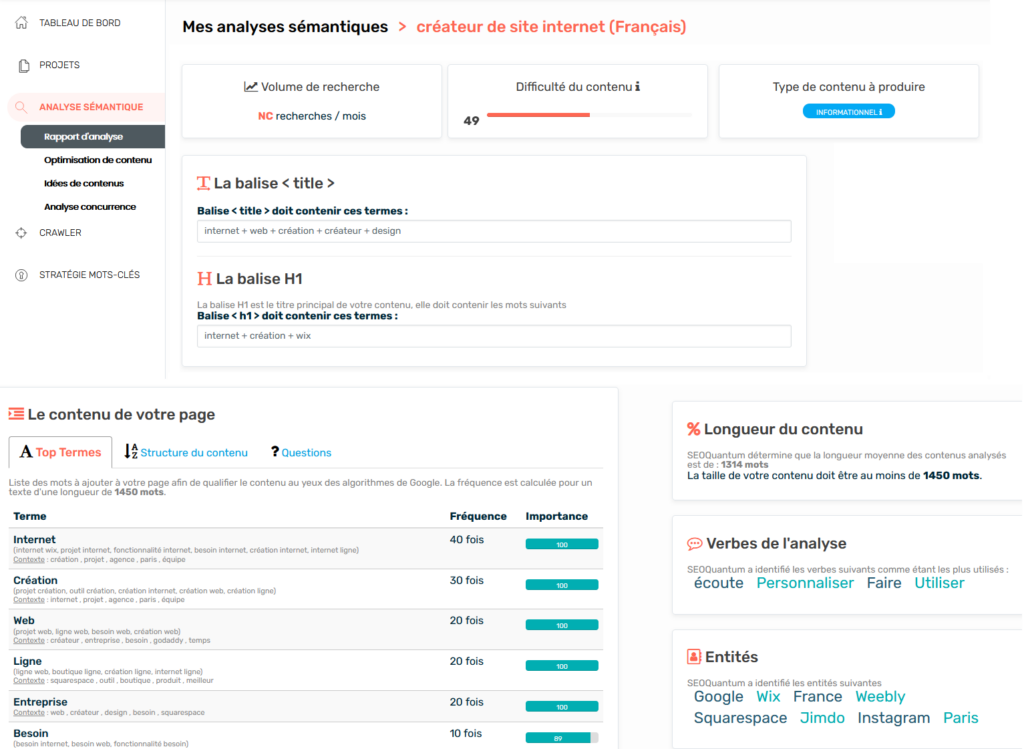
The tool also offers semantically close article ideas to improve the relevance of your articles in relation to each other, even offering the visualisation of a semantic cluster by priority order exportable as a mind map:

Then below it gives more information for these article ideas:

Note: As you will see later in this article, having semantically close articles is perfect for optimising your content.
The tool also offers keyword suggestions and many other things by inserting its URL or its content directly (similar to 1.fr) — ideal for optimising your content again after writing it.
It also offers competitive analysis showing the heading tag architecture of the first SERP, the number of words specific to each, the global topics, a score and much more. And that is not all — it also offers a crawler as well as “create a keyword strategy”. In short, the tool is very comprehensive and very good for optimising your content and writing your SEO-optimised articles well from the outset.
To optimise your processes, I strongly advise you to go and consult the article on content generation with artificial intelligence for your search engine ranking.
4. Concretely, How to Use SEOQuantum for Your Writing?
When you analyse a keyword, take all its suggestions and place them in your text document!
- Place the meta title and meta description suggestions
- The complete heading tag architecture (which you can refine later)
- The content ideas + entities to mention
- Integrate the questions (then answer them when writing)
- And many other things
You can then keep the tool in the corner of your eye, so that when you write you can, for example, place verbs different from those it suggests. You can also check your final article by placing it in the content analysis tool.
5. Understanding Search Intent
Optimising search intent is probably one of the greatest factors for successfully ranking your pages.
Search intent corresponds to what the internet user wants to find after a Google search. For example, if they search for “SEO tool”, the search intent is probably of the “informational” category — they therefore expect to see an article describing the best SEO tools.
Search intent is often natural, but this is not always the case. Sometimes internet users do not really know what they are looking for and it is imperative to check the first pages of search results to determine search intent.
If your competitors all frame their articles like this: “The best SEO tools” (purely hypothetical), you should not offer an article with a different angle. Google has described the search intent as a list of tools, and if you do not match the search intent — for example by writing an article “SEO Tools Tips & Tricks” — you will have no ranking potential on the search engine.
Note: By using SEOQuantum, you are less likely to fall into the trap by directly using the correct format, type and angle for SEO-optimised content.
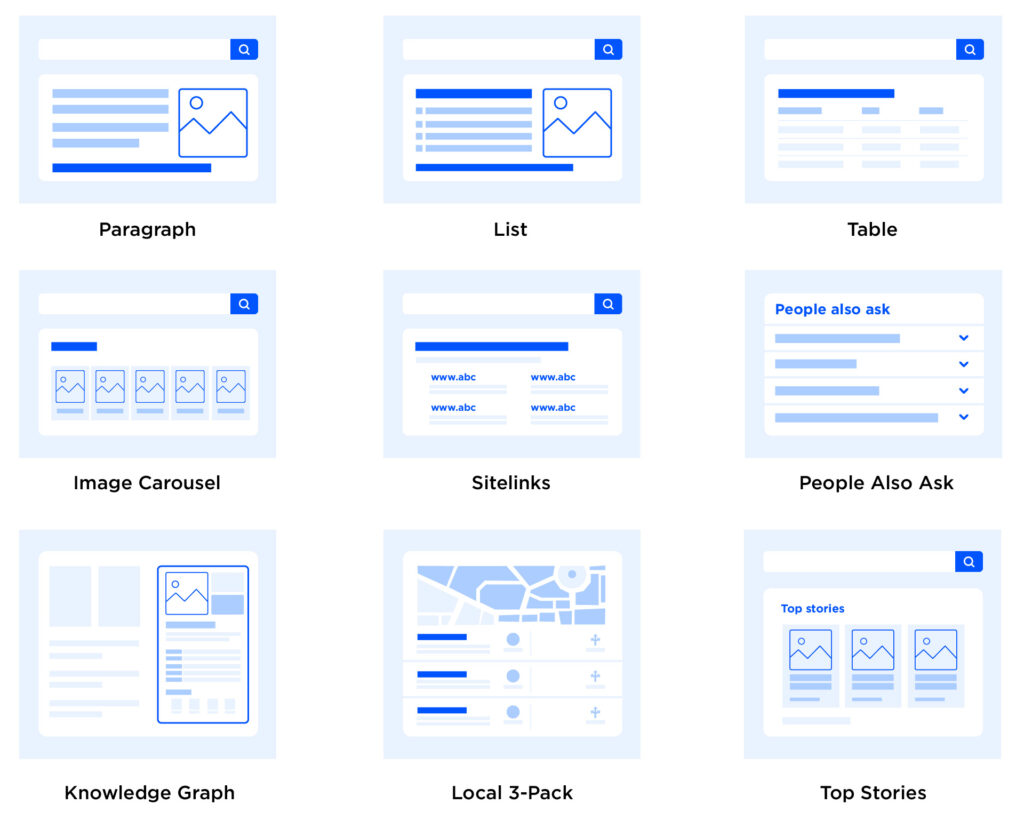
Optimise Your Content for the SERP: Featured Snippets
We have already talked about People Also Ask — “frequently asked questions” — however you can multiply your visibility opportunities by taking into account the other types of featured snippets (rich snippets) to increase your click-through rate to your article. It is also important to bear in mind that if your article is well positioned, your site will be more attractive than that of your competitors by not being a simple link.

Concretely, use bullet lists, tables, paragraphs, complementary links, carousels for your products, and answer the questions that internet users are searching for.
7. Respecting H1, H2… H6 Title Tags
H(n) title tags such as <h1>, <h2>, <h6> are there to hierarchise your content, and Google takes them into account to determine whether your content is correctly hierarchised and logical — which therefore improves search engine ranking.
The H1 title tag is the most important — take advantage of it to place your targeted keyword(s). In any case, do not overdo it — Google detects when you place your keywords everywhere on all your headings. You can optimise it but make sure it remains at least minimally natural. The ideal is to place co-occurrences on secondary tags.
Here is an example of a title tag architecture:
H1: Your keyword + hook (use only one).
… content …
H2: Explanation of a main characteristic of the keyword
… content …
H3: Sub-explanation that expands H2 with a specific characteristic
… content …
H3: Another sub-explanation that still depends on H2 but with another specific characteristic
… content …
H4: Sub-explanation of the sub-explanation of the last H3
… content …
H2: Explanation of another main characteristic
etc.
Do not write long blocks of text that one does not want to read. Title tags allow you to segment your content but also improve the user experience. Do not hesitate to use headings quite often. It is better to use too many than not enough.
8. Producing Epic Content
When you write content for a keyword, it is imperative to try to produce the best content. There is no point in creating an article as good as, or slightly worse than, those already existing — whether for internet users or for Google.
Therefore, create the best possible articles with epic content. Do not hesitate to write comprehensive guides by filling in the gaps between your competitors, then add extra tips (from your own experience, for example).
9. Content Length
Content length never finds consensus. Some say you need content of 5,000 words, others 2,300, etc.
In reality, the size of the content must depend solely on search intent. If your targeted query is “complete guide”, obviously produce long content. If it is a quick piece of information like “president of the republic”, produce short content presenting all the recent presidents (fewer than 300 words).
You can, for example, use SEOQuantum to see the number of words in each piece of content on the first SERP — this way you will obtain the right content length value you need to produce.
As a general rule, aim for at minimum 1,250 words for blog articles. Otherwise, if you are unsure, a good indicator for knowing whether you have too many words is when you start writing sentences with no substance.
10. Duplicate Content
If you borrow too many ideas and sentences from your competitors, Google will describe the first piece of content as the original. This means you will probably have no chance of being placed in search results. Technically, duplicate content is taken into account from the crawl stage — so you will not even be indexed in the search engine. Therefore, offer something unique — you can borrow ideas, but ideas only.
11. Internal Linking: Links
An internal link is simply a link (href) that connects to another page on your site.
When you build your content, you must take into account the articles or pages already created on your site. If you want to be in Google’s good graces, it is important to show it that you have authority in the field. By placing internal links in your content that cover the same theme as that content, you increase your relevance in Google’s eyes and the user experience. For example, I have an article about SEO writing: within the article I place an internal link from my complete guide on keyword analysis when I touch on keyword analysis.
If you want to go further, read our article on internal linking optimisation.
12. Images & Videos
When writing your SEO article, it is important to include images and videos (your own) to improve the relevance of your content, but also for the user experience and search intent.
For example, if you want to rank for a keyword such as “most beautiful dress”, you will probably create an article with the best dresses, and the search intent is to see images. But ultimately, almost every query has more or less an image and video search intent.
13. Alt Tag, Titles, Description
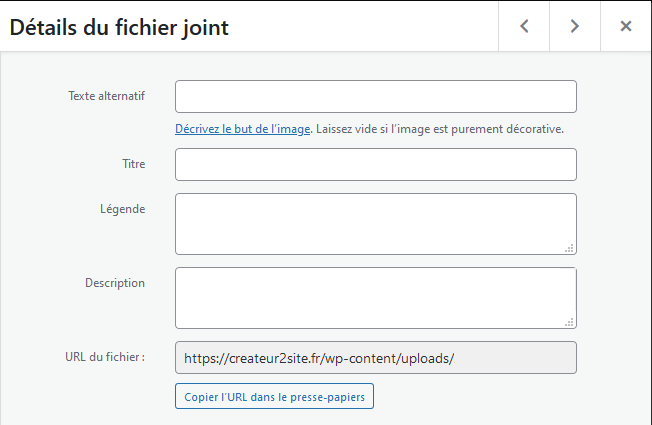
To optimise the SEO of your images, it is important to include an alt tag, title, caption and description.
If you use WordPress, simply go to “Media”, then select your image. You will then have all the SEO parameters for that image:
14. Title and Meta Description
Finally, it is important to include a title and a meta description for each of your articles. As a general rule, the title is taken from the H1, or even identical to it. Definitely do not do that. Write a title that attracts clicks.
The meta description meanwhile must briefly describe your article. Placing your main keyword will allow it to be displayed in bold in search results.
If you created your site with WordPress, simply install a plugin such as Yoast SEO. Then go to your page and click on edit. All you need to do is go to the Yoast settings and add your title and meta description:
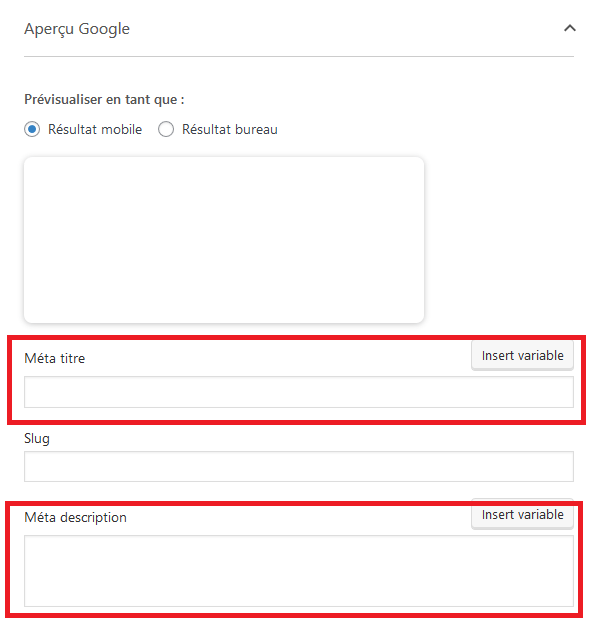
Note: saying “title” or “meta title” is fine. We say “meta title” to simplify comprehension, but it is like saying you are eating a Greek when you mean a kebab, or “chocolatine” when it is actually a pain au chocolat.
15. The Slug, the Article’s URL
A final note: it is important to give a short URL to your articles. As a general rule, simply using the targeted main keyword is more than sufficient for the name of your URL, example: /seo-writing/ .
- Use the targeted main keyword
- Lowercase and without accents
- Use the “-” character as a separator
- No numbers / dates
- Short URL!
Summary on SEO Writing:
Now that you know all the best practices in natural search engine ranking, all that remains is to write an article “normally” while taking all these parameters into account! When writing an SEO text, it is better to include directly in your text — in Word, for example — the title, meta description, internal linking with the precise details of the URLs that will need to be linked, etc. Be organised.