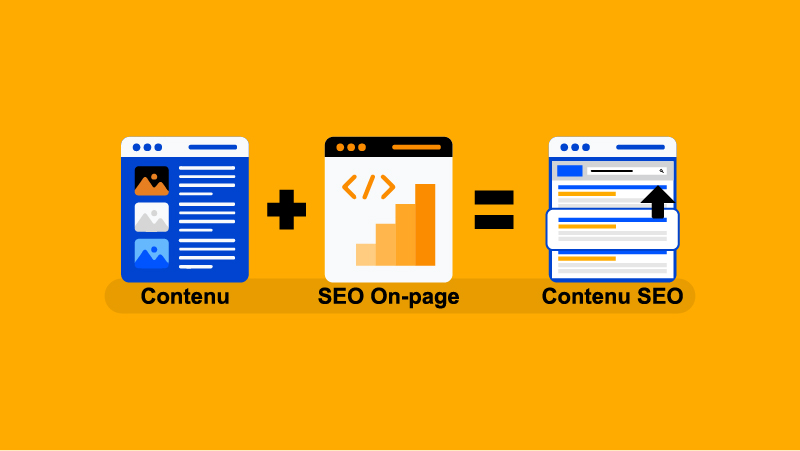
In SEO, they say content is king. Creating SEO-optimised content with good semantic optimisation and a solid structure — notably with H1, H2 tags — is different from simple writing. If you write content without doing it for SEO, you will not be targeting keywords and you will not be visible.
What is SEO content?
SEO content is, simply put, content designed to rank in search engines like Google.
You might think that all content is SEO content, but that is not the case. A lot of good content is simply not visible. For example, I have written a comprehensive article on off-site strategies (also called off-page), which, with a bit of luck, could bring me around twenty visits per month if it ranks very well according to SemRush. It was important for me to write it. There is a lot of content like this out there.
Does that mean the article is doomed to fail?
Not at all. It brings information to the SEO community and is a logical follow-up to my articles, not something intended to rank in Google.
It is also important to note that any type of content can be “SEO content”: product pages, landing pages, interactive tools and even videos. But most people talk about “SEO content” when referring to blog articles.
That is why we are going to focus this guide on that.
But before talking about how to write articles that rank, let us make sure we understand why this type of SEO content is important.
Why is SEO content important?
No matter what your business does, you can only obtain a limited amount of organic traffic towards your “money pages” (also sometimes called “landing pages”).
My three main landing pages, and a few other landing pages, account for barely 2% of my potential traffic. Beyond this, a lower traffic volume can bring more prospects than a sales page with a lot of traffic.
For example, very short and simple words like “CBD” (a short-tail keyword) get a ton of traffic but most will be curious people who will not take action.
Conversely, there is a much greater chance that an internet user searching for “Nike shoes” or even “Nike Air Max Plus 3 shoes” is completely in buying mode, since they are searching for something specific that they will therefore very likely purchase. That is why targeting broad keywords with a lot of search volume is not always relevant.
This can also work with blog articles. Your potential customers do not always search directly for your products or are probably not even aware of them. If you build an article on “sleeping well / anti-insomnia” and you are a CBD company, it is possible that with your article “How to succeed at sleeping” you could obtain many more sales than with a short, generic keyword like “CBD” which has a ton of search volume, the majority of whom are “curious” and not in buying mode.
How to create SEO content that ranks?
The most effective way to write perfectly SEO-optimised content is to apply best practices from the outset. This is, incidentally, the subject of my article on SEO writing.
If you want to improve your already-created SEO content, then you are in the right place!
Note: Here we go much deeper into content optimisation.
Let us look together at the 6 (major) steps for writing SEO content that ranks.
1. Keyword analysis
If you do not analyse the search volume / traffic potential of a keyword using tools such as SemRush, your SEO articles will be useless. Why? Well, simply because otherwise you are not producing SEO content. It would be a shame to create articles for a word that internet users are not searching for. Otherwise, your optimisations do not matter.
When you optimise content for SEO, it is essential to keep a guiding thread on your target keyword throughout your content. The main keyword you are targeting must reflect your entire content!
When you analyse a keyword and its traffic volume, take the opportunity to analyse the keyword in more detail and target an achievable query for yourself by choosing a keyword difficulty consistent with your site’s authority. If your site is new and has few backlinks, you should target low-competition queries.
2. The 3 best tools to optimise SEO content
Let us get to the heart of the matter. The most appealing aspect is undoubtedly the use of tools to increase the relevance of your content — and for good reason, they are very interesting and easily actionable. That is where we are going to start.
If you have already written your article and want to optimise it, the main advantage of these tools is to add keywords that are synonymous with your initial keyword, thereby increasing your chances of ranking. You simply need to sprinkle your content by adding words. This also avoids redundancy while enriching your text semantically.
SEOQuantum
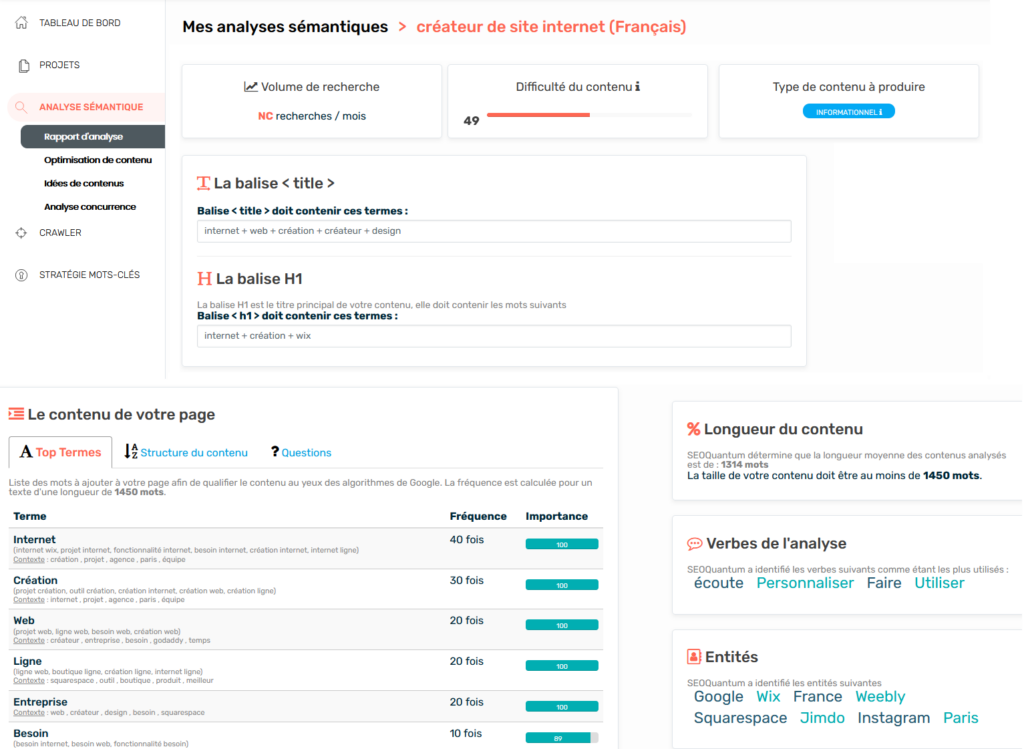
SEOQuantum is a tool that suggests many things to improve your content for SEO.
The tool is really comprehensive and has a multitude of features:
- Determines the search intent
- Keywords to add in your text.
- Keywords to include in the meta title and the H1 tag
- Content structure to adopt (suggests title tags with its architecture H1, H2..).
- Allows you to visualise the frequently asked questions that internet users ask (PAA).
- Average size of content length for the query.
- Main verbs and main entities to include in your text
- … and… a multitude of additional parameters impossible to list for optimising your content.
Another thing that could improve your content: optimise the semantics by building internal linking around it. The tool thus offers ideas for articles to improve your text semantically and even suggests a semantic cocoon exportable as a mindmap:
The tool also allows you to analyse your content with a score that aggregates factors, just as 1.fr or YourTextGuru would do.
Note: recently, SEOQuantum has also added automatic text generation with artificial intelligence.
Yourtext.Guru
Yourtext.Guru is a true heavyweight for optimising your texts. It gives several scores to your texts such as the optimisation score and the over-optimisation score (SEO Danger).
YTG will display a precise graph to guide you: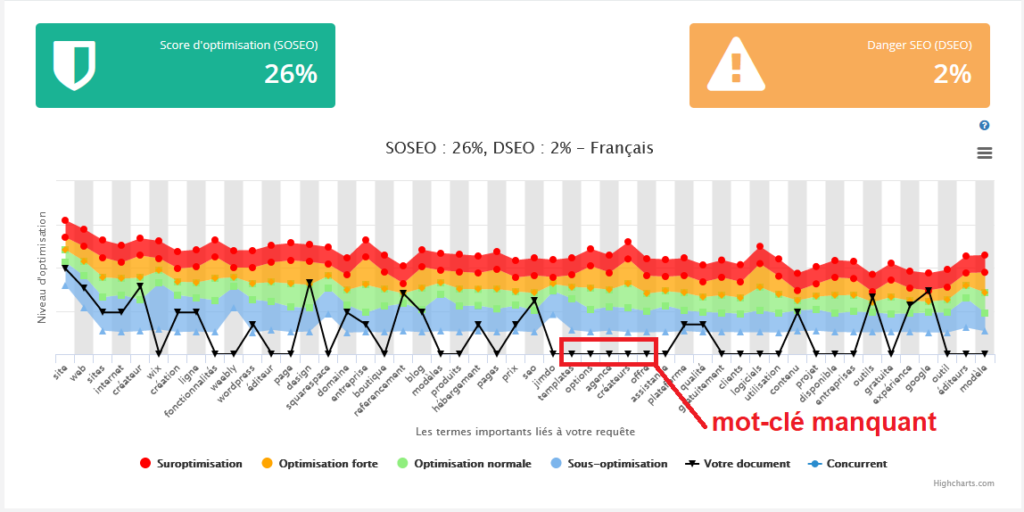
The tool also provides a semantic analysis of the search intent for your content compared to that of the SERP:
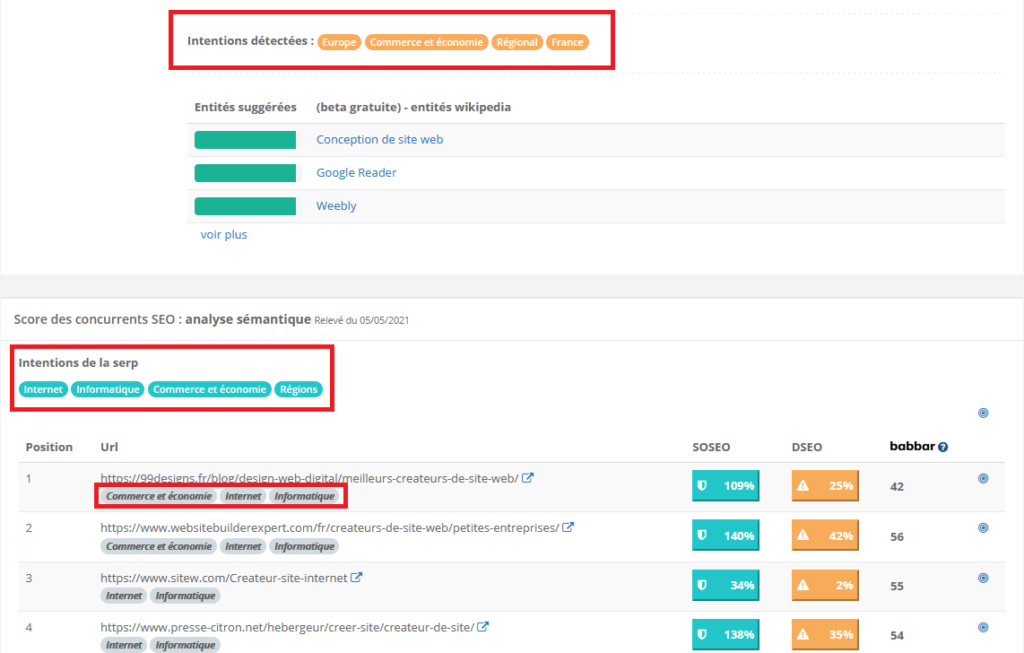
The tool also provides an overall popularity index of competing domains, suggested keywords and other things.
Note: recently, YTG has also added automatic text generation with artificial intelligence. Based on their algorithm, you can choose the strength of semantic optimisation for text generation by the AI.
Want to discover the best content generation tools for SEO?
1.fr
1.fr only suggests the addition of words it has determined as relevant to the query. It also gives you a score to determine how well your content is optimised. You can then add keywords until you obtain a recommended optimisation score of 80%.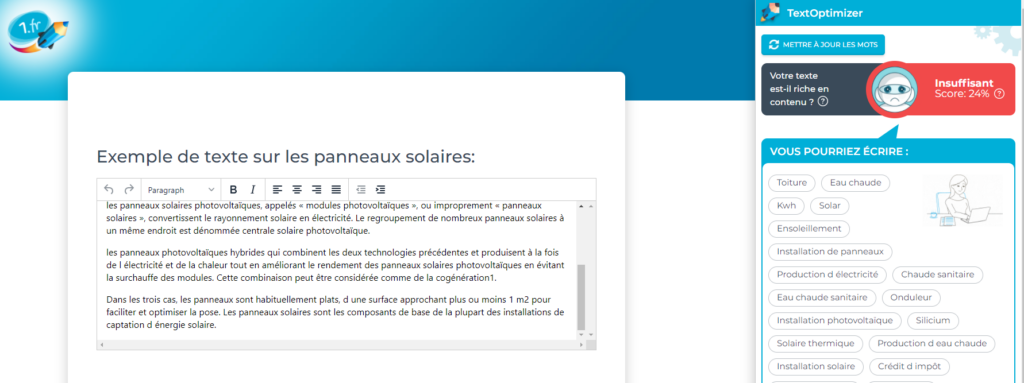
Note: Very fast in use. I recommend it as a complement to SEOQuantum or YTG since it goes less far in the analysis but is cheaper.
The foundation of everything: search intent
When you want to optimise content, you must first understand the search intent of the people who are going to search for your keyword. You have to think about what the internet user is looking for, because Google is extremely good at understanding what an internet user really wants.
This is why, if you write a buying guide for a transactional keyword, your content has very little chance of ranking.
To determine the search intent of a keyword, the easiest thing is to search for your keyword on Google and analyse what types of content you find. The type of content presented corresponds to what Google has determined that users want:
Content type
The content type corresponds to the type of pages that are presented:
- Blog Article
- Product page
- Landing Page
- News
- Something else…
If the content type is not mixed — for example if there are only blog articles ranking for the query you want to target and you want to place a product page there — it is important to revisit your keyword or your page.
Content format
Which pages rank the highest? Do not take into account the 7th or 8th, stop at 6 and look at its format. Is it a guide, a list, a review, tips, or something else?
Content angle
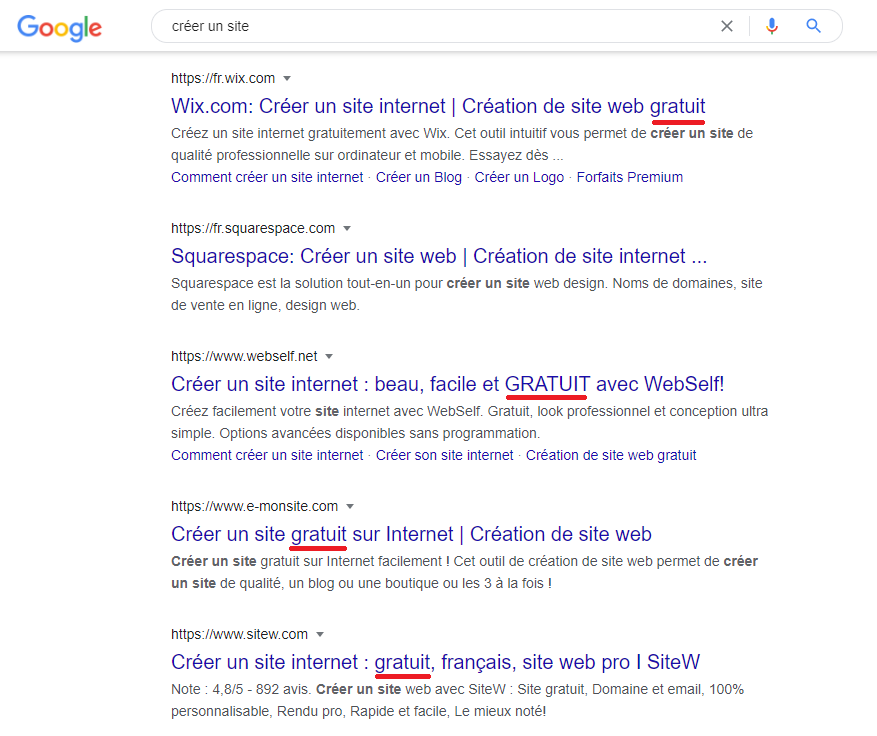
The angle represents the guiding thread within the format. For example, an angle might be speed and simplicity. For the keyword “create a site”, most results have an angle around free of charge:
3. Ranking content is good content
What better way to optimise your content than to write the best content in the entire SERP? Google is intelligent — if you offer the best article for internet users, you offer the best article for Google. This obviously involves writing an article around the search intent, and then offering epic content on it. There is absolutely no point in writing an article that is poorer than those of your competitors who are already positioned.
Note: It is good to add many keywords to increase the relevance of your text — this allows you to optimise the position of your page on Google. But above all you must think about search intent, the quality of your article, and write around a keyword.
SEO-optimised content is long content
If you write 500-word articles, unless your site has a great deal of authority, you will not be visible in the results. My old home page had around 400 words and ranked for a competitive query such as “web creator”. So yes, I am contradicting myself, but in reality it depends on what you offer.
This query is both informational (article on the best site creators) and transactional (finding a site creator to do it for you), my page is transactional — it is a landing page, not an article. The difference lies here: if my page were an article, I do not think for a second it could rank in search results with 400 words. It is important to maintain a certain logic. If you are targeting a transactional query like a product, no one is going to want 5,000 words describing your product.
Overall, 500 words remains risky because Google could consider the content as spammy, thus giving you indexation problems.
As for articles (informational query): on average write an article of 1,250 words but it is possible to write an article of more than 3,000 words as well as 300 words. It is neither all black nor all white. What is important to keep in mind is search intent. The vast majority of pages on definitions have content of under 300 words and rank very well. Nobody wants a 1,250-word definition.
Nothing is fixed and you must adapt to the search results already present because ultimately that is what Google has judged as relevant. All the tests of your competitors, and therefore the pages that rank, have already done the work for you. It is possible to offer something different, but your chances of ranking will be more limited.
Drawing inspiration from your competitors for your content
Your competitors are a goldmine for getting good content that will rank on search engines. But this does not mean that you should imitate them word for word: good content is something that will bring added value to your internet users.
You can take ideas, concepts, average the text length of each of your competitors, but you must not copy. This is, incidentally, called duplicate content and Google can analyse whether your content is too similar to another. Since the competitor is already positioned, it will take their content as the original content. So there is no question of copying your competitors. Inspiration and copying are opposites.
4. Optimising content for the SERPs
When you want to optimise content, it is also important to optimise it for the SERPs through the featured snippet. These are rich results or featured extracts, search results that do not look like simple links and that present a part of a page’s content.
Why? Thanks to rich snippets, you will obtain more pixels in search results, thus improving CTR. CTR is a ranking factor due to the Learning to Rank algorithm.
If it is a transactional query, your products could be displayed among your competitors in product carousels; if you have bullet-pointed lists, the list could be directly displayed in the results, etc.
Here are the different featured snippet possibilities:
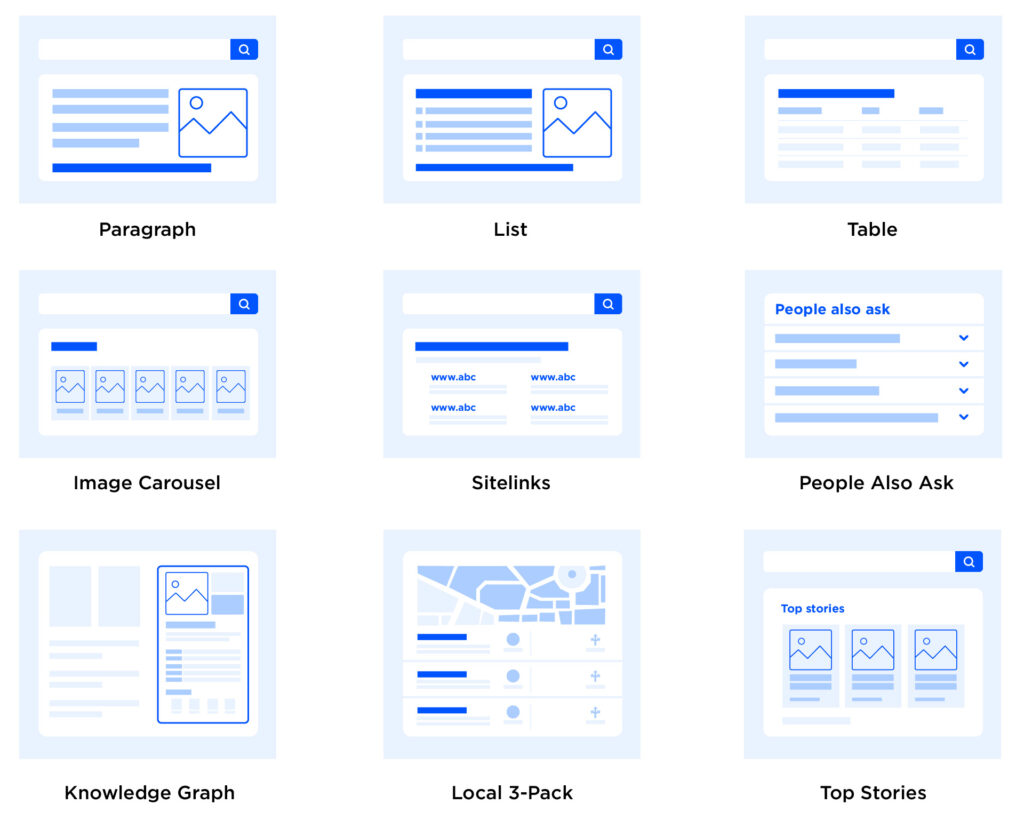
More concretely, the PAA for “People Also Ask” allow you to enrich your content. You find them when you perform a query on Google.
It is always interesting to include them in your text and answer them to increase the relevance of your text.
Internal linking
Internal linking consists of placing links to your own pages within your content. Think of it like this: who is related to whom and why?
As you will have guessed, this is how you optimise your content.
If you write an article on “the most beautiful shoes for women”, ideally you should link to “Top heeled shoes”, rather than to “Men’s shoes”.
Some on-site SEO to optimise your content
When we talk about SEO of any kind, there is always on-site, off-site and technical SEO. In this post we are going to focus on the “classic” on-page optimisations that you must apply to each of your articles.
Title tags <h1>, H2, H3, H4…
Do you respect title tags in your content? Are they organised and do they maintain a certain consistency? It is important for your users and for the search engine to have organised and well-used title tags. If you wonder whether your title tags follow Google’s guidelines, you can go to the WebRankInfo site (https://www.webrankinfo.com/outils/balises-h1-h6.php).
Meta title and Meta description
The meta title and the meta description are the texts that will be displayed in search results. It is important to include them for your articles.
If it is an “SEO optimisation”, note that they have no direct ranking factor. But remember, Learning to Rank evaluates your CTR, which is a ranking factor.
You may have already guessed, but if you want to optimise your site’s SEO with these tags, you will need to optimise them in the sense of making them attractive.

Optimising images: Alt tag, titles, description, caption and image weight
To optimise the SEO of images present in your text, it is important to include an alt tag, a caption, a title and a description. You can even include a good image format in terms of weight such as jpg and if possible .webp. Indeed, optimising page speed is already an SEO criterion for Google search results. This speed factor comes from the page experience.
Writing clean URLs
It is important to have short URLs, especially for user experience and display in the SERPs:
Simply reuse your main targeted keyword in the URL: without accents and with a hyphen.
Final word: a good SEO article is complex and time-consuming to produce. Think about it and do not focus too much on the time it will take you but rather on the time it would take you to have to go back over it if you did not do things correctly from the outset.