
Keyword research is crucial for a successful SEO strategy. To do this, it is essential to know a few best practices in SEO such as search intent and how to properly choose your keywords by knowing how to use the dedicated tools. If you apply all of these practices, you will have completed a large part of the work needed for a successful SEO strategy!
Why is finding the right keywords so important?
If you do not analyse the potential of keywords upfront, you cannot guarantee a good daily volume of visitors to your website. This is because some keywords you might think of will not have the same search volume as others.
Take the example of “create a website”. It gets 15,000 monthly visits on Google, whereas if you targeted the keyword “create a professional website” without analysing it first, you would not know that it only has 40 searches per month.
As a result, you miss out on considerable traffic. It is therefore essential to target the right keywords that users are actually searching for in order to receive traffic to your site. If no one is searching for what you write about, you will not get any traffic regardless of your efforts.
But it is also important to analyse the competition for a keyword — some may be too competitive for you to target, which is probably a waste of time.
In most cases, the keywords with the highest volume are the most competitive, but not always. If you do real research and analysis, you can find niches — keywords with a lot of search volume and little competition.
What is keyword research?
Keyword research is a crucial process for understanding the language used by your potential target customers when they search for your products, services or articles. What you think people search for is not always what they actually type into search engines.
Is this keyword truly relevant for you?
It is also important to correctly choose the keywords you want to target based on your offers.
If you are a business that sells services or products, you should target keywords that are related to your business and attract potential customers.
For example, HubSpot creates articles such as “famous quotes” even though they sell marketing services. Obviously those articles do not attract prospects. Moreover, users will not associate what the company does and the consistency of their brand becomes blurred.
Look — they have 5.7M monthly organic visits (SEO):
5.7M traffic is great, but they have articles like “How to Find the Perfect GIF: 10 Must-Try Websites”, which targets the keyword “GIF”:
Do you see where I am going with this? It is good to rank for high-traffic keywords like this one at 545,000 monthly searches, but it is not very relevant. It is important to note here that it is better to have half the traffic on your site but have a lead generation potential on each of your articles — this is far more beneficial.
Note: It will also be easier to manage semantics and therefore optimise your site’s SEO by not targeting your keywords too broadly.
In summary, do not get lost in choosing which keywords to target and respect a conversion funnel you have defined. Here is a small example of keywords linked to the conversion funnel for a CBD site:
Top of the Funnel (TOFU): “How to fall asleep?” → Informational
Middle of the Funnel (MOFU): “Case study on the benefits of CBD” → Commercial
Bottom of the Funnel (BOFU): “CBD oil” → Transactional
Sometimes conversion funnels are closely linked and difficult to separate, but this still gives you a clearer picture of which keywords you should and should not target.
The 5 best tools to find keyword ideas.
Let us get down to business and find your first keywords. Think about your conversion funnel and create one if you have not already.
You can also define buyer personas — your “perfect visitors”, the ones you want to target.
Following this process enables organised and productive brainstorming, giving you plenty of good keyword ideas.
Finally, avoid overly technical terms that users do not know — unlike you. You can also use several of the tools below as a starting point for your brainstorming.
1. Google, the search engine.
What better way to find ideas than by typing things into the search engine? Here are 4 steps to get keyword ideas using the search engine:
1. Use autocomplete:

2. Vary the autocomplete keyword ideas by adding an asterisk:

3. Frequently asked questions, also known as PAA (People Also Ask)

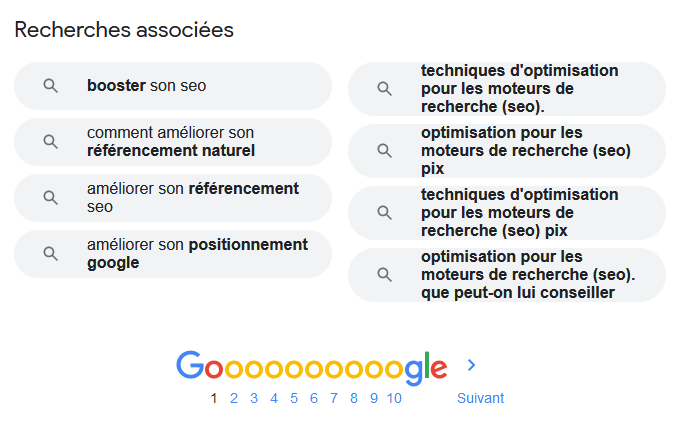
4. Related searches
2. Google Keyword Planner (the Google ADS tool)
Google Keyword Planner is the tool integrated into Google Ads that allows you to check the search volume of your chosen keywords. It also suggests a large number of closely related keywords. The tool is very powerful and completely free.
However, do not rely 100% on the search volume thinking Google is the most reliable data source. In reality, Google sometimes groups several keywords into one, and there are also many other parameters to take into account.
3. AnswerThePublic (https://answerthepublic.com/)
A tool that lets you see the questions users ask about a keyword. However, the free version is very limited.
4. Google Trends
Google Trends displays what users search for most and primarily tracks trends. It is very interesting for looking at keywords related to a brand or generic keywords that are frequently searched. It is powerful but its usefulness is limited for smaller keywords.
5. SeedKeywords.com (Tips)
This is a little-known SEO tip — in fact, if you use the same seed keywords as your competitors, you will see the same keywords as them.
However, the SeedKeywords.com tool allows you to get around this problem.
Once on the site, click “Create my scenario” to get your link. Then send it to your friends, family, and target customers to see what keywords they would use to search on Google. You will get a list of effective keywords that you can then run through Google Keyword Planner.
Keyword analysis and ideas using SEO tools
Now that you know how to find and search for your keywords, you need to know how to correctly analyse each one you choose.
The tools we are about to look at can also help you find ideas. To find more ideas, you can use the “seed” technique. This involves entering a very generic keyword (short-tail keyword) and then letting the keyword idea suggestions from the tools flow.
Thinking about the keyword phrased as a question and voice search
Today, the majority of people use smartphones and sometimes AI assistants like Siri, Google Voice Search or Alexa, Google Home etc. It is therefore important to consider keywords that are phrased as questions, since users ask questions to their devices. Furthermore, these long-tail keywords allow you to attract a very targeted audience.
Note: It is also possible that a person phrases a question in a search engine even without using voice search.
The 4 best SEO tools for analysing keywords:
All of these tools allow you to analyse volume, but also competition and more depending on the tool. They are all free up to a certain point but do allow you to properly analyse your keywords for free and are indispensable. They also allow you to get keyword suggestions for a given keyword. I therefore strongly recommend using them.
SemRush
The heavyweight of SEO tools, SemRush is probably the best keyword analysis tool and reflects very good indicators for any given keyword. Furthermore, it is packed with other SEO-dedicated tools you will need. It is probably the most comprehensive SEO tool in terms of features. If you do not have a large budget and therefore cannot subscribe to multiple tools, this one is a great option.

Ahrefs
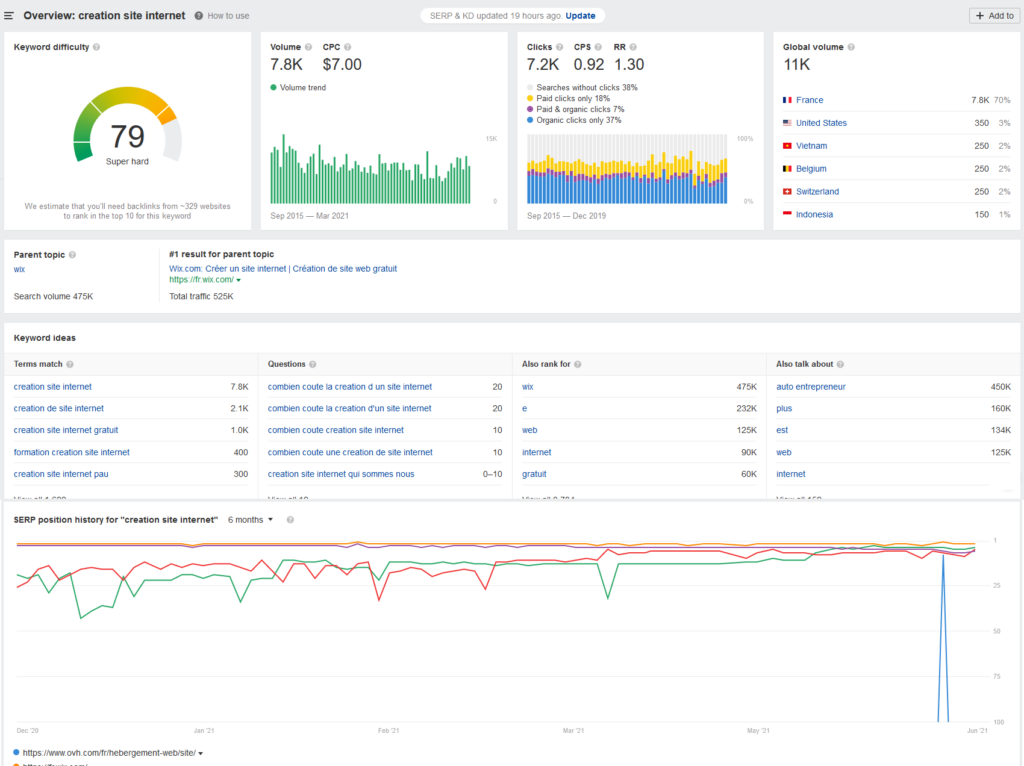
Ahrefs is a personal favourite for many reasons, however its competition analysis tool for a keyword is less interesting than the others. For example, SemRush for the competition metric analysis takes into account both the page’s backlinks and the domain’s backlinks, whereas Ahrefs only takes into account the page’s backlinks, which is not very revealing.
On the other hand, its SERP history for analysing search intent is excellent, and the other metrics are very good too. It also has many other really interesting keyword analysis features.
Moz

Moz is a very good SEO tool and also has keyword research capabilities. The tool is very interesting, its metrics are solid and it also has a priority metric that allows you to judge the importance of choosing a keyword. As its name suggests, priority is a powerful and easy way to sort your keywords by order of priority. Like its peers, the tool allows you to get suggestions for your original keyword. In my opinion this tool is actually the best of all of them. You can then analyse the suggestions to see their competition, priority etc.
Ubersuggest
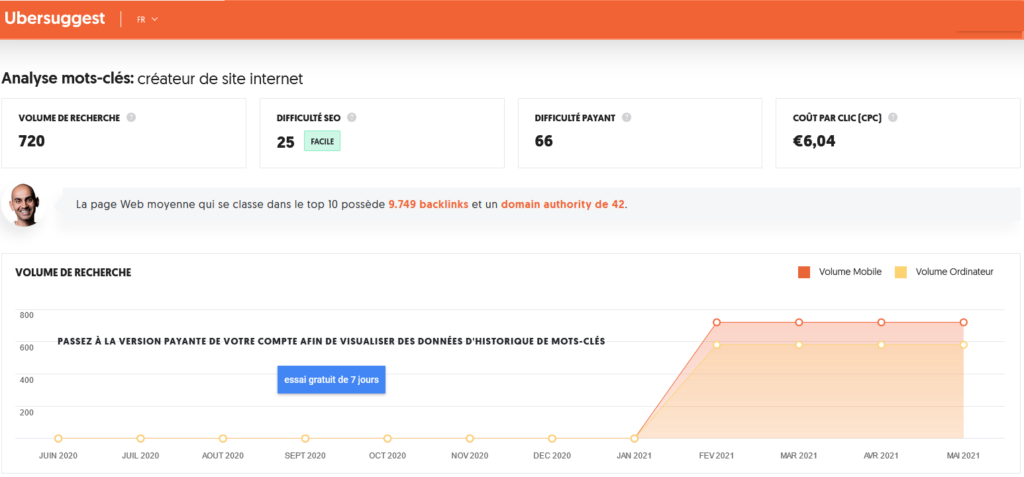
Ubersuggest is a keyword analysis tool that is less powerful than its competitors. It still performs well, offering a competition metric, keyword search volume and similar keyword ideas. What we like is that it has a more flexible free version than the other freemium tools.
Finding keywords through competitor research
A super powerful technique for uncovering great keywords is to research your competition. This allows you to see which keywords you are already exploiting and which ones your competitors are using.
For example, you can use SemRush’s keyword gap tool. It is possible to add several competitors relative to your own site and see the keywords you are not targeting. SemRush then highlights the best opportunities.

Note: You can also use a search engine and enter your keywords on Google. You can then analyse your competitors who rank for the same keywords as you. Then simply visit their blogs and pick up article ideas they have covered that you have not written about, giving you new keyword ideas.
Checking keyword metrics: Competition & Search Volume & Clicks
To properly choose your final keyword, you also need to explore its search volume relative to competition and its click count. If your main domain has little authority, it is better to target low-competition keywords below 50 on SemRush rather than trying to rank for a keyword at 80 and never getting indexed. It is better to be visible for one keyword than for none. Try to strike a good balance between search volume and competition.
Keyword competition
The ideal approach for analysing the difficulty of a keyword is to dig deeper than the metrics provided by tools. They are not 100% reliable, and it is always better to check each site on the first SERP for factors like:
- Number and quality of the page’s backlinks
- Domain backlinks (homepage)
- Content length, relevance, freshness… Can you do better?
- Brand recognition. If the site is Nike for “shoe”, even if you manage to rank, will people want to click on your site?
- Etc.
If a keyword is very important for you and your brand, you can still try to rank for it by pulling out all the stops. It is possible. Moreover, it is better to try to rank for high-competition keywords sooner rather than later.
Note: Long-tail keywords are less competitive. For example, “SEO” is a short-tail keyword and “how to optimise your SEO” is a long-tail keyword. A long-tail keyword is often longer, but not always. To target short-tail keywords, the best idea is to create pages around them that target long-tail keywords in the same topic area as the short-tail keyword.
Keyword search volume
Search volume must be analysed carefully — it does not at all indicate the actual traffic you will receive.
- A keyword’s search volume corresponds to the number of searches, not the number of people who searched. Indeed, one person can search for the same keyword multiple times — they are a single potential prospect but contribute several times to the search volume. For example, if they search “weather” several times a month.
- Furthermore, the number of people searching for a keyword does not mean you will receive 100% of the organic click share. You can comfortably divide this number by 4.
- Also take into account the global search volume across all countries. A Canadian speaks French and makes the same queries, as does a Belgian, etc. It is also possible that a French speaker from the United States formulates a search in French.
- You can even consider purchasing power across different countries since it is important to take all of them into account.
Identifying the parent topic to evaluate the right search volume
Good news — it is also possible that a keyword ranks for other similar keywords and can often double the search volume.
For example, “site creator” has a search volume of 500 and “site creator” (without accent) has a search volume of 800, giving you a combined volume of 1,300 for a single keyword. It is also very likely that your keyword will rank for other keywords even if they are less closely related than in this example.
On Ahrefs, there is a specific “Parent topic” field. For “optimise your SEO”, Ahrefs indicates a search volume of 30 but indicates a parent topic of “SEO optimisation” with a volume of 350:

Note: a web page will rarely rank in search results for a single search query. It is also important to check the parent topic to avoid targeting keywords that do not appear difficult but where the sites ranking for that keyword are the same big players as for high-competition keywords — making them actually much harder than they appear.
Is the search volume consistent?
Search volume depends on the consistency of user search behaviour. For example, if you analyse a keyword during the Christmas period and it is “Christmas tree”, you should not assume you will receive that search volume every other month of the year.
Even more treacherous: if you use keywords by adding marketing buzzwords such as “turnkey”, “360°”, “click & collect”, by the time your page ranks, those terms may have been replaced by other commercial terms.
Concretely, if the search had a very low volume in the past, you can either hope it becomes the norm, or you are wasting your time.
It is also possible that your keyword is not being searched much right now while in previous months it had a much higher volume. It is therefore imperative to check the search volume history.

Number of organic clicks and number of paid clicks
Analyse the number of organic clicks — if it is low, it may be linked to 2 main factors:
- The search intent is not strong enough or there is a featured snippet (check the number of organic clicks)
- A good proportion of the clicks go to ads
If more than 50% of clicks come from Google ADS, this means that to get traffic you will need to be in the top three results of the first page of search results — because even being on the first page at the tenth position, you may not receive any visits at all.
If the keyword registers many “no clicks”, this is probably because the user finds their answer directly. For example, “President of the Republic” will not generate many clicks on pages since Google will display the answer to the question directly.
Finding niches
The keyword idea databases of tools are not complete. There can be a large number of keywords with high search volume and low competition. You must therefore deepen your research about what people are asking about your activity. To do this, you can delve into groups, social media, forums, Amazon, subreddits etc. This also allows you to anticipate trends.
Another point: your customers are a great source of good keyword ideas. For example, a great keyword idea database is the messages your prospects send you at first contact.
Here are 5 examples for uncovering a niche:
- Do not determine your keyword by volume alone but by the number of keywords that rank for that low-volume keyword. → When combined, low-volume keywords have the potential to generate good traffic and also very targeted traffic.
- Get inside your customers’ heads and out of your own → For example, instead of targeting a technical keyword from your field like “sleep headset” (yes, that exists), you could think from your customer’s perspective and target “how to fall asleep”.
- Collect data from your customers. → Look at how they phrased their first contact with you — you can even add a “how can we help you” section to your payment form, quote etc. You then gather a wealth of interesting data.
- Use social media, forums, Facebook groups, communities like Reddit and Quora but also major e-commerce sites like Amazon, eBay etc.
- Talk to the people around you, your friends for example, while using SeedKeywords.com
Analysing keyword search intent
It is important to understand the principle of search intent. When you analyse keywords and one of them interests you, it is essential to analyse its search intent to avoid being misled.
Let us take an example: “creating a website for dummies” — it has 150 monthly searches and a difficulty of 0, making it rather interesting. In reality, by analysing the search intent by looking at the SERP, you will discover that users’ search intent is to find a book. Unless you are the publisher of the book “creating a website for dummies”, you should not target this keyword.
Moreover, by analysing the frequency of pages selected for this query over recent months, you can determine whether Google has properly evaluated this keyword. You can also assess whether the intent is good by analysing the click count for the keyword to determine whether the SERP results are good. In this case, the intent has been properly evaluated. Therefore you should not target this keyword since users are clearly looking for the book on Amazon and nothing else. Ultimately, this means you must be careful because search intent is not always obvious for a keyword.
The 3 main types of keyword search intent
Now that you understand the general principle of search intent, it is important to know the 3 main types of keyword search intent.
- Informational keyword: the user is looking for information. These keywords can also appear in featured snippets. After typing the keyword, the user will find their answer directly in the search results. If that is the case, the user will never click on the proposed sites. It is therefore not always worthwhile trying to rank for them.
- Commercial keyword: having done their research, the user is looking for comparisons, reviews, etc. If you are an antivirus software company, you might want to write an article on “your antivirus vs Norton”.
- Transactional keyword: the users’ search intent is in buying mode, such as for a product or service. For example, the query “creating a website for dummies” is about buying a book — you therefore need to offer the sale of that or a similar product. If your site cannot match this intent, it is obviously not relevant to try to rank for it.
If you have followed the article, search intent links back to conversion funnels. After identifying the correct search intent, you should offer your own articles or product sales pages related to your chosen keywords.
Using extensions to analyse competition and find keyword ideas
There are plenty of highly effective extensions to automate your processes and simplify your work. For example, the Ahrefs extension shows volume, global volume, number of clicks, page rank, page backlinks, keyword ideas and much more for every query you type into Google.

Semantic analysis
After understanding the basic concepts of traditional SEO keyword analysis, you may want to move towards semantic keyword research and thus conduct semantic analysis.
To begin semantic analysis you will need to:
- Identify entities
- Identify keywords similar to your main target keywords. We therefore prefer to use the word “concept”. Identify the concept of the “primary” keyword.
- Pay particular attention to search intent, and semantic search intent
Finally, equip yourself with a dedicated semantic analysis tool such as:
- Google Docs
- YourTextGuru
- Cocon.se
- Wordlift
- …