
The meta description is an HTML attribute that briefly describes the content of a page. It appears, among other places, beneath page titles in search results to provide additional context:
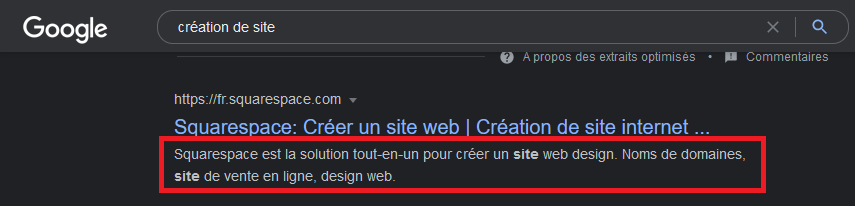
Here is what its markup looks like:
<meta name=”description” content=”Every day, we strive to make createur2site the obvious choice for growing your business on the Web”>
If it can appear (sometimes) in search results, it also shows up when pages are shared on social media:
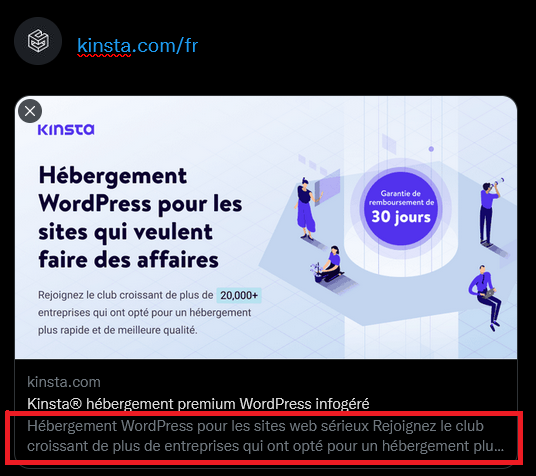
It’s worth noting that with Open Graph tags, it’s possible to override the meta description tag. But if you haven’t defined an OG description, a meta description is pulled instead. So if you’re only willing to make the effort to define one of these tags, it should be the meta description.
Is the meta description a ranking factor?
Even though writing a meta description is frequently mentioned in on-site (or on-page) SEO optimizations, it carries no ranking weight whatsoever. Not even a little.
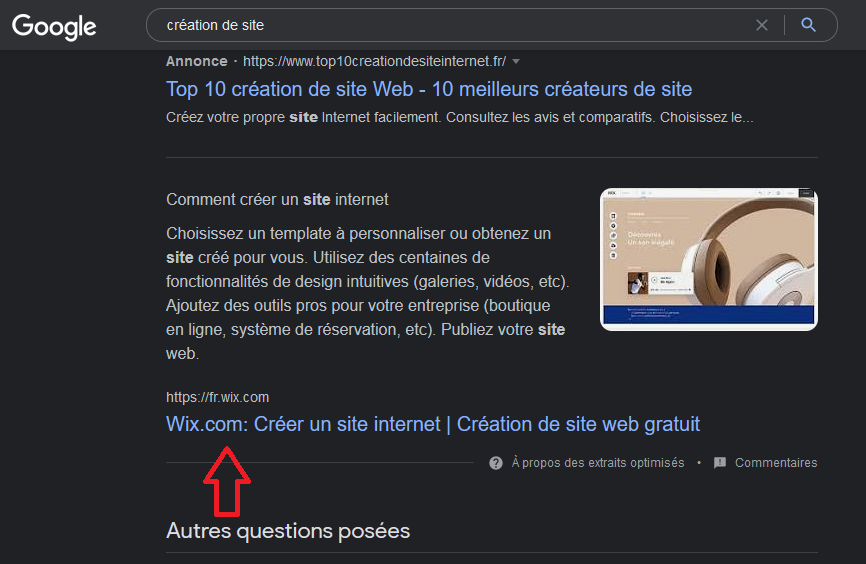
Moreover, the meta description is only displayed 37% of the time in search results. For example, when rich snippets appear, the meta description is pushed aside:
Moreover, the vast majority of the time, Google rewrites meta descriptions even if you’ve specified them — more than 60% of the time, according to an Ahrefs study:

So there’s little point being obsessed with it — though nothing stops you from doing it properly. In any case, don’t spend more than two minutes writing your meta descriptions unless it’s for your homepage or key landing pages.
5 Tips for Writing a Meta Description
Always write a meta description in relation to your title tag. If the title tag drives clicks, the meta description provides additional context — it should complement the title.
The meta description should not exceed 155 characters, otherwise it will be truncated.
1. Include your keyword
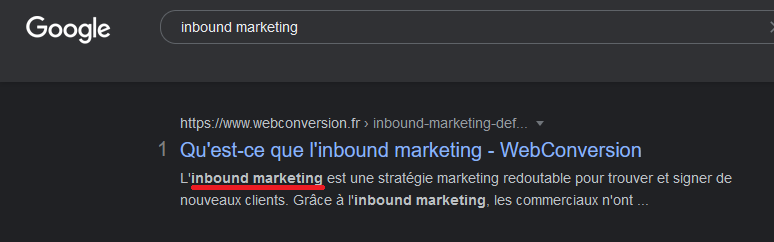
I’ll say it again: including your main target keyword will add no ranking factor for your page. However, including the keyword lets users know that you can answer their query. Also, when users type their keyword, if it appears in your meta description, it will be displayed in bold:
2. Think about search intent
Simply put, search intent is what users want to find when they formulate a query.
Ask yourself what users might be looking for when they type your keyword:
- Are they looking for information?
- Do they want to buy something?
- Are they looking for a specific website?
- Do they want a quick answer to a question?
For example, a keyword like “inbound marketing” should at minimum provide a definition. Giving a quick answer to that question in the meta description would be quite effective.
3. Use the active voice
For a definition, using the active voice isn’t always ideal — but in most cases it is.
Active voice examples:
- Monkeys love bananas.
- The cashier counted the money.
- The dog chased the squirrel.
Passive voice examples:
- Bananas are loved by monkeys.
- The money was counted by the cashier.
- The squirrel was chased by the dog.
Using the active voice prevents the description from sounding dull and uninviting.
4. Be concise
Nobody wants to see a boring meta description, or something non-descriptive with truncated text. In short: don’t write a novel for your meta. Try to write something as compelling as a title tag, but longer and more descriptive.
If your meta description is too long, it means it’s not concise enough.
Note: 920 pixels (~160 characters) on desktop and 680 pixels (~120 characters) on mobile.
5. Play on emotions
Like a title tag, your meta description should attract clicks. The goal is to better describe the page while enticing searchers.
Here is an example of an emotion-driven meta description:

The punctuation is good, and it invites users to discover the products “right away.” Here the meta description plays on emotions using an expiration-style cue. Leverage the urgency signal.
Avoid this kind of meta description — especially when targeting a keyword like “sales”:

It’s boring, it feels long, it implies the sale is never-ending. Not clear, not concise.
Have tips to share? Feel free to leave your suggestions in the comments!