
A title tag is an HTML element used to specify the title of a web page. Here is what the HTML code looks like:
<title>The ultimate guide on the title tag</title>
Its purpose is to describe to search engines and visitors the subject of the page:

But that is not all — the title tag also allows a title to be displayed in search results:
 And finally, it is also used for social media shares:

That is why it is essential to optimise your title so that internet users want to click on your website.
Difference Between the Title Tag and the H1 Tag
The title tag and the H1 tag are completely different.
Sometimes people say (and I include myself) “H1 title tag” because H1, H2, H3 tags are the main headings of a page. But the title tag is <title> and the H1 tag is <H1>.
If beginners sometimes confuse them, it is also because most people use identical text content for both the H1 tag and the title tag.
Although this practice is very widespread, you absolutely should not do it.
Normally, an H1 tag should contain your keyword, and is broadly optimised for SEO.
Imagine that the H1 tag on my home page is “Modern and innovative website creator”. Would you want a title tag with the same name? Personally, no.
I much prefer “Modern website creator | UI / UX Design – SEO – Data”. Catchy, piques curiosity, much nicer.
Moreover, by indicating a variant to the page title (H1), you avoid redundancy and attract the reader more to continue reading.
Does the Title Tag Help With SEO?
Adding the target keyword in your title tag is indispensable for optimising your natural SEO.
The title tag, beyond the simple keyword, also has an indirect ranking factor.
Thanks to the RankBrain algorithm and more recently NavBoost, Google will try to decide that one page is more relevant than another based on CTR in search results. That is, if your title is more attractive than others, and thus more clicked, Google will consider placing you above your competitors.
That said, this should only be taken into consideration if you are at least tenth from the first position on the SERP.
CTR is the number of clicks as a percentage of the number of impressions. A CTR of 1% equals 1 click per 100 impressions. An impression is a display.
How to Optimise Your Title Tag?
Now that you know your title tag must be attractive — both for the user and for Google — let us move on to optimising it.
To start, on average do not exceed 55 characters (Google calculates in pixels, i.e. 600) otherwise your text will be truncated:
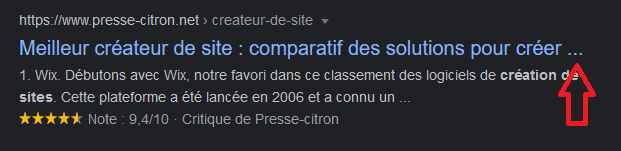
Do not write a title tag entirely in capital letters either. That will attract attention. But not for the right reasons. The same applies to emojis.
What I am about to say ties into the previous point: the ideal way to stand out is to not do what your competitors are doing.

It is ingrained — maybe it worked in 2004. Today it is completely absurd.
To give this example, I only tried a single query on Google. It is very widespread, so make the most of it!
The title tag in the green box is not perfect, but at least it will be more considered by an internet user. Imagine a visitor looking at this SERP. Either they click the first link or they click on the green box.
We can also analyse the SERP more finely. The keyword is a broad query. A user might be looking for something other than a definition — for example how to “do inbound marketing”.
Moreover, a user often searches for things without knowing exactly what they want, does not necessarily know how to formulate their query, and relies on Google to help. They may also want to learn more after discovering the definition. Among other things going through their mind.
Simply reading the “People also ask” (PAA) section reveals the different search intents. In this case:
- How to do inbound marketing?
- What are the most effective techniques in inbound marketing?
- …
Offering an ultimate guide is therefore very relevant.
1. Play on Emotions
It is well known that playing on emotions in marketing is very powerful. But since an example is worth a thousand words, let us take “SEO Tips” as an example (I am using the English SERP because it is exceptional):
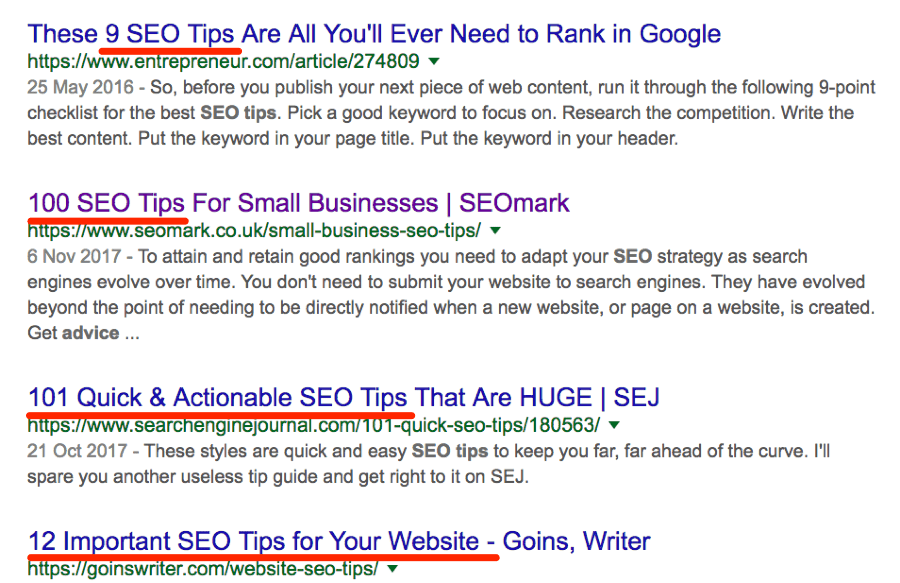 It makes you want to click, doesn’t it? They play with your emotions. It works well.
You can also think psychology. What are the weak points of people searching this query? In this case it seems to be the type of query that intermediate SEO professionals search — since terms like “actionable” and “small businesses” come up. Some searchers probably want to see tips that can be easily implemented and without too much difficulty.
And then, offer something unique, once again. Everyone here stands out, so the user might probably open all the links in a new tab.
2. Use Curiosity
Not to be confused with “clickbait”, or Google will make it clear that this is not acceptable. But if you pique curiosity, without overdoing it, and then answer it, there is no harm.
This could give something like: “10 Quick Win SEO Tips for 2024 (That Your Competitors Use)”.
OK, we agree that in English it is easier to be catchy. But the harder it is, the better, right?
But… Be flexible — in France we do not react the same way. So do not make titles that are too catchy. Try to aim for a happy medium. All the same, if you had to choose, it is better to call for the user’s click than to use titles like “how to optimise your title tag? – SEO”. That really does not inspire action.
Note: curiosity rhymes with moderation — if you do it all the time it will no longer have the same impact at all.
3. Add Brackets, Parentheses, Hyphens…
Nobody wants to see simple, long sentences. Airing out your sentence will give the searcher a better user experience.
Internet users read your sentences but focus on specific things. Help them focus on the right things.
Here is an image from Backlinko. After adding parentheses they got 128% more organic traffic.
 To start with, it was not bad — there were capitals to improve visibility, “:” to let the sentence breathe. They have refined it further.
A good title tag will generally take you no more than ten minutes, and can yet make a significant difference.
Google Can Rewrite Your Title Tag
More commonly it is meta descriptions that are rewritten by Google. But this also happens frequently with titles.
There can be various reasons why Google does this, but if it does, it is for a good reason.
Google Thinks Your Title Tag Could Be Better for a Query
Based on a query, Google may decide to display a different title tag depending on its precision.
Imagine something like this for a title tag: “How to clean your shoes” and you explain how to brush the shoe. If the user does not use the keyword “clean” but “brush”, Google may choose to display a title tag like “How to brush your shoes”. The user will be more inclined to click.
But this is not always very relevant in reality, and you will sometimes bang your head against the wall. Brand and entity searches are an example that affects everyone.
Here is Shopify’s original title tag:
When searching only for “shopify”, here is what Google determines as relevant:
Yes, perhaps that is sufficient, but allow me to be ambivalent about the value of this rewrite.
Your Title Tag Is Poor
Here is what Gary Illyes from Google says:
“We will never stop rewriting titles. We have seen so many sites whose title is truly awful. Many sites have no title at all; many sites have a title saying ‘Top Page’. In fact, Google almost always rewrites titles. We could not provide useful results to our users if we abandoned title rewriting. Experiments have shown us that users prefer rewritten titles. So, we will continue to write titles.”
Indeed, as we saw at the beginning, the title tags in the SERPs are really bad. And this leads others to believe they should be done the same way, which creates a vicious circle of title tags that make no sense, are stuffed with keywords and are utterly uninviting.
Preventing Title Tag Rewriting
There is not much you can do to prevent title tag rewriting. Google is the sole judge. However, the best advice I can give you is to make it enticing. If your assumptions are correct, and therefore your title tag is enticing, users will click on it. If your search result gets a lot of clicks, Google will find no reason to rewrite it.
If you enjoyed this article and learned something from it, do not hesitate to share it!