Today, websites have revolutionised the way people interact with the world. Website owners who wanted more visibility in their city suddenly find themselves receiving orders from the entire country, sometimes from different countries. It is enticing, and rightly so.
However, setting up a multilingual site — whether on an existing site or a new one — is something complex. The ideal approach is to call upon a SEO consultant to avoid any problems. That said, we will nonetheless go through the topic in this article.
Here are the main questions you should ask yourself if that is not the case:
- Which CMS is the best?
- How do you translate content for users and for search engine optimisation (SEO)?
- Separate domains, subdomains, or subfolders — which are better for SEO? What should the domain name extension be? my-site.com?
Targeting the Right Countries
Assumptions are fine for the imagination, but that is not how I work — and it should not be how you work either.
Rather than simply speculating about the best countries, you should determine the most profitable ones, to avoid targeting everyone and failing to keep up with the pace.
A fairly quick and simple method is to evaluate the search volume of a keyword related to your field, and the competition that comes with it. The main thing is the search volume.
When searching for a keyword with a tool such as SEMrush you must check whether:
- the keyword is identical in another language, such as English. In that case the total volume corresponds to a search volume relating to countries searching for that English term.
- your keyword corresponds only to the French language — the total search volume corresponds to the French keyword typed in other countries, probably by French people living there.
Take “hreflang” — it has more than 10K monthly visits, and this keyword is in fact used worldwide:
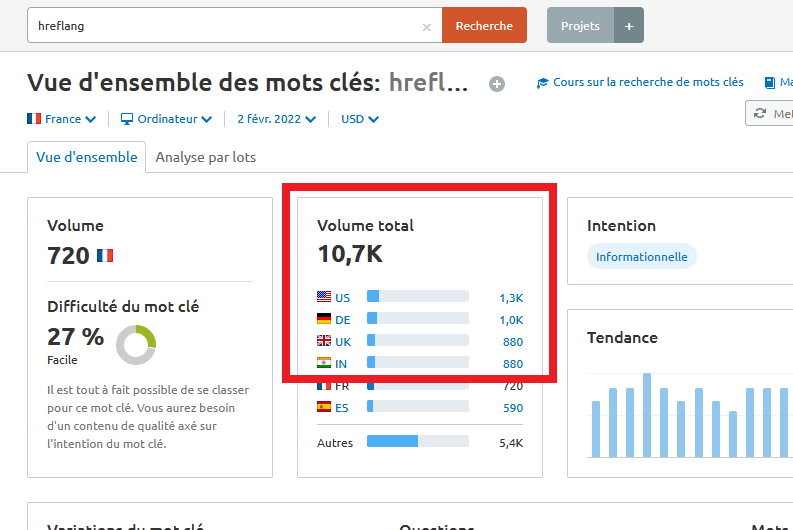
Here, you should target the following countries: United States — Germany — United Kingdom — France and possibly Spain.
Why do I not mention India? That is the second point to consider. Nothing stops you from targeting India — however, it depends on why and how you wish to target the keyword. If your content strategy is dedicated to conversion, it is necessary to take a country’s purchasing power into account. Since it is better to focus on as few countries as possible, perhaps India should not be considered. That is for you to decide.
Keyword difficulty varies depending on the specific country you initially selected — here it is France. So if you want to see the keyword difficulty for other countries, repeat the search specifying the relevant country.
After having done this for as many keywords as possible, you will be able to determine which countries you should and can target.
Another useful tool for assessing the strength of a target market is Google Trends — it lets you see whether interest in a particular topic or keyword is increasing or decreasing, while filtering results by country.
Note: some keywords can show you “false data”. For example, “leads” is perfectly usable in both French and English, but could have zero traffic from Québec residents, simply because they use the term “pistes de vente”. This can apply to all countries with their specific nuances. A translated word is not enough — they may use a synonym of it in everyday language, or use a completely different word. You could then potentially miss out on exceptional traffic.
Which CMS to Choose for a Multilingual Website?
The most popular CMS platforms are generally the ones that make it easiest to have a multilingual site — provided you have not listened to the “top website creators” who recommend Wix.
So CMS platforms such as WordPress, Drupal, Magento, Shopify, and Webflow are all very good.
A myth persists about the use of CMS platforms. In reality, it is always better to use a CMS than to develop a site by hand or create a “homemade” CMS — for reasons I will not go into here. Simply know that the White House website runs on WordPress even though they do not even need to manage thousands of pages in multiple languages. There is a reason for that. Think about it.
If your site is not compatible with multilingual SEO, you will need to rebuild it.
Subdomains, Domain Name Extensions, Subfolders…
Each option has advantages and disadvantages compared to the others.
Here are the different possible structures:
Separate domains per country
- google.fr
- google.de
- google.co.uk
Subfolders
- www.apple.com/ca/
- www.apple.com/fr/
- www.apple.com/de/
Separate subdomains
- fr-fr.facebook.com
- en-gb.facebook.com
- de-de.facebook.com
Separate pages / filtered URLs
- youtube.com
- youtube.com/?hl=fr&gl=FR
- youtube.com/?gl=DE&hl=de
We could discuss this topic at great length. The best approach is subfolders, i.e.: https://site.com/fr/page/.
Indeed, Google detects subdomains like “fr.site.com” as separate websites, meaning the authority of each site will need to be built up from scratch for each language. In other words, your SEO efforts will need to be repeated each time. The same applies if you choose a country-specific domain name extension (google.fr / google.com / …). As for parameterised URLs — to put it simply, they are bad for the crawl bots that index the web.
How to Translate Your Website for SEO?
Google Translate is fine but not ideal. In fact, it could even be seen as spam by search engines. And that is without considering the poor user experience it produces. If you want to compete in other countries, seek the help of professional translators.
Also take cultural differences into account. There can be a significant gap between what you might imagine and local expectations. Address people formally in Spain and you will be met with bewilderment.
False keyword friends are very common too. That is why it is preferable to call upon people who — ideally SEO practitioners — live in the relevant country, and not just a bilingual person or a translator.
On the technical SEO side, you will need to implement HTML attributes called hreflang. We have created a fully detailed article explaining how to set them up correctly.
Tips & Tricks
To succeed with a multilingual site, it is essential to:
- Target keywords with sufficient search volume to make it worthwhile.
- Use a CMS to produce content efficiently, with a website structure that allows Google to easily index all the content on your site. Ideally WordPress.
- Do not rush into word-for-word translations — call upon someone who knows the target country well. If you want to learn more, Nicolas Audemar speaks very well about this topic.
- Run an international link building campaign (of quality).
That is the whole secret of good multilingual SEO, which will help your business reach a wider audience.
If you have any questions, comments, or multilingual SEO tips you would like to share, the comments section is the place for that!
