
In the world of SEO, everyone is looking for that little extra edge to propel their site to first position.
Is video that secret weapon?
I conducted one of the most comprehensive French studies to date to answer this burning question. And the results will… surprise you!
Study Methodology
To ensure the relevance and diversity of our study, we analysed nearly one hundred thousand pages, for high-traffic keyword queries, covering 12 varied topics, ranging from baby products to cocktail recipes, through gaming, SEO and even keywords with government statistics.
For each query, I dissected the top 50 positions on Google France.
My objective? To discover whether integrating a video (YouTube or otherwise) has an impact on SEO ranking.
Doubtful about the results obtained by topic, I also created another study available at the end of the article by adding approximately 200,000 websites with keywords that had nothing to do with each other, to compare it with the first graph obtained.
What I Discovered
It appears that YouTube videos have no significant impact on organic search. In fields such as bodybuilding (for example, on the query “bodybuilding exercise”), YouTube videos do not seem to make much difference either.
However, regarding videos not hosted on YouTube, but directly on the site, the situation is more nuanced.
Nevertheless, the results obtained are not sufficiently conclusive for me to recommend to a client that they add videos to improve their ranking on the first page of Google. In my opinion, there are other actions to prioritise that would have a more significant impact. The systematic integration of videos can prove to be a long and tedious process — it does not seem cost-effective.
But perhaps you disagree. So tell us what you think in the comments!
Do not hesitate — it would be a pleasure to debate.
Without further ado, let us move on to the main subject. Below, you will find the graph representing the average obtained for all the topics I analysed:
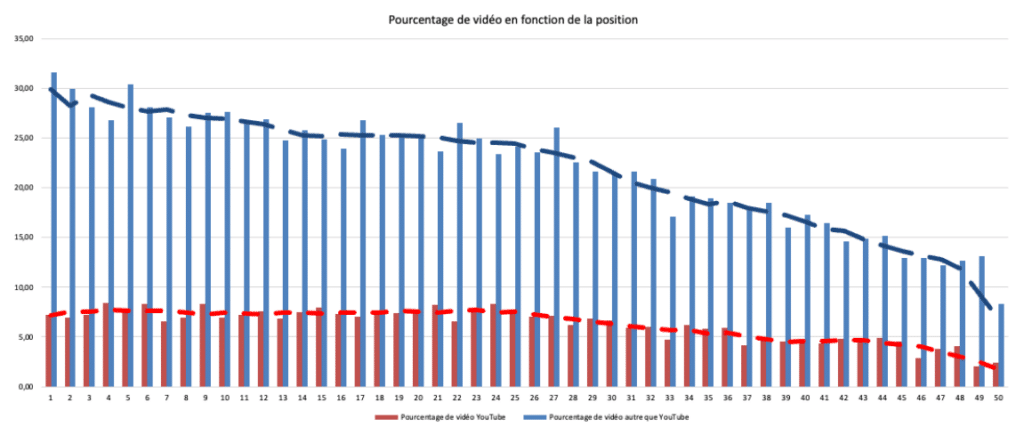
In the graph, YouTube videos are represented in red, while videos in blue symbolise video files (.mp4 or other formats) identified via the <video> tag, hosted outside of YouTube.
We instinctively observe a downward trend between position 1 and position 50, whether for YouTube videos or videos hosted directly on the site.
However, by analysing data from position 1 to position 10, we see that this has little influence on ranking:
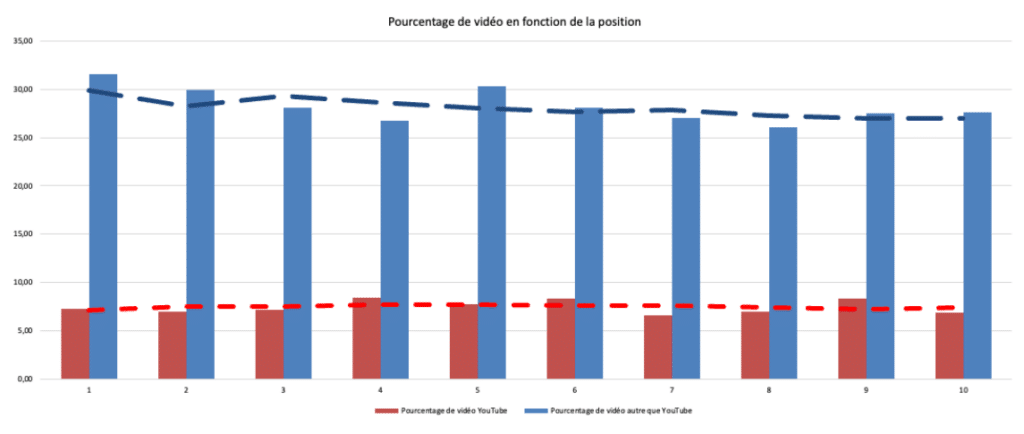
We notice slightly more “other” videos at position 1 on average, but this observation does not translate to YouTube videos, as on average, position 9 contains more of them, at least according to the analysed keywords.
Regarding videos other than those hosted via YouTube, the gap is approximately 1.25% between position 1 and position 5, and 5.5% between position 1 and position 10.
Conclusion: this suggests that, on average, there are fewer YouTube videos and non-YouTube videos on pages further down in Google’s results. However, does this mean that the presence of videos contributes a certain percentage to improving ranking in the top positions of Google? That is uncertain. In general, those who occupy these positions do not seem to make any particular effort.
Some statistics: On average, from top 1 to top 20, approximately 27.5% of web pages contain videos, and about 7% contain YouTube videos.
Analysis by Topic
Why proceed with a segmented analysis by subject?
Because a ranking factor can vary depending on the search intent associated with each topic.
For example, integrating a video explaining bodybuilding exercises could potentially optimise SEO for the query “bodybuilding exercise” — at least in theory, as such a video would be relevant and useful for the user. This is what I am trying to demonstrate by conducting this study.
On the other hand, for a query like “Unemployment Rate France”, adding a video might not have the same impact on SEO, as the search intent is different.
This is why I display graphs here according to the topic.
Each graph is based on a sample of more than 5,000 websites.
E-commerce Keywords
Example: baby shoe, nail polish, washing machine
Baby products:
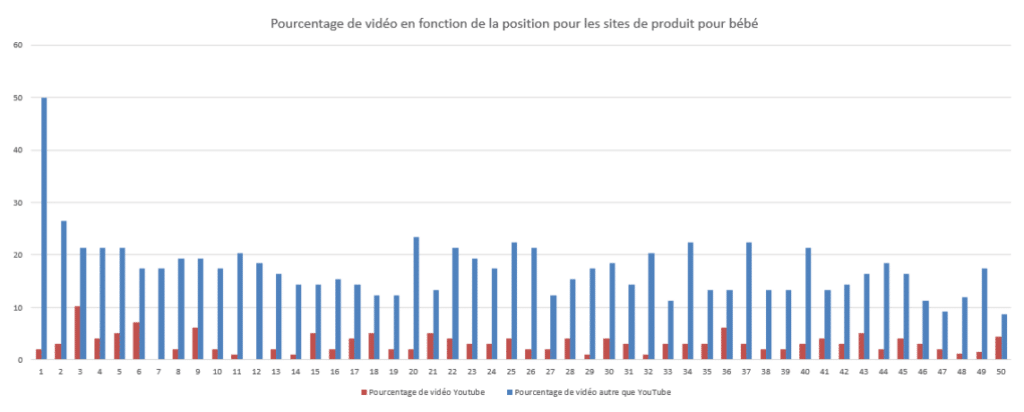
It seems that from position 1, integrating videos on product pages could potentially improve ranking (excluding YouTube videos).
Beauty products:
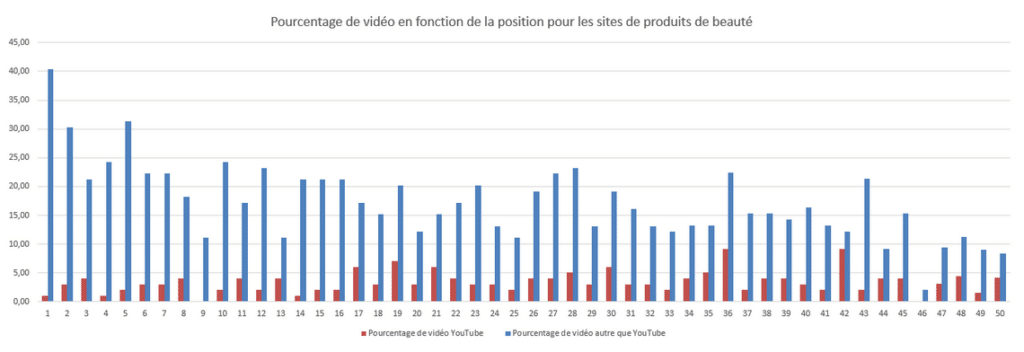
A similar trend can be observed for beauty products, with a possible improvement in ranking up to position 5.
Home appliances:
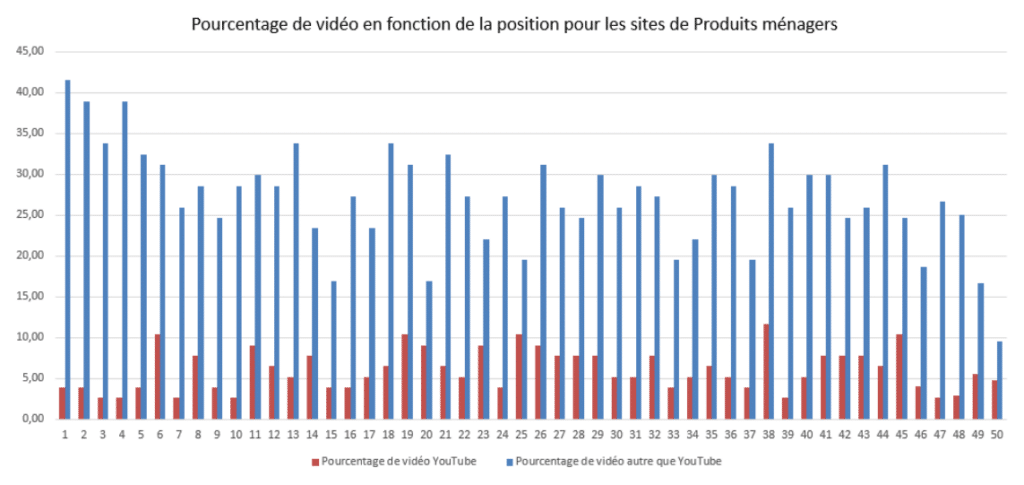
Here, the progression is more gradual, but we also notice that the first four positions have, on average, a higher number of videos compared to the others.
Average curve for e-commerce across the 3 analysed topics.
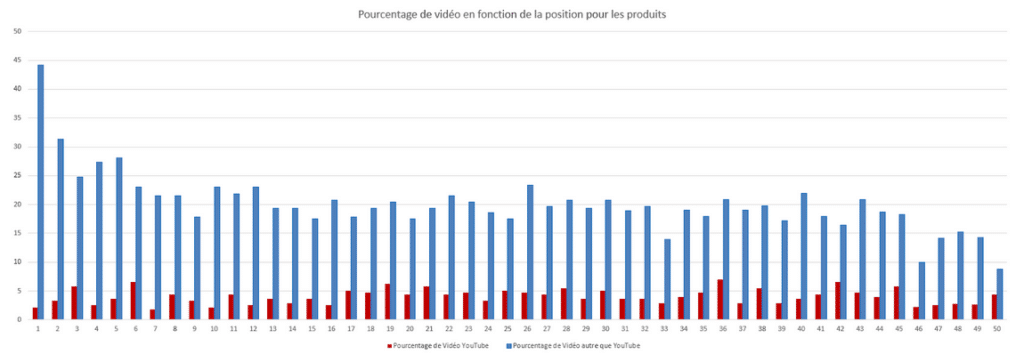
The average across our three topics suggests better potential ranking through the addition of videos, at least up to position 5.
Review Keywords
Example: best gaming chair, best destination Paris, best restaurant Dublin.
Gaming:
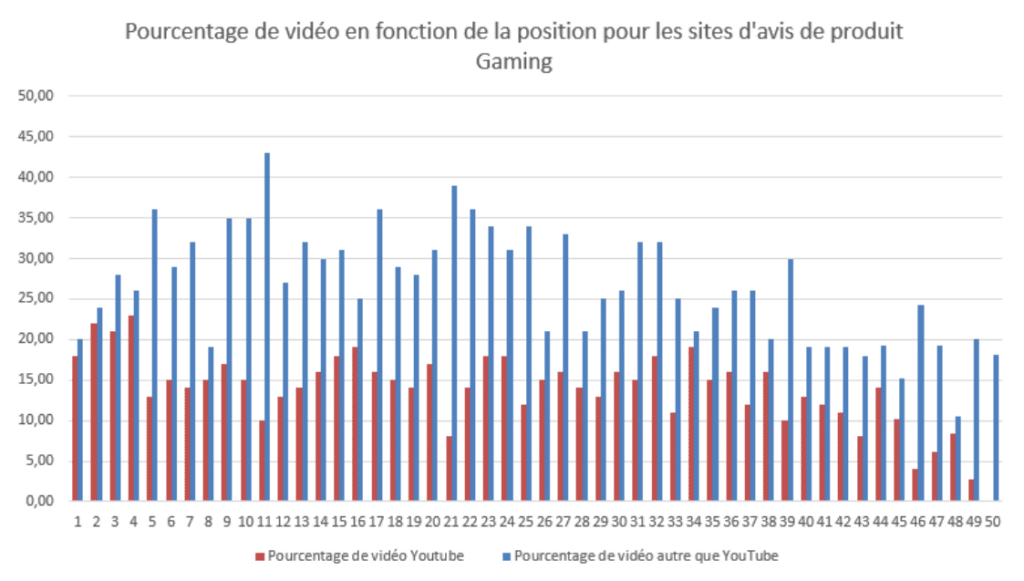
Google does not appear to favour videos for this topic. At least, it optimises almost nothing.
Reviews on destinations:
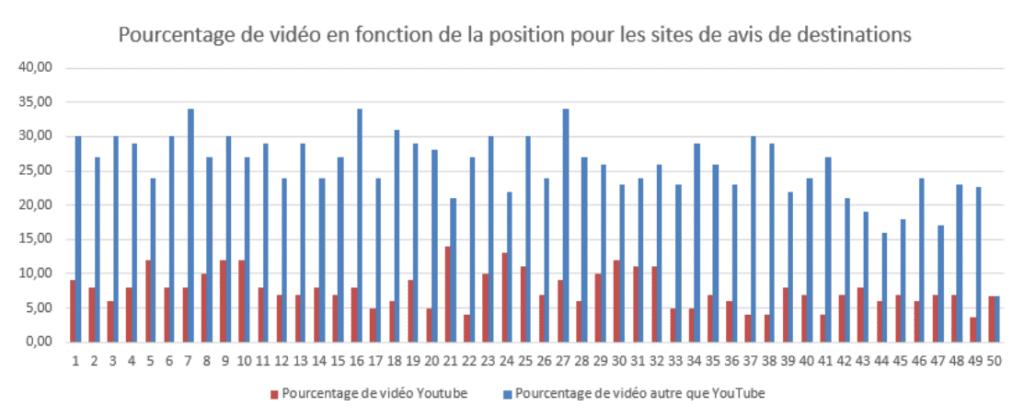
As with the previous topic, Google does not appear to favour videos for this topic.
Reviews on restaurants:
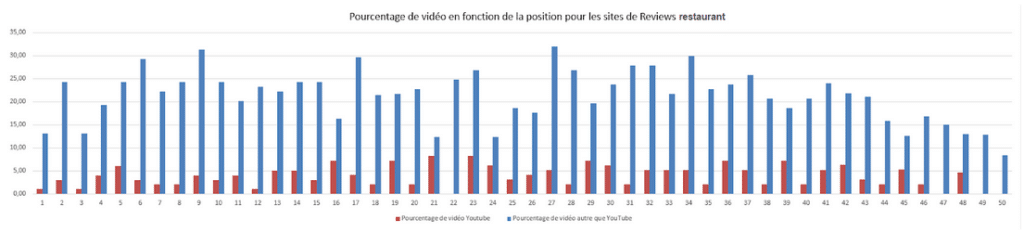 Similar observation.
Average:
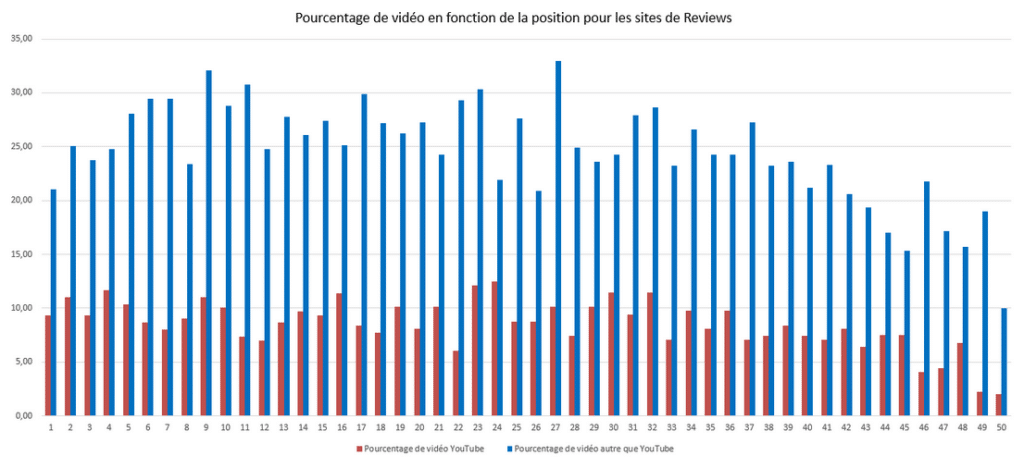
Well-ranked pages for reviews contain fewer YouTube videos compared to poorly ranked ones.
Recipe Keywords
Example: vegetarian lunch, easy cocktail
Food recipes:
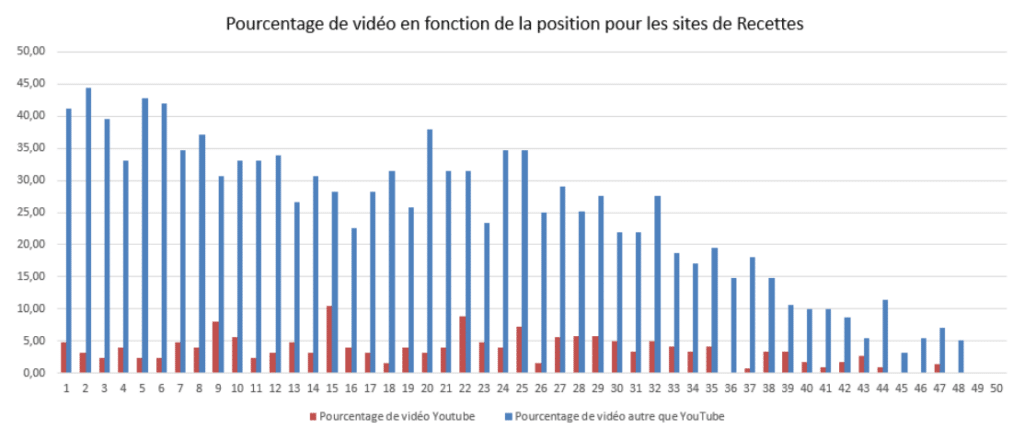 A downward trend is observed as the ranking decreases, but nothing suggests a notable improvement in the top 10, in my opinion.
Cocktail recipes:
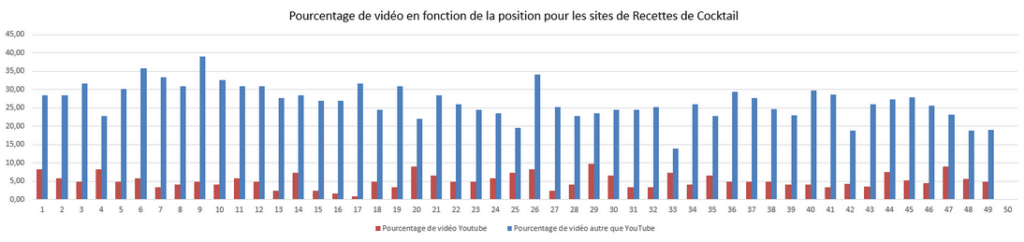 Regarding cocktails, the presence of videos does not seem to influence ranking.
SEO Keywords
Example: On-page SEO
Are you curious about the SEO topic?
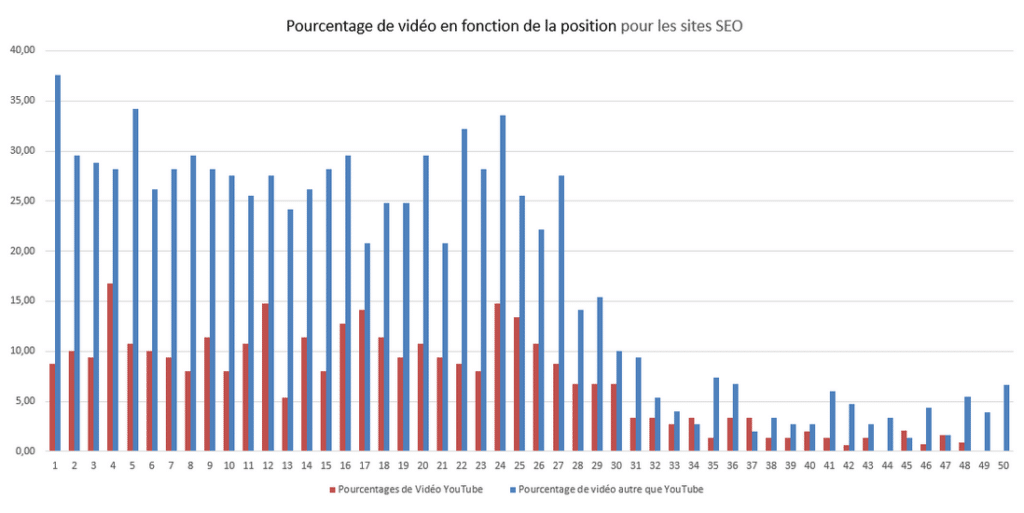 Well-ranked pages contain more videos, but excluding top 1, the distribution seems fairly even, up to position 27 where a clear difference is observed.
Bodybuilding Keywords
Example: bodybuilding nutrition
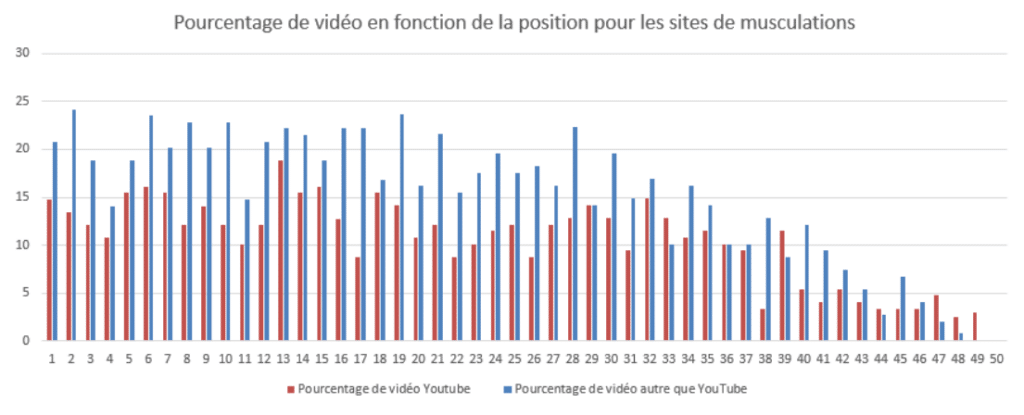 There is a large quantity of YouTube videos related to bodybuilding! However, they do not seem to explain better ranking between position 1 and position 10, for example. On the other hand, in the absence of videos, your page could drop in Google search results.
Scientific / Mathematical Keywords
Example: linear algebra, quantum physics, …
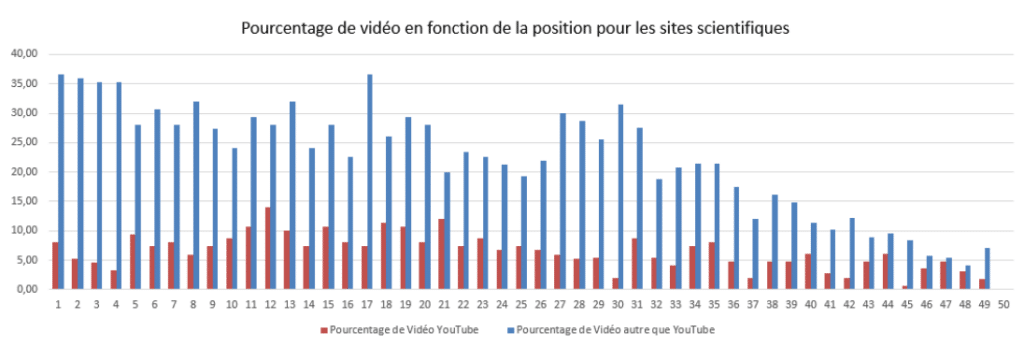 There is not much to report — the presence of videos does not seem to have a notable impact.
Statistics Keywords
Example: work statistics in France
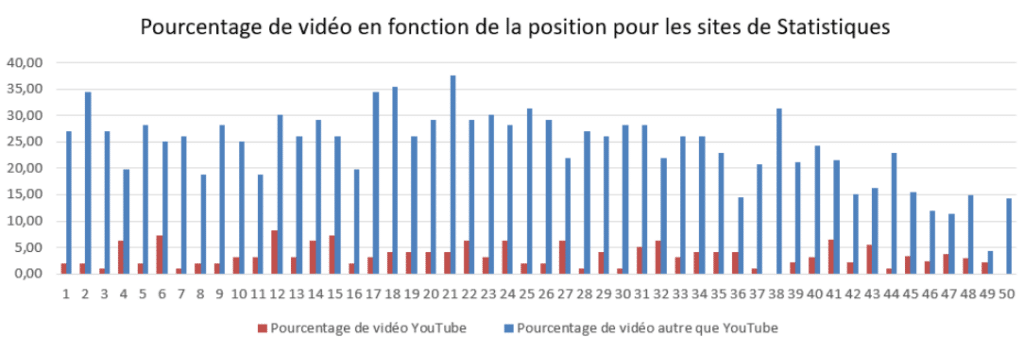 Similar observation.
Conclusion on the First Study
It appears that integrating videos into pages/articles can potentially have a more pronounced impact on certain topics (such as beauty products) compared to others (such as statistics). However, it is difficult to extract a definitive conclusion from this data, as the observed trends could be a matter of causality rather than correlation.
It is nevertheless interesting to note that statistically, position 1 contains more videos. This could therefore be worth exploring. On the other hand, the contribution of YouTube videos proves to be completely disappointing.
It could be relevant to conduct an additional study examining whether the YouTube channel belongs to the web page creator and whether this changes the statistics. However, I doubt the results would differ significantly enough to change this conclusion. It would also be interesting to conduct a global study with competitive keywords that have nothing to do with each other, across hundreds or thousands of different topics, to strengthen the conclusion. Which is what I did in the second study.
Furthermore, according to my results, the data shows that:
- YouTube videos have no impact on pushing a page up.
- Videos in general can potentially have a slight impact on page ranking for the top positions, and in particular the first position on the first page.
The Second Study on Videos and SEO
After viewing the graphs from my study, I had doubts — there were, in my opinion, too few websites for my liking (~<100,000). I therefore conducted a new study on high-traffic keywords, covering approximately (+) 200,000 websites. These keywords were chosen randomly, in the sense that they have no relationship with each other.
Example: Cake recipe – Meditation – Sports shoes – Organic gardening
Here is what this shows us:
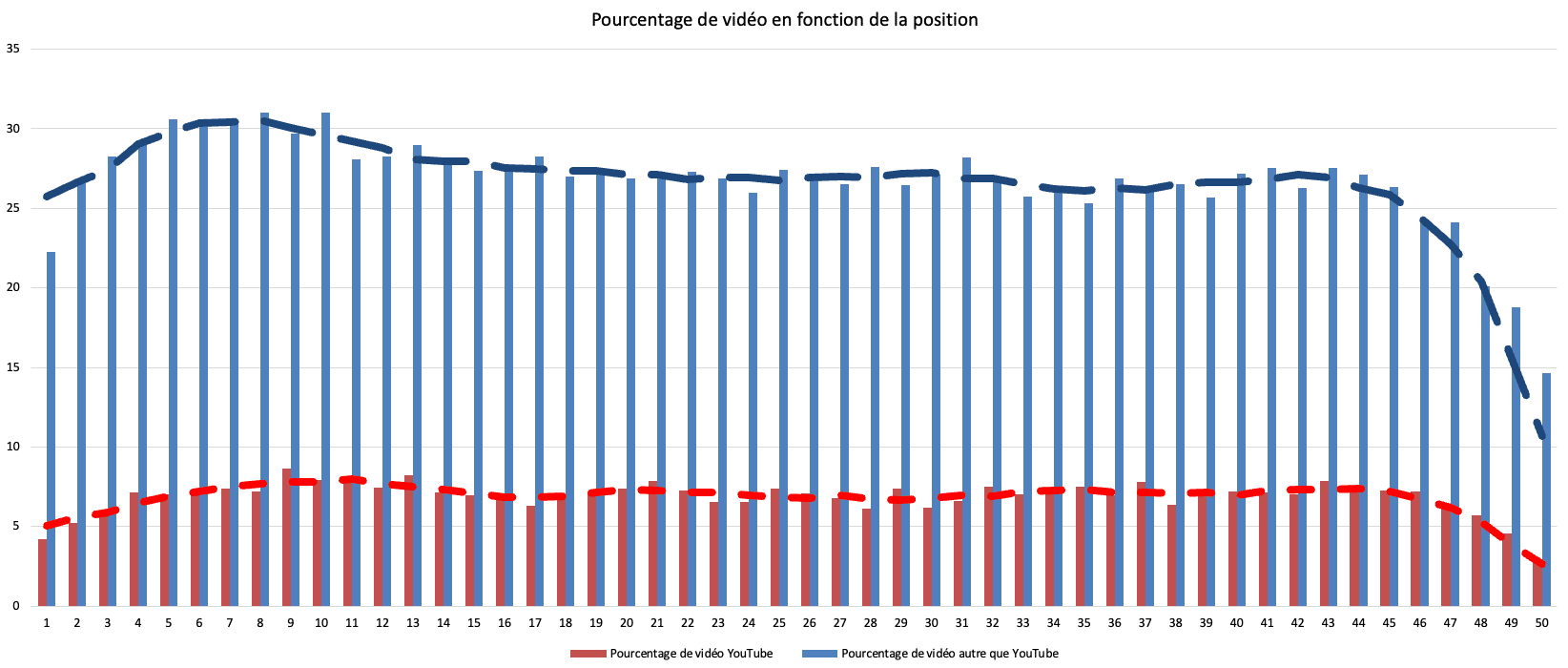
We can clearly see that here the video or YouTube video does not appear to have any SEO impact.
And if we overlay the average topics from study 1 with this new study, it does not change much as we are in the law of large numbers:
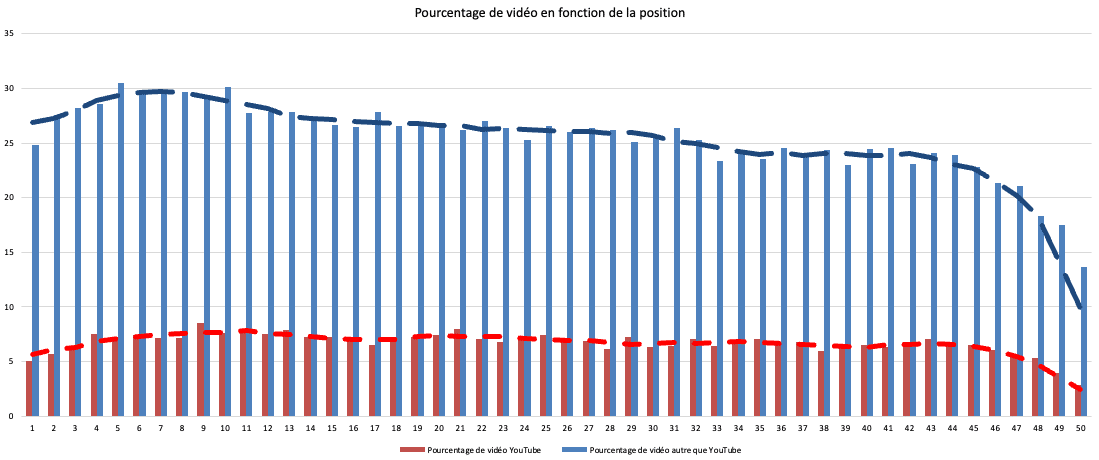
Although we do see a significant drop between position 45 and position 50 for non-YouTube videos, this in no way indicates that video matters, but rather that at these positions, websites are simply poor on average, and this is also reflected in their average number of videos.
I even hesitate to extrapolate, as I wonder whether this graph simply indicates that on average people between position 5 and position 10 make more effort to reach the top 3 of the SERP, and at the end of the graph one can distinguish people who simply make no effort at all.
In any case, we cannot claim that video in general has any impact on average.
Some statistics: on average, from top 1 to top 20, approximately 27.5% of web pages contain videos, and about 7% contain YouTube videos, almost identical to the first study. However, the graph is more linear between each position.
Would you like to know more? Do you represent a renowned media outlet or organisation? Do not hesitate to contact me for more details about these studies, their methodology, position 1 to 10 graphs for any charts, or anything else.