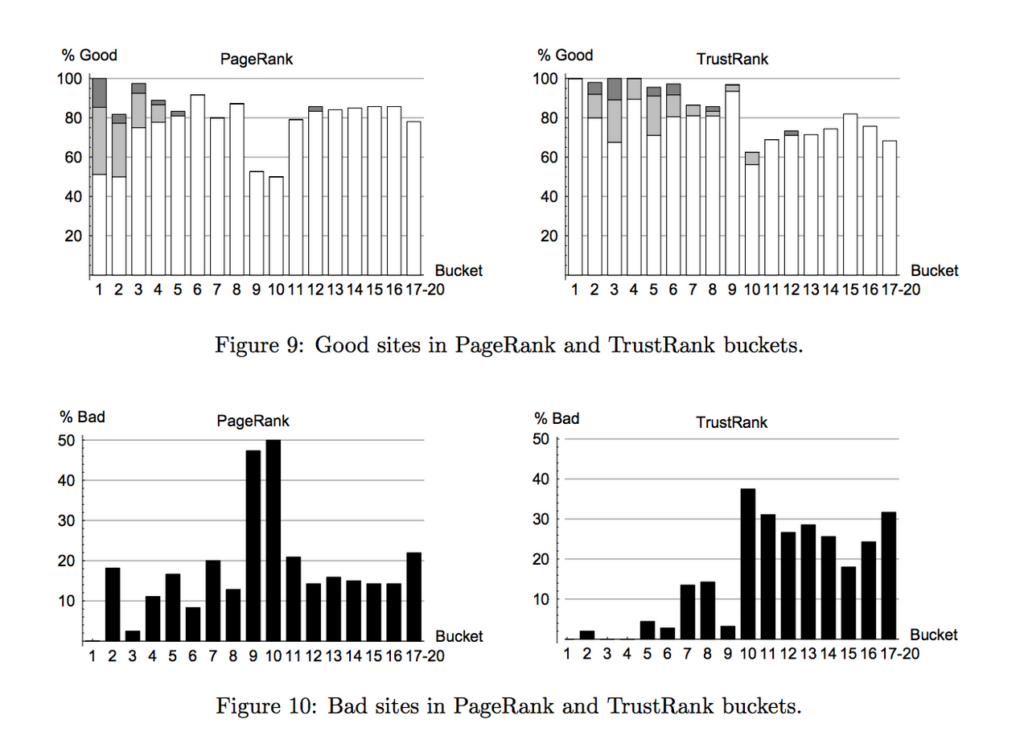
TrustRank is an algorithm invented and developed in 2004 by Zoltán Gyöngyi, Hector Garcia-Molina and Jan Pederson from Yahoo!.
TrustRank, developed by Yahoo, was intended to more effectively evaluate the value of links. Based on the principle of PageRank, TrustRank adopted the same logic while preventing link spam, a technique aimed at artificially inflating the popularity of a website.
Google then followed suit by creating a registered trademark called TrustRank in March 2005.
Google abandoned the TrustRank trademark in April 2008, but filed a patent on 13 October 2009 entitled “Search Result Ranking Based On Trust”.
How TrustRank Works
The TrustRank algorithm was initially created by Yahoo! and Stanford University in 2004 to combat link spam, a common tactic at the time when sites were trying to improve their search engine rankings through a multitude of low-quality links.
The basic concept of TrustRank is simple: trustworthy sites are more likely to link to other trustworthy sites, while spam sites are less likely to receive links from trusted sites.
This is how the first “seed sites” appeared. The idea was to manually or semi-automatically create lists of legitimate and non-spammy sites — for example, the New York Times (often cited in Google patents).
In other words, if a site receives a link from the New York Times, then that site is considered trustworthy. The received link must therefore be valued.
Here is how it works: Google selects these sites and assigns them a TrustRank of 10/10.
TrustRank then diffuses as follows:
- Harvard.edu -> your site = best TrustRank transmission
- Harvard.edu -> another site -> your site = fairly good
- Harvard.edu –> another site –> another site –>another site–>another site –>another site –>another site –>another site –> your site = negligible.
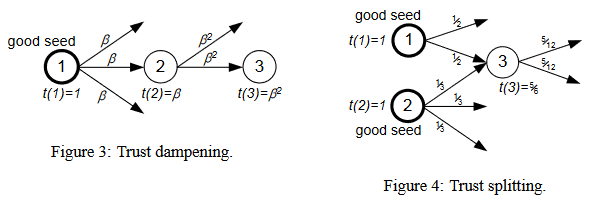
The precise TrustRank calculation can be found on various sites by searching on Google: “Combating Web Spam with TrustRank”.
TrustRank is also the main reason why websites with .edu and .gov extensions have a stronger link power than others.
Google’s “TrustRank”
Today, the term TrustRank is mostly associated with Google, which registered the “TrustRank” trademark shortly after Yahoo! in 2005.
However, Google’s TrustRank is in reality a filter designed to detect harmful sites, and has no direct relationship with Yahoo’s algorithm.
Google’s TrustRank trademark was abandoned in April 2008.
That said, Google filed a patent on 13 October 2009 entitled “Search Result Ranking Based On Trust”.
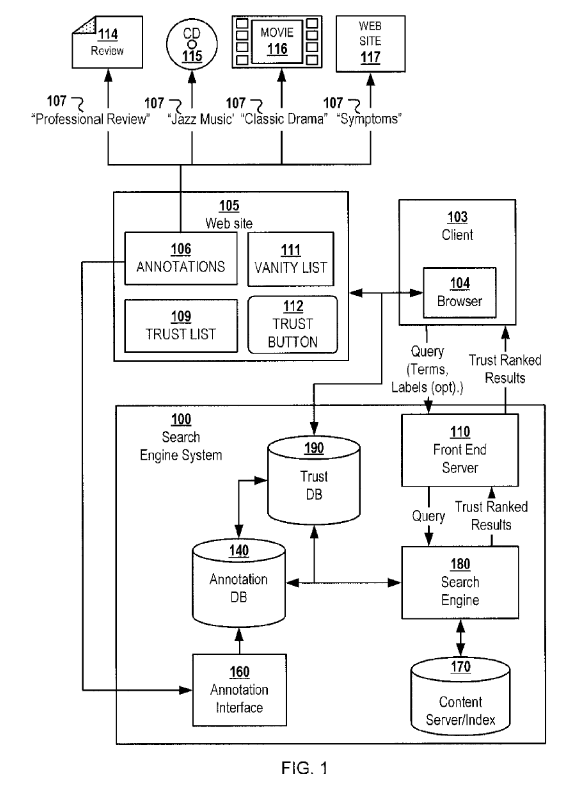
The patent works as follows:
- When a search query is received, the search engine selects documents relevant to that query.
- The search engine also identifies the labels (keywords, categories, descriptions, etc.) associated with these documents and determines the trust scores of the entities that provided these labels. An entity could be a website, a user, a company, etc.
- These trust scores are then used to calculate a trust factor for each document. If an entity has a high trust score, the document for which it provided labels will receive a higher trust factor.
- The trust factors are then used to adjust the initial search scores of the documents. For example, a document with a high trust factor may be assigned a higher search score.
- Finally, the search results are ranked according to these adjusted search scores. This means that documents associated with trusted entities are more likely to appear at the top of search results.
In short, TrustRank is a means for Google to ensure that the most trustworthy and relevant documents are presented first in search results.
But it has nothing to do with the seed sites from Yahoo!’s TrustRank paper!
However, this does not mean that Google does not use the seed site technique described in Yahoo’s TrustRank document. As I mentioned in my article on PageRank, the PageRank patent was updated on 24 April 2018. It is entitled: “Producing a ranking of pages using distances in a web-link graph”. This patent clearly states that Google uses seed sites for PageRank propagation.
Thus, Google calculates the geodesic distance (the shortest path) between the seed site and the website.
Conclusion
In conclusion, TrustRank is an essential element to consider for SEO professionals. This algorithm demonstrates the importance of a site’s trustworthiness and age, rather than simply a high authority recently acquired. Links from trusted sites such as .edu, .gov, or major institutions like the New York Times carry significant weight in valuing a site on search engines.
Furthermore, TrustRank introduced the importance in history of an effective fight against link spam, highlighting the risks associated with “black hat SEO” tactics. This practice of using unethical methods to improve a site’s ranking can in the long run harm a site’s visibility and reputation.
Finally, even though Google has adopted a slightly different approach to Yahoo’s TrustRank, the fundamental idea remains the same: trust and relevance are key factors in search result rankings. Thus, for SEO professionals, understanding the principle of TrustRank in their strategy can prove beneficial for optimising their positioning in search engines.