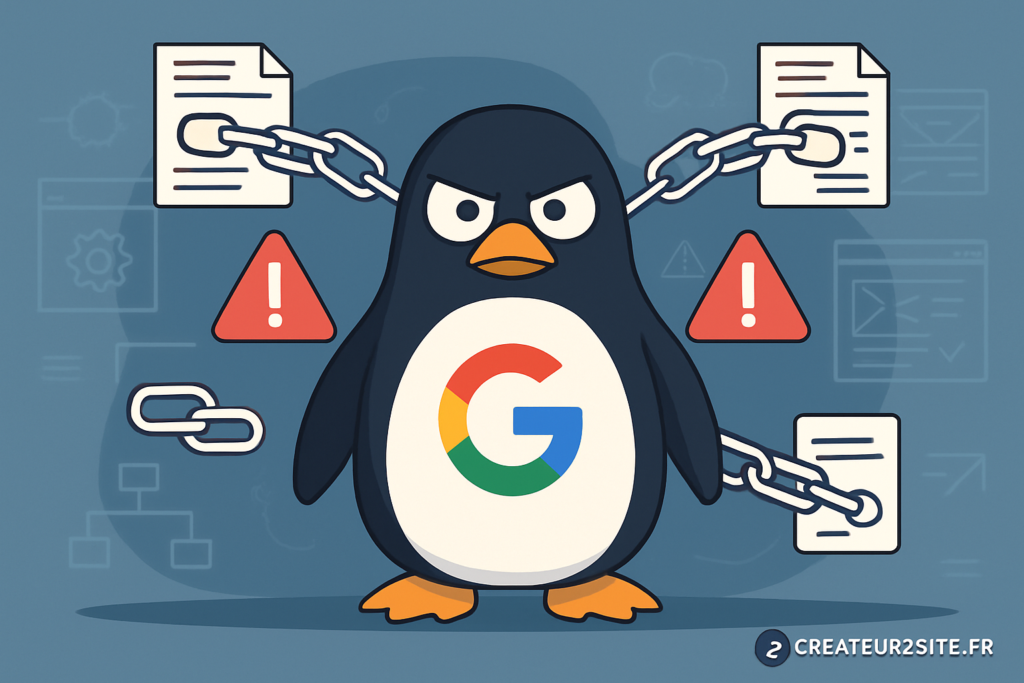
Google Penguin Definition
On 24 April 2012, Google Penguin made its entrance into the workings of Google. Its goal was to act as a spam filter with the aim of penalising sites abusing PageRank.
After numerous updates over the years, the last known version is Penguin 3.0 (or 2.2), corresponding to the last update (Google Penguin 6) of the algorithm on 18 October 2014.
According to Google, Penguin is now at the core of the algorithm and operates in real time.
Does this mean Google Penguin is no longer updated? No.
It is precisely because Penguin is used during the crawling and indexing of web pages that they no longer communicate updates.
With this update, Penguin’s data is refreshed in “real time”. Changes are therefore visible much more quickly, generally shortly after the page has been crawled and indexed again. This also means we will not be commenting on updates in the future.
Source:
https://developers.google.com/search/blog/2016/09/penguin-is-now-part-of-our-core?hl=fr
Google Penguin: How Did It Work?
Penguin was originally a Google algorithm spam filter that focused largely on link anchors.
Beyond understanding link networks (PBNs), link exchanges, paid links, netlinking strategies, and dubious backlinks — which it slightly altered — that was not where it focused.
The main goal was to penalise websites that used over-optimised anchors targeting the same keyword they were aiming for.
For example, target keyword: “car sales”
Link anchor: “car sales”
Other link anchors composing its link graph: “car sales”
When Google detected this type of spam, it penalised the website broadly.
Google Penguin Today
To date, and specifically in 2022, the penguin filter no longer works in the same way as before. If it detects a form of web spam and manipulation of its ranking factors — such as the presence of links from PBN sites and over-optimised anchors — it does not penalise the site broadly.
- If it detects a link from a site that only links to “money sites”, the link is not taken into account to boost the money site’s authority. But Google does not punish.
- If it detects over-optimised anchors, there may be a penalty on the specific page concerned, but the site in general will not be penalised. Note that Google increasingly ignores exact anchors and looks for other factors to determine the relevance of a page for a given query.
Penguin is now more precise. It now devalues spam by adjusting rankings based on spam indicators, instead of affecting the ranking of the entire site.
How Does Google Penguin Detect a Fraudulent Link?
Whether it is a purely spammy link or a “valueless” link, Google, and specifically the Google Penguin algorithm, uses a whole range of signals to detect them.
Here is a non-exhaustive list:
- similar whois
- same <title>
- identical hostnames
- identical domains
- the first IP octets are identical
- many links in common (PBN)
- statistically spammy domain extension
- same DNS
- same contact address
- same name in the legal notices
- …
Example of a Google patent for identifying low-quality sites:
https://patents.google.com/patent/US9002832B1/en

Difference Between a Google Penguin Penalty and a Manual Penalty
Both sanctions aim to combat abusive netlinking (or linkbuilding) techniques. What we can simply call black hat SEO.
However, manual penalties are manual as the name suggests, whereas algorithms are automatic and simply modify your position in search results.
If you receive a manual penalty, it will come from Google’s Search Quality teams. They check for fraud and penalise the fraudulent site(s) “by hand”. It is also possible that one of your competitors manually studies your link profile and then reports it to the humans manually checking quality.
FAQ: Common Questions
Difference Between the Penguin Filter and the Panda Filter?
These 2 algorithms work differently. In fact Panda also checks your link profile to some extent, but in any case, Google Panda is more regarded as a filter aimed at checking content quality, i.e. the “on-page” element.
What Is Google Penguin?
Google Penguin is an anti-spam filter algorithm at the heart of the workings of Google that detects fraudulent actions in terms of netlinking.
How to Recover from an SEO Penalty?
To date, there is no SEO penalty due to Penguin. It simply ignores the PageRank power sent by links if it detects the source as a spam site. John Mueller also reminded people on Twitter that “since Penguin 4.0 Google ignores bad links”. There is therefore no point worrying about toxic links from SEO tools.
Why Google Penguin?
Because links, called backlinks — that is, a site sending a link to another site — allow your site to rank better on Google (SERP). This filter therefore aims to prevent this criterion from being abused to manipulate its search results.
What SEO Impacts?
It is necessary to think about creating natural links, and/or to approach netlinking in a cleaner way than before.