
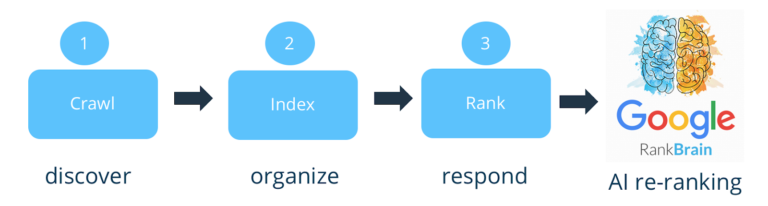
Officially announced and confirmed on 26 October 2015, RankBrain is based on machine learning. It helps Google process search results and provide more relevant search results to users.
If you are serious about SEO, you need to optimise your website for the RankBrain algorithm.
Why?
Google has announced that RankBrain is the third most important ranking signal for appearing on page 1.
And, on average, it is involved in 15% of queries.
In this guide, you will learn everything you need to know about Google’s RankBrain algorithm. And how to optimise your website for RankBrain.
RankBrain and Semantic Search
If RankBrain encounters a word or phrase it does not know, the algorithm can guess which words or phrases might be similar and change the result accordingly, making it more effective at handling unusual search queries.
RankBrain also looks for entities (things) or groups of words that have the best chance of matching. As a result, RankBrain tries to guess what people mean and changes the results, leading to greater satisfaction for users.
RankBrain and Semantic Search
RankBrain is linked to semantic search. Because RankBrain is an AI that relies on BERT, the Knowledge Graph, and other things linked to the semantic search engine that is Google. It interprets words as entities, things, rather than character strings.
This can also include the use of stop words in a search query (“the”, “and”, etc.): words historically ignored by Google, but which are sometimes of major importance for properly understanding the meaning or intent behind the search query (in a different way from BERT).
Once RankBrain’s results are verified by Google’s team, the system is updated and becomes operational again.
RankBrain vs Hummingbird
At its core, RankBrain is a machine learning system that builds on Hummingbird, which moved Google from a “character strings” environment to “entities and relationships”.
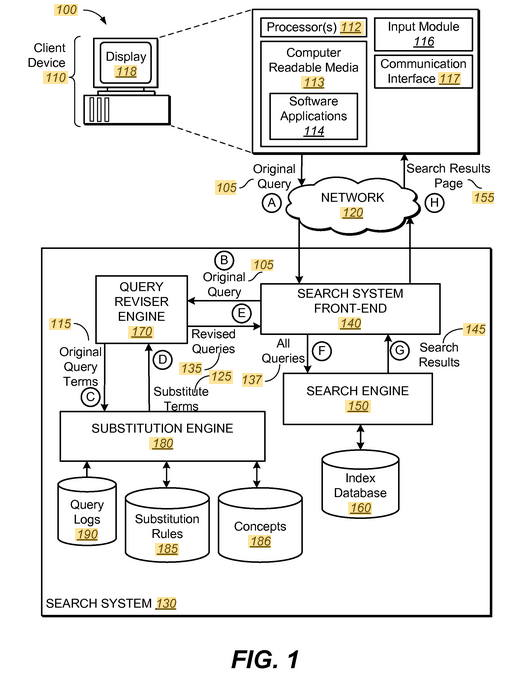
Behind the most likely patent underlying RankBrain, Google gives among other examples the following:
- Original query = “New York Yankees Stadium”
- Revised query = “Yankees?Baseball (“New York”: “Stadium”)”
Here, the substitution engine determines that the term “Baseball” is frequently a substitution term for the term “Yankees” in the context of the combined concepts “New York” and “Stadium”, and sends an indication to the substitution rule collection to add the substitution rule “Yankees?Baseball (“New York”: “Stadium”)” to the collection. For subsequent user queries containing the original query terms “New York Yankees Stadium”, the substitution engine can then apply the substitution rule “Yankees?Baseball (“New York”: “Stadium”)” and communicate with the query revision engine to include the replacement of the term “Baseball” in the revised query.
This patent is “Using concepts as contexts for query term substitutions”:
https://patents.google.com/patent/US9104750B1/en
As for Hummingbird, the algorithm allowed query terms to be replaced in the same way as RankBrain.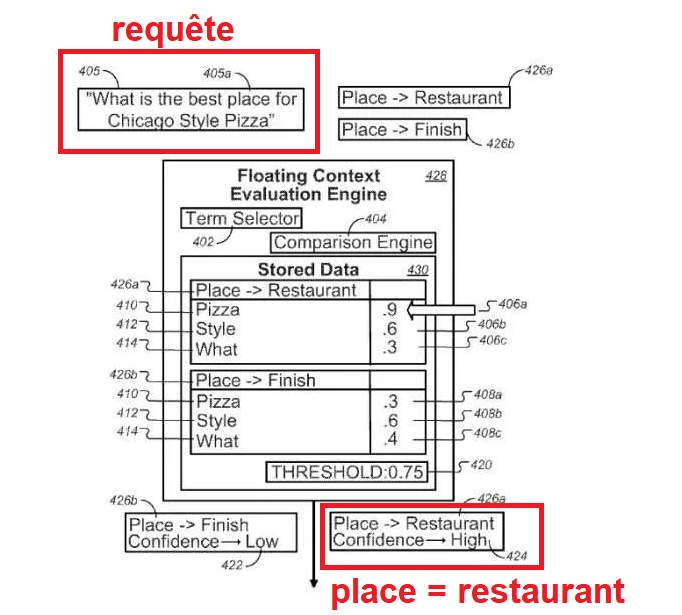
In this infographic of the most likely patent behind Hummingbird, at the bottom you can see that “place” is identical to “restaurant”. The query is in the top left.
This means that for this query, Google thus determines that the word “place” is equal to the word “restaurant”, so Hummingbird returned the same search results based on words meaning the same thing but described differently.
Furthermore, RankBrain relies on artificial intelligence to achieve the same thing as Hummingbird. Except that Hummingbird was not an artificial intelligence and was not necessarily connected to semantic algorithms.
RankBrain could rely on NLP and BERT models to change query terms in a way that meets users’ needs in a semantic web.
Also, one last interesting point to note: every day, Google sees new queries it has never seen before. This is particularly relevant since if RankBrain encounters a word or phrase it is not familiar with, the machine can guess which words or phrases might have a similar meaning and filter the result accordingly, making it more effective at handling previously unseen search queries.
Optimising RankBrain for Semantic Search
To put it simply, you need to add synonyms and co-occurrences to your text, or words from the same lexical field, and even mention entities. You can use semantic writing tools for this, such as SEOQuantum, YourTextGuru, or Inlinks.
You can also start writing headings (Hn) in a more natural language style.
That is what optimising for RankBrain means. You can also optimise the user experience.
Word Vectors and RankBrain
Google transforms words into vectors — that is how it has been built to rank documents. RankBrain uses vector spaces to understand what lies behind the query and what the human is thinking to a certain extent:
Particular embodiments of the subject matter described in this specification can be implemented to realise one or more of the following advantages. First, unknown words in sequences of words can be effectively predicted if the surrounding words are known. Second, the words surrounding a known word in a sequence of words can be effectively predicted. Third, numerical representations of words in a vocabulary of words can be easily and efficiently generated. Fourth, the numerical representations can reveal semantic and syntactic similarities and relationships between the words they represent.
By using a word prediction system having a two-layer architecture and parallelising the learning process, the word prediction system can be effectively trained on extensive word corpora, for example corpora that contain on the order of 200 billion words, resulting in better quality numerical representations than those obtained by training systems on relatively smaller word corpora. Furthermore, words can be represented in very high-dimensional spaces, for example spaces on the order of 1000 dimensions, yielding better quality representations than when words are represented in relatively lower-dimensional spaces. Additionally, the time required to train the word prediction system can be considerably reduced.
Thus, an incomplete or ambiguous query containing certain words could use these words to predict missing words that might be related. These predicted words could then be used to return search results that the original words might have difficulty returning. The patent describing this word vector approach prediction process is:
Computing numerical representations of words in a high-dimensional space
Inventors: Tomas Mikolov, Kai Chen, Gregory S. Corrado, and Jeffrey A. Dean
Assignee: Google Inc.
US Patent: 22 August 2017
Once again, adding a broad lexical field to improve Google’s understanding of your text and to appear for more keyword variations.
If you are not familiar with TFIDF and vector spaces, visit our article: How Google Understands Content and Gives It a Quality Score
RankBrain Weights Ranking Factors
RankBrain can help Google understand each query — this is the part where RankBrain determines part of the searcher’s intent.
RankBrain will essentially ask: “Now that I have understood the needs, which signals tell me how best to rank these pages?”
It is possible that depending on the keyword, RankBrain increases or decreases the importance of backlinks, content freshness, content length, domain authority, etc. In other words, it weights ranking factors based on a query.
RankBrain also accounts for local ranking factors.
Google’s algorithms always have a lot of vertical dimensions. Optimising for RankBrain therefore also involves measuring internet users’ satisfaction with search results. And this is very important to know for optimising your natural search engine ranking.
Google’s algorithms analyse whether internet users are satisfied with search results.

It is possible that depending on the keyword, RankBrain increases or decreases the importance of backlinks, content freshness, content length, domain authority, etc. In other words, it weights ranking factors based on a query.
RankBrain most likely relies on Learning To Rank.
It then examines how Google searchers interact with the new search results. If users prefer the new ranking, it stays. Otherwise, RankBrain starts again.
How Does RankBrain Measure User Satisfaction?
RankBrain may try to understand new keywords, or it is helped by other algorithms like Hummingbird.
But the real question is:
Once RankBrain displays a set of results, how does it know whether they are actually good?
Well, it could potentially observe, in the same way that A/B testing is done:
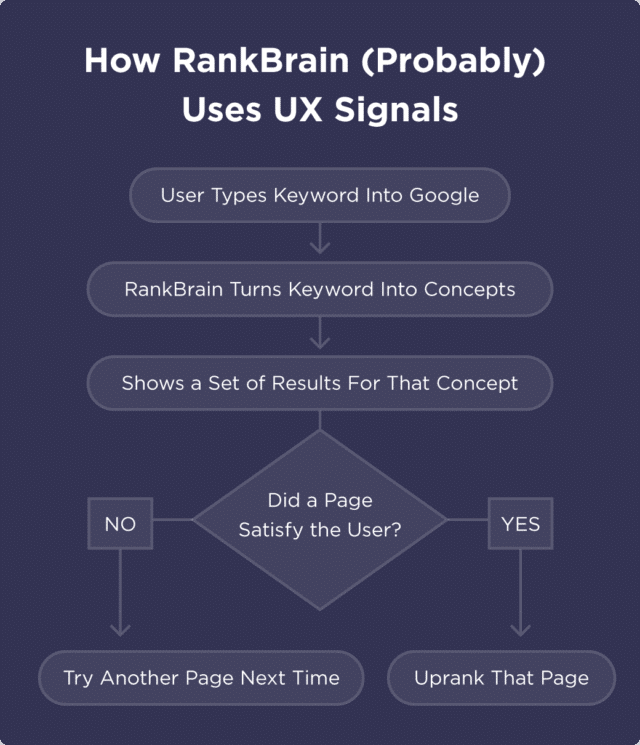
In other words, RankBrain displays a set of search results it thinks you will like. If many people like a particular page in the results, they will give that page a boost in ranking.
And if you dislike content? They will remove that page and replace it with another page. And the next time someone searches for that keyword (or a similar term), they will see its performance.
It pays particular attention to how you interact with search results.
Concretely, this refers to:
- Organic click-through rate
- Dwell time
- Bounce rate
- Pogo-sticking
Imagine that an internet user searches for help with SEO, but lands on a boring definition about search engine optimisation and is not satisfied with the content.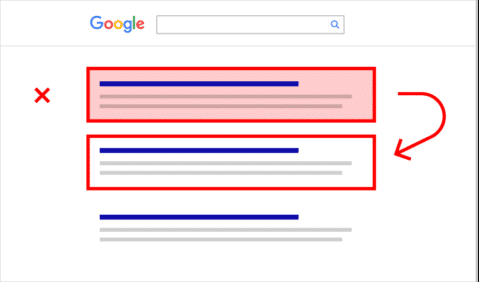
So you go back and select other content. This one is not much better. It is full of generic advice.
So you start again.
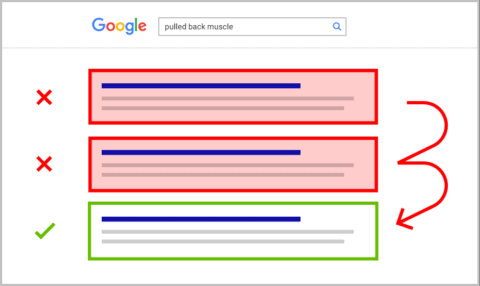
Then you finally find content that helps you deepen your knowledge.
Then, instead of clicking “back”, you spend 5 minutes reading the content, even clicking on new links on the same site to learn more.
This back-and-forth is called “Pogo-sticking”.
If Google notices that people quickly leave a page to click on another search result, it sends a strong message to Google: “This page is terrible!”.
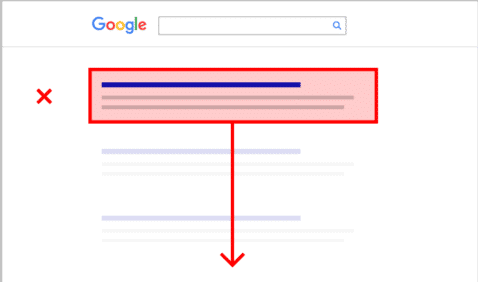
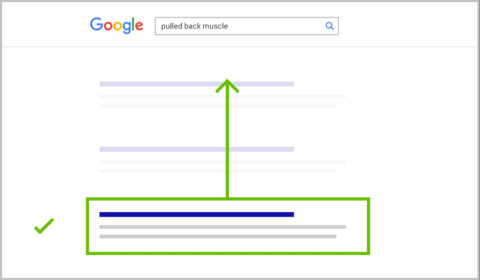
And if Google notices that many people stop leaving and returning to a specific result, they will give that page a boost to make it easier to find.
Many studies have detected CTR as a possible ranking factor as this corresponded with page positions. In any case, as a good SEO professional you must pay attention to this.
It is also important to note that in the patent indicated at the beginning, a sentence refers to user interaction:
A substitution term rule in a specific context identified by a concept can be determined empirically from user interactions with search result data. By extending the formation of a context beyond two words, the search system can determine substitution rules directed at more specific contexts and potentially improve search results.
How to Optimise for RankBrain?
Create content for the user experience.
This means:
- Hook the reader from the very beginning of the content
- Optimise your title tag and meta description to attract the reader
- Optimise search intent
Optimising Your Title Tag
Your <title> tag is poor. You know, the one displayed on search results. Stuffed with keywords.
That is not SEO.
The presence of keywords in a title tag has no ranking factor.
But optimising your title tag to attract clicks — that is a ranking factor. Moreover, you do SEO so that users see your page, so attract the click when you are on page 1.
What is the ideal title tag to create?
A catchy title certainly, but one that evokes emotion in the internet user is even better.
For example, here is a generic title tag:
Productivity tips: how to get more done
It lacks the “umph” that pushes people to click.
Here is how you could transform this title tag into an emotional powerhouse:
Crush your to-do list with these 17 productivity tips
Or better still,
Crush your to-do list: 17 productivity tips (& TIPS)
Or better still,
I will let you make your own suggestions in the comments.
How to Reduce Bounce Rate?
When an internet user arrives on a site, they want to find the answer to their questions directly. After that, if the topic interests them, they need to be able to read more on the same page. This will keep them on the page.
It follows that it is very important to ensure that the content provides the answer directly to their question.
But when they find it directly, this can impact your bounce rate.
For example, articles that can rank on Google News provide the answer in the middle or even at the end of the content so that users stay on the site.
I do not think this is a good long-term strategy.
The ideal approach, although I encourage you to run your own tests, is to provide the answer from the outset but give readers reasons to continue reading. This way, you do not deceive the internet user while keeping them on your page.
Optimising Semantics for RankBrain
Work on improving the semantics of your content for RankBrain by following these steps:
- Map your website according to content type and page categories.
- Analyse the presence of entities in your content and study how pages containing entities are linked to one another.
- Use named entities in your linked anchors and create sets of linked pages based on entity typology.
- Monitor the word count per page group to define ideal content metrics to maximise your crawlability.

Inrank flow: shows how internal linking popularity spreads across groups – OnCrawl Data
Summary on RankBrain
RankBrain is a search algorithm that uses artificial intelligence and machine learning to achieve better rankings of web pages. Named entities play an important role in the RankBrain system and can be used to optimise your content. It is also important to monitor loading speed, page weight, and user experience to improve your website’s ranking.