Induced strength is a concept created by the Peyronnet brothers, working via their SEO tool Babbar. Induced strength allows the ideal power of a link for a site to be calculated.
Induced strength fits perfectly within a well-crafted netlinking strategy.
If you did not already know, a domain’s authority (PageRank / DomainRating) is not a reliable metric. A more reliable metric would be one that calculates DR based on the thematisation of the links that make up its PageRank. Well, as it happens, this is exactly what the Semantic Value of the SEO tool Babbar does.
But there is still one flaw. Just because its links are thematised does not mean a site can give you a high-authority, thematised backlink for your site.
This is where induced strength comes into play. Induced strength calculates semantic proximity to determine which site would be the most optimised for obtaining a backlink.
Why Use Induced Strength?
The budget is not unlimited, nor is time. If you have several site options and you want to pay for your links or suggest guest articles to them, how do you choose the best site for your own? Between the PageRank of sites and the thematic proximity of their links, will these sites send you powerful and thematised links?
When you use a tool such as Ahrefs to look at the popularity of a site, or Majestic to see the trust of a site, you cannot see the true power of the links that said site could actually provide for yours — because you are not calculating thematic proximity (and you are not even sure the domain has not manipulated its PR).
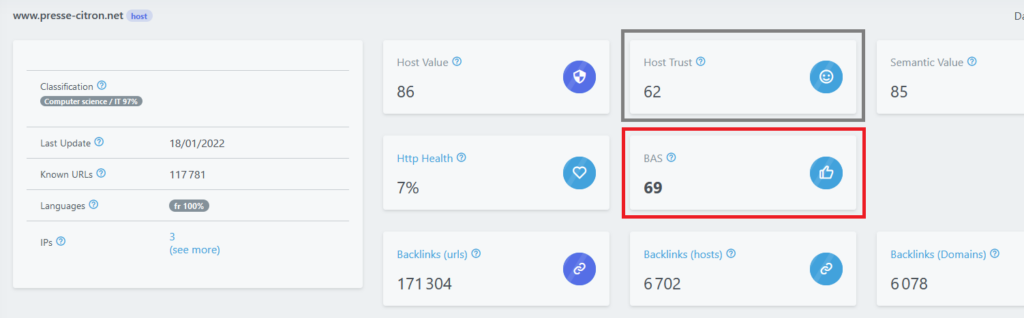
At Babbar, the Host Trust metric corresponds to the CF (Citation Flow) of a site, the Host Value to the DR (Domain Rating), and the BAS is the aggregated metric. Put simply, BAS — Babbar Authority Score — directly calculates the “true authority” of a site. But that is not all: you do not only have to rely on the BAS to judge whether one site or another is better. Also use induced strength.
While it is possible to do this manually, it is not at all optimised. On the other hand, nothing prevents you from checking for yourself by hand.
If you want to further optimise the power of your backlinks, you should take a look at the link anchors to use.
How to Calculate Induced Strength?
Calculating induced strength is very easy, but you will need to pay. By taking a subscription at €90/month at Babbar, you will have access to all the features — the tool is comprehensive and does many things beyond just calculating induced strength.

Once logged in, click on “Toolbox” then select “Batch Induced Strength”:

Once redirected to the relevant page, all that remains is to enter up to 100 URLs of pages from which you potentially want a backlink. On the right, you enter the target URL — the one that will hypothetically receive the backlink.

In this example, I took a few URLs that rank for the keyword “site creator” — my homepage also ranks for this same keyword.
Here is what Babbar shows us after the calculation:

IS is the induced strength metric — IS for Induced Strength. The maximum possible score is 100, but in reality you will very rarely see scores above 40.
The second metric is confidence — it indicates to the user the probability that the tool has correctly understood the thematic of the source URL in relation to the target URL. There are 2 possible confidence levels: LOW and HIGH.
Here, the tool tells us that Wix is the best site for obtaining a link (induced strength of 43). However, since the tool is not certain of its calculations, nothing prevents you from refining if you are in the same situation.
We can still see that a URL talking about “site creator” from Presse Citron has a significantly higher IS than the JDN article describing “10 steps to create a website”.
Taking thematic PageRank into account, it would be better to target Presse Citron rather than JDN. Presse Citron has a really close BAS, and while Journal du Net is still superior in terms of host popularity, it is not at all the best for obtaining a link (IS = 6).
JDN BAS 77 (IS = 6):

Presse citron BAS 69 (IS = 30):
How to Find Good Backlinks?
If you do not yet know which site to target, it is possible to use tools such as Ahrefs or SemRush — for example with its competitive positioning map.
Otherwise, there is also the “Similar Hosts” tool from Babbar:

Since the tool gives you the sites that are semantically closest to you, their links will potentially be very good. One idea among others would be to take a few URLs and suggest guest articles to them, while prioritising your efforts by calculating the best induced strength between these sites.
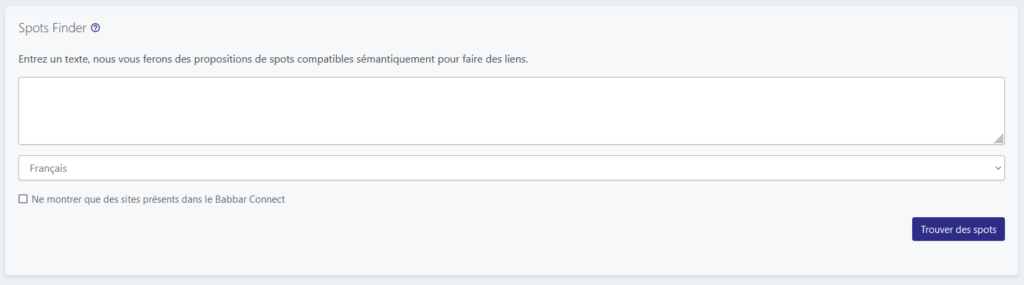
Otherwise, it is also possible to use Spot Finder — simply enter your text and Babbar finds the best backlinks to obtain for your page: