
A PBN, standing for Private Blog Network, is a set of websites — generally interconnected — allowing you to send a multitude of links (backlinks, transmitting authority) to a money site.
Google confirmed in 2016 that backlinks are one of the three main ranking factors. That is why this technique is so well known — a site needs backlinks, that is a fact. The problem with link building is that it involves off-page SEO (or off-site), and by definition you do not have total control over your off-page optimisations.
With a PBN, the game changes. It will be possible for you to create links, keep them, optimise them and send them in abundance to your main site. This technique is black hat — it does not comply with Google’s guidelines, just like link purchasing.
Moreover, if you are buying links, there is a strong chance they come from a PBN.
What Is a PBN?
Private Blog Networks or PBNs are simple to understand but technical to execute (to do correctly).
The idea behind PBNs is to create a massive quantity of backlinks from websites — generally blogs — which can themselves have high authority, pointing towards a main site.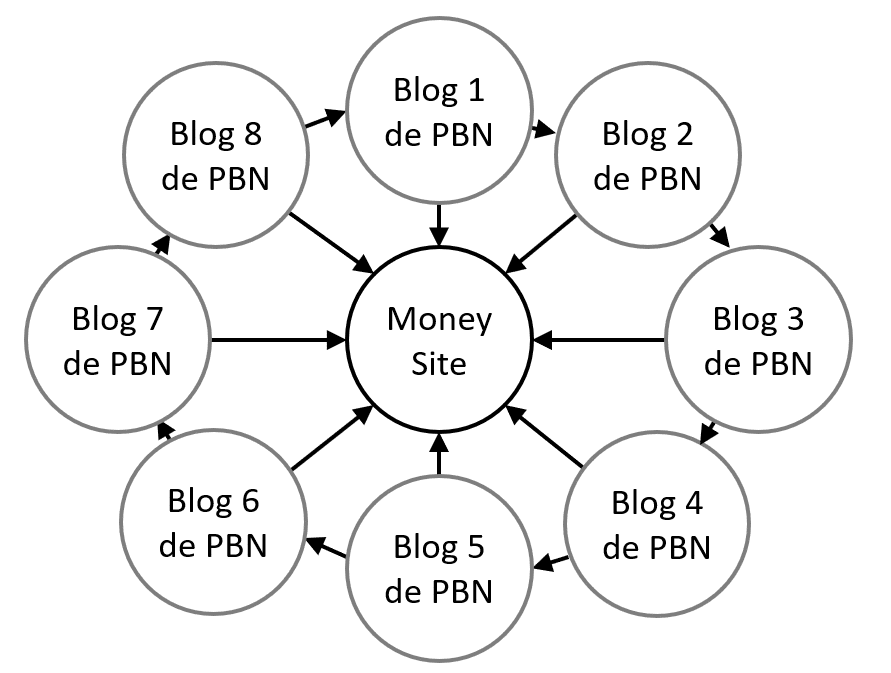
How Does a PBN Work?
If you did not know, a backlink has value especially when the site sending the juice also has authority (in part).
So initially, SEO professionals creating PBNs sent backlinks between all their PBNs so that they built authority among themselves, and then each PBN sent links to the main site. I can tell you this is no longer possible to do something so “dirty” today. Google will detect you.
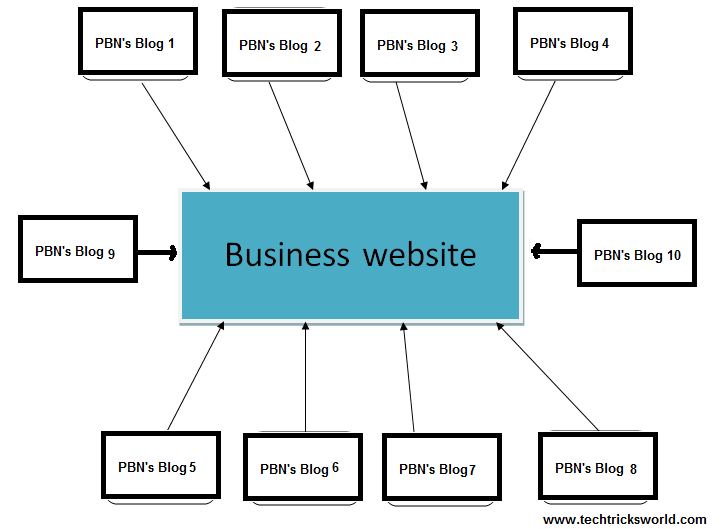
That is why — and also for simplicity — the majority of PBN creators today buy expired domains. The advantage being that expired domains have already acquired authority on their own and probably naturally. Therefore, they can directly send links to the main site while being much less detectable.
The Advantages of a PBN
A PBN can allow you to reach Google’s first pages, and that without much effort or money. What is even more remarkable is that by managing the blogs yourself rather than buying links, you will be able to create optimised internal linking strategies on your PBNs treating the same theme as your money site with an optimised internal linking treating the same theme as your main site. This may be complicated to understand.
What is important to remember: since you have total control, not only can you send links to yourself, but you can optimise them perfectly — through link anchor, article targeting and semantics. This could result in an ultimate netlinking strategy.
The Risks of PBNs
A PBN may seem like a dream, but only if done extremely well. While it is very simple to understand what a private blog network is in theory, it is not simple to do (correctly). If you over-optimise, if all your blogs have the same IP, if they all send links to each other — all these elements could send your site towards a manual penalty from Google. Or Google may simply not take into account the links you have created.
If this happens, you simply need to remove the links for Google to lift your penalty. Your site cannot die permanently if you are detected — not in 2024. The webspam hunt ended long ago.
It is still unlikely that your ranking will return to its previous position, given that unnatural links had artificially supported it. It is also possible that you will not be visible on Google for a short month while things return to normal.
In the vast, vast majority of cases, if Google detects a spam technique, it will rather ignore the links and therefore the juice they send. In other words, the backlinks will have no effect on your site’s authority — they will be completely useless as if they did not exist. But they will not be negative either, so you will not be penalised.
The risks exist, but they are not enormous. That is surely why SEO events are sponsored by 30 sites that sell links (some with PBNs) — if we can still call them PBNs.
Moreover, I wrote an article on the 5 best netlinking platforms if that interests you.
The Different Forms of PBN
The entirely private PBN: this type of PBN does not sell links. It is entirely private and is only there to boost your money site.
The link-selling PBN: type of PBN for selling links to other SEOs.
The marketing PBN: type of PBN that focuses on improving branding to make your site more visible but also to convert visitors. This implies a more natural construction.
Creating a PBN Correctly
If you want to do things correctly, I might as well tell you right now that it will not be a walk in the park. Even so, you do not need to overthink it as much as your money site — the purpose of this technique is still to save time and money.
If your PBN is poorly built, it is said to “leave traces” — what is more commonly called footprints (“footsteps”). Footprints are simple: they are common points between the sites that make up a PBN. And to create a good PBN there must be no common points.
Here are some examples of what not to do:
- All the sites look visually similar.
- They all have the same IP address
- The majority use the same type of anchors and treat very precisely the same themes
- Registering domain names on the same date, same for article or link creation (…)
- They do not use a “pyramid” structure…
- etc.
I do not advise you in any way to create a PBN. This is an explanatory and informational article.
The Basics — “Technical” Elements
Before even creating links or content, you first need to correctly set up the sites. This includes:
- Having an IP that does not match between each site composing the PBN (and your money site). The ideal would probably be to install each site on a different hosting and each domain name on a different registrar (lol). There are simpler methods, such as services like o2switch with its ipXtender tool allowing you to have up to 2,000 different IPs for each domain name, all while paying very little for hosting and domain name. However, if you want to do things more correctly, installing a VPS with multiple IPs is better.
- Knowing how to correctly buy an expired domain name. Avoid buying an old poorly-made PBN or an old spam site. For this it is fairly simple: analyse its link profile and use the Wayback Machine to see what the domain looked like throughout its life.
- Download WordPress. However, avoid using the same themes and plugins on each site. Also avoid calling yourself the same name as an article author.
- Do not have the same name as the site owner, on the hosting and domain name side. This element is easily verifiable via WHOIS, although it is possible to hide it with InternetBS for example. You can also use different names and still hide the WHOIS information.
10 Essential Tips for Creating a PBN
Here are some tips “in no particular order” if you want to create PBN sites:
- Avoid publishing simultaneously on all sites
- Maintain links between only a few sites and not across all of them
- Send links with non-optimised and sometimes optimised anchors — be natural. Also send links to other sites such as authoritative sites like Wikipedia (but not only). Be as natural as possible, and obviously create relevant links in the same theme.
- Do not put links to your money site in the menu or footer — links must be in the text content of articles.
- Create several pages before sending backlinks to your money site. Make sites with at least 20 pages.
- Articles on a PBN site must treat the same theme as the money site to which the link will be made. Also do not make 100 sites all treating very precisely the same theme as the money site. For example, if your money site has a blog about SEO, you can create a PBN about digital marketing and discuss SEO across several articles…
- Do not create duplicate content. No content spinning. In short, avoid doing black hat on your PBNs.
- Publish regularly — do not let the sites sleep. Also update plugins, design, etc.
- Add videos, images and other elements to your content. Texts must appear natural (you get the idea, I think).
- Always have “About”, “Contact us”, “Privacy policy”, “Legal notices”, “FAQ (Frequently Asked Questions)” pages etc., to simulate a natural site. (Do not always put the same name in the legal notices and do not put the same email address)
Or even, if you specifically edit your robots.txt, do not always put the same special code on all your sites. In the end, it is mostly common sense.
Creating a PBN the “Expert Way”
It is difficult to think of all the methods to create an undetectable PBN — moreover, if you have additions to suggest that I may have forgotten to mention, do not hesitate to ping me on Twitter or leave a comment.
However, here are 3 essential tips to ensure you build a good PBN.
Create PBNs with Personas
Do you know about buyer personas? Roughly speaking, “personas” are a marketing technique that precisely defines the people you are targeting. You give them a name, surname, you define what they do in their lives, what generally concerns them, and many other things that can be very precise.
Creating PBNs with personas allows you to create genuine identities. More than a target, it is a real person you define behind your site (one persona per site).
Beyond being able to fill in your legal notices and other things, when you create your articles, you could put yourself in this character’s shoes to change the way you speak.
Create a Pyramid Structure
Normally, there are already many sites that have talked about you — truly real blogs.
Simply send your PBN links to these blogs instead of sending them directly to your site. You therefore send one or more links to the specific page that has linked to you.
This way you increase the authority of a real link pointing to your money site.
If you did not understand: the power of a link depends mainly on the power of the page itself.
So if you boost the page of a real blog that has already linked to you, you boost the power of the outgoing links from that page. Therefore, you boost the power of a natural link pointing to your money page. You send your PBN links to the “real” blog to boost the link it gave you.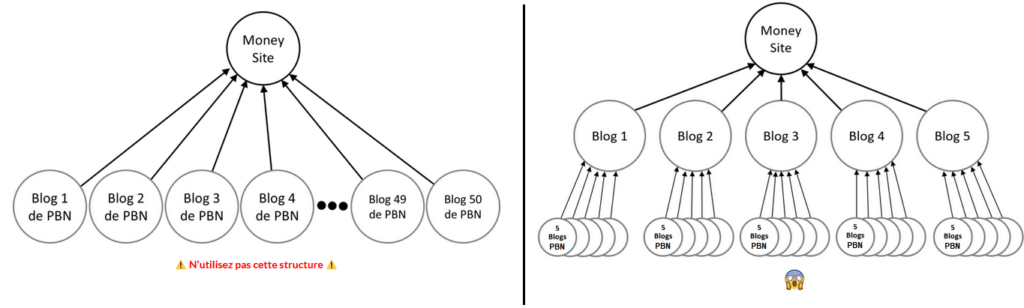
In terms of integrity, that is for you to decide.
With this technique, you can create super-optimised and almost undetectable structures.
To detect the entire PBN, a competitor (or Google) would need to finely analyse the link profile of each blog — which is time-consuming, complex, tedious and unprovable.
Check Whether You Can Detect Your Own PBN
What better way to build a good PBN than to try to detect it yourself?
If a competitor wants to outrank you, it is much more likely they will send a warning to Google for a manual penalty rather than Google detecting you itself.
For this they will use tools such as SEObserver, Majestic, Ahrefs… However, a whole article would be needed to explain all the different ways of detecting a PBN. (an article I may write one day).
In any case, if you have truly followed all the advice, you probably have nothing to worry about. You can always call upon an SEO expert to try to detect your PBN. If they manage it, ask them how they did it — you will then simply need to remove the footprints concerned.
PBN Content Creation
Once all the technical elements are respected and in place, all you have left to do is create the content. For this, it is very simple — equip yourself with a content generation tool (artificial intelligence) such as GPT-3, Jarvis or SEO-TXL.
Step 1:
Choose the subject of the article.
Step 2:
Create the article outline.
Step 3:
Generate the content automatically.
Here is an excellent video on this subject: https://www.youtube.com/watch?v=4tOT3PzOD9k