
You have surely heard about the importance of links in SEO and why netlinking is so effective. However, it is important to know that link anchors play an important role in the power of a link. In this article you will learn how to optimise your anchors and vary them to acquire more positions in search results, but also how to gauge your optimisations in order to avoid any Google penalty.
What Is an Anchor in a Link?
An anchor is the text containing a link, displayed to the user. It is the visible, clickable text that directs to a new page. Here is a link in HTML:
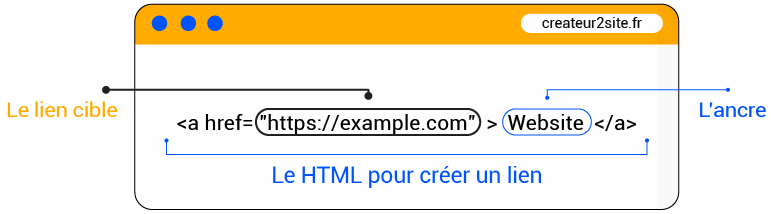
The anchor indicates to your readers the content of the link, but it also indicates to Google’s algorithms the subject of your link — much like a summary would.
The History of the Anchor
Anchors were very powerful in the past and produced aberrant results — this was not a problem for users at first, but it was so manipulable that it absolutely had to change. Today things have changed significantly, notably thanks to the launch of Penguin in 2012, an algorithm detecting overly abusive SEO techniques on backlinks and in particular against spam from over-optimised anchors on these links.
We can also note the arrival of Hummingbird in 2013, an algorithm that places greater emphasis on natural language queries, taking into account the context and meaning of searches rather than individual keywords. Moreover, in October 2019, Google published the BERT update, which uses natural language processing to understand and rank pages. And finally in 2021, Google communicated about MUM — an algorithm 1,000 times more powerful than BERT for understanding natural language.
What does all this mean? Not only today does an over-optimised anchor no longer have the same power as before, but it also needs to be natural in order to be optimised — since Google is getting closer and closer to user experience and natural language for ranking pages.
The Power of the Anchor in SEO
It is imperative to create descriptive anchors, allowing Google to know what the linked page is about. As we have seen, anchor text is a ranking signal and is included in several patents filed by Google. This means that using generic anchor text such as “click here” is considered a bad practice in SEO.
A relevant link can improve the ranking of your page (A) but also of the linked page (B) if it deals with the same topic. So show Google through your anchor that page B is indeed correlated with your page A and that they complement each other semantically.
The Different Types of Anchors
There are an infinite number of anchor types, but here are the most used and most common ones with their effectiveness and penalisation risk ratings:
Exact Match
The “exact match” anchor text includes the main targeted keyword of the page it links to. For example, the anchor “SEO optimisations” links back to a page about SEO optimisations.
SEO Optimisation: High
Risk: High
Partial Match
Anchor text that includes a secondary keyword of the linked page or a variation of the main keyword. For example: “improve SEO” links to a page about SEO optimisation.
SEO Optimisation: High
Risk: Medium
Brand
A brand name used as anchor text. For example: “vogue” links to the home page of vogue.com
SEO Optimisation: Medium
Risk: Low
Naked Link or URL
The naked link is the URL of the page you are sharing. This can be the domain name for the home page or a full URL such as for sharing a blog article. For example “https://vogue.com” or even “vogue.com” is a naked link anchor.
SEO Optimisation: Low
Risk: None
Generic
A generic word or phrase is used as anchor text. For example “Click here” is a common generic anchor.
SEO Optimisation: Low
Risk: None
Images
Whenever an image links to another page (linked image), Google uses the image’s alt attribute text as the link anchor.
SEO Optimisation: Low
Risk: Low
It is above all important to remember that your anchor profile must be natural and must not be over-optimised by only targeting your main keyword. Nor should you repeat the same anchor — the same text — over and over, whatever its type. That is common sense.
Pay Attention to the Surrounding Text
Google is increasingly improving the intelligence of its algorithms towards user experience. And when you read something, you refer to the text before and after — which is also why you have surely dared to make anchors like “click there”.
This means in an optimisation context that to create a good anchor, you also need to think about the surrounding text. Indeed, one can assume that Google already does this to some extent (BERT) and it will be even more determining in the future for analysing the relevance of your link and therefore your ranking.
Avoid repeating the same keyword in your sentence and then reinserting it again in the anchor of that same sentence. Also avoid creating anchors at the beginning of paragraphs without context.
Some Notable Information About Anchors
The optimisation of an anchor and its risk in SEO depends on whether it is present on an external site or on your own site (internal). There is no danger (or almost none) in optimising your anchors within your own internal linking. However, if you are doing external link building known as netlinking, it is imperative to diversify your anchors so as not to be penalised by Google (Penguin).
However, whether in the context of internal or external links, it is good to diversify your anchors to further optimise your SEO. Let me explain: as a general rule, a page for which you have targeted a main keyword will in reality only generate 20% of your visits to that particular page. This means that if you offer many variations of anchors with many different keywords, you optimise your other 80% of keywords that generate traffic, while also improving the main keyword since they necessarily deal with the same topic.
If you are worried about over-optimising your anchors, look at the competition. Google is an analytical machine — if you present no anomaly compared to others who have +10% more over-optimised anchors, you can potentially do the same thing. Conversely, if your anchor profile is over-optimised but the competition is not, you face a much greater risk of penalty.
Finally, do not forget that links absolutely must have a dofollow attribute to pass PageRank.
Summary:
It is important to remember that it is much more interesting to make varied anchors by incorporating multiple keywords, one at a time for those that allow you to rank. Also avoid using the exact target keyword (main) or “click here” anchors. Now that you know these principles, keep them in mind while remaining as natural as possible.