
Entities are specific terms in a document that describe a person, a place, a thing, or an idea. Semantic search engines use techniques to detect and identify these entities in documents in order to provide more relevant search results. Entities can also be used to organise and categorise information in a database.
By using entity recognition techniques, semantic search engines can understand the context and relationships between terms in a document. This allows users to ask more complex questions and receive more precise answers. For example, if a user searches for “who is the president of the United States in 2021”, a semantic search engine can use entity recognition to understand that the question is asking for the name of the person currently holding the office of president of the United States, rather than returning results about the history of US presidents.
In addition, semantic search engines can use entities to create links between documents and data sources. This makes it possible to connect information in a way that is not possible with traditional search techniques. Semantic search engines can also use information about entities to improve the quality of search results by ranking them according to their relevance or reliability.
In summary, entities are specific terms that are detected and identified by semantic search engines to provide more relevant search results, organise and categorise information in a database, understand the context and relationships between terms in a document, and to create links between documents and data sources.
Keyword versus Entity
Unlike a keyword, which is ultimately just a set of letters specific to a language, an entity carries meaning and is independent of the language and synonymous keywords that designate it.
More precisely, in the world of SEO, an entity concerns any subject that can be linked to the knowledge graphs of search engines, such as the Google Knowledge Graph.
We know that Wikipedia has acted as a primary set of trusted seeds for the Knowledge Graph.
Examples of Entities for Semantic Search Engines:
Here are some examples of entities that could be used by semantic search engines:
- People: Barack Obama, Mark Zuckerberg, Beyoncé
- Places: Paris, France, Eiffel Tower
- Things: iPhone, Tesla Model S, Harry Potter (book)
- Ideas : Artificial intelligence, gene therapy, climate change
These examples may vary depending on the domain or data source used by the semantic search engine. It is important to note that entities can be defined in different ways depending on the application or data source.
I emphasise that “ideas” can be anything. Entities are not simply places or people; for example, “search engine optimisation” is an entity.
How to Identify Google Entities?
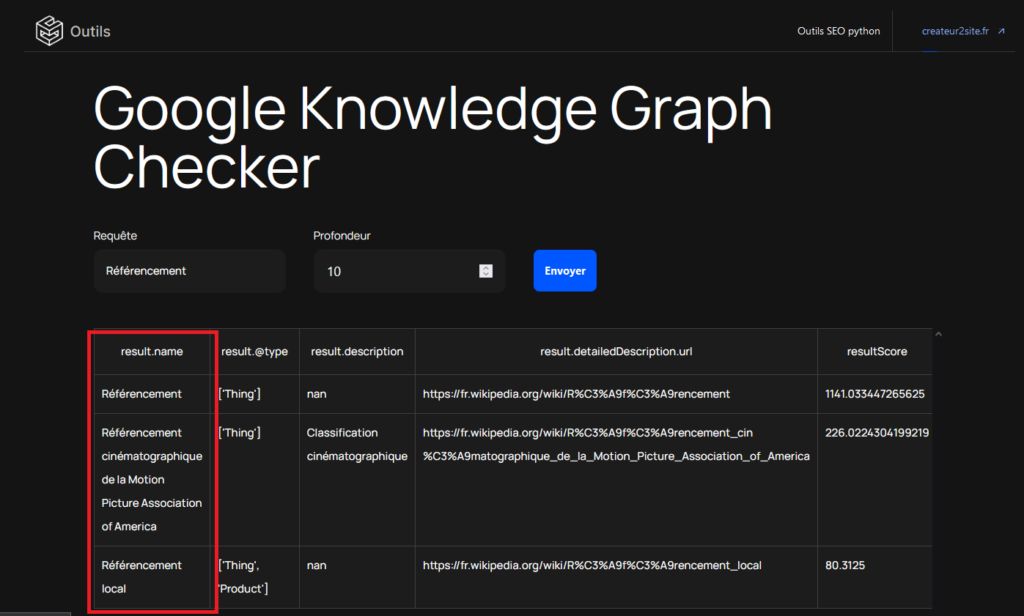
The simplest way is to use the Google Knowledge Graph API and see if a word is a GKG entity. You can also use Wikipedia because every subject it covers, to my knowledge, is a Google entity. I have also created a more visual tool to analyse all the entities related to a subject with respect to a parent entity. One could also speak of semantic analysis.
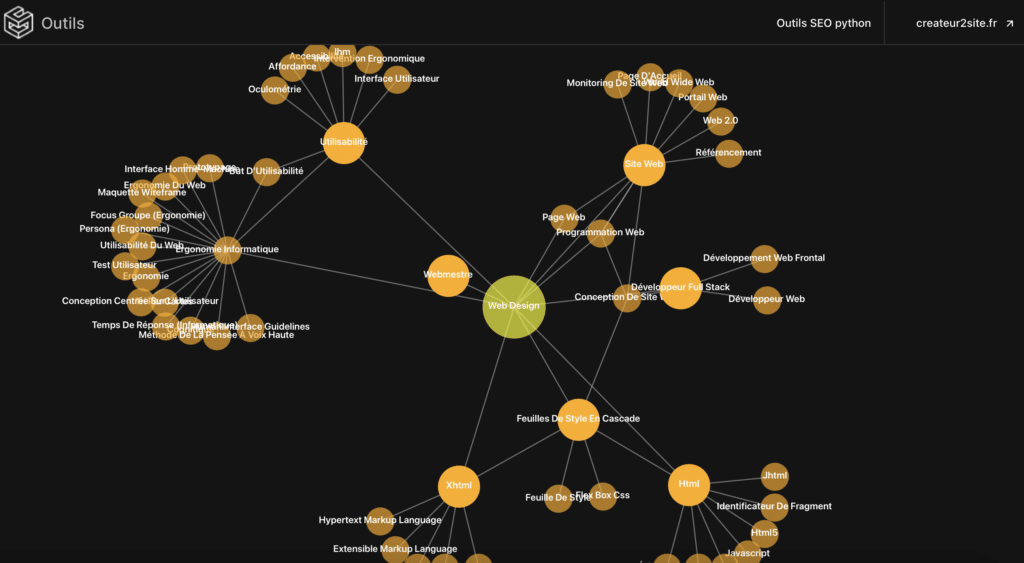
https://tools.createur2site.fr/wikipedia
Moreover, this is surely the most effective method along with the Google Knowledge Graph Checker API, also available from my tools (https://tools.createur2site.fr/google-knowledge-graph-check) because Google only lists entities if they correspond to the Wikipedia links associated with each word in their NLP API.
The Different Techniques Google Uses to Identify Entities:
There are different techniques for identifying entities, such as:
- Syntactic analysis, which uses grammatical rules to detect entities in a document.
- Machine learning, which uses machine learning models to detect entities in a document.
- Ontologies are a set of concepts and relationships that describe a theme or domain. Ontologies allow entities and the relationships between them to be defined.
Semantic search engines can use ontologies to better understand the relationships between concepts in a document and to organise search results based on these relationships. This allows users to ask more complex questions and receive more precise answers.
In summary, entities are key concepts for semantic search engines because they allow the content of a document or data source to be understood more precisely. Semantic search engines use entity recognition techniques (this technique is called NER for Named Entity Recognition, for example BERT is trained for this — it is a Google AI algorithm) to extract information and use ontologies to better understand the relationships between concepts in a document and to organise search results.
Here are some examples of patents enabling these entity extraction methods.
- Using queries for a given entity (entity search queries) to extract questions.
- Using search trends for entity attribution and entity relationship profiling.
- Using FAQ pages to see the different aspects of a given entity as well as the answers.
- Structuring information in the unstructured database (web) via commonalities and popular patterns for a given query group.
- Clustering entity types to group associated questions and queries.
- Extracting HTML tables to group statistical data and explore relational data.
- Using Entity-graphs to answer missing facts about another entity.
- Using ontology to understand and define the merged attributes of an entity via web documents.
- Classifying queries with micro-intentions and characteristics as well as “click satisfaction” patterns and user preferences.
- Defining different phrases for the same entity, determining the phraserank for a given entity.
- Generating different and related questions for a given entity via web documents.
- Using context vectors and Word2vec for named entity disambiguation.
- Using images on web documents to identify entities on web pages and their relationships.
- Using quality and authority scores for images to reinforce the confidence score for a given entity-query relationship.
- Using web documents, links, text, images, videos, subtitles, mentions, comments, views, music, applications, search queries, trends
- Using already structured data such as the Wikipedia site or other similar sites (CIA FactBook, etc.)
- …

Can Entities Improve Your SEO?
Yes, the use of entities can help improve a website’s SEO. Search engines use entity recognition techniques to understand the content of a website and to rank pages based on their relevance for a given query.
By using relevant entities and integrating them naturally into the content of your website, you can help search engines understand the subject of your site and rank it based on its relevance for specific queries. This can help improve your site’s ranking in search results for relevant keywords.
Entity SEO Optimisation Suggestions:
Entity SEO optimisation means doing semantic SEO, so I invite you to read the full article on this subject.
However, here is a short summary for doing entity referencing:
- Find the entities in your theme
- After identification, enrich your site with content that covers not only your products and services, but also topics related to your area of expertise (i.e. the entities), in order to reinforce the relevance of your site for the subjects for which you want to rank in search results.
- Create a cluster linking entities in a coherent manner
- Add semantic structured data to your content
- Become an entity