
Semantic SEO writing consists of writing for semantic search engines, i.e. structured search engines such as Google. Semantics is as much about synonyms, lexical fields, vector space as it is about entities linked to the Knowledge Graph. It therefore means writing so as to cover a topic with keywords that revolve around a main keyword, as well as entity writing.
- The most important concept in semantic writing is triple writing, which can also be called entity writing in unstructured data.
- Then, it is necessary to always think about disambiguating your ideas so that Google can understand what you are talking about, in a general way and not only for entities.
- Finally, equip yourself with a SEO writing tool or semantic SEO writing tool. This will allow you to add words that are close in the same vector space to improve your thematic relevance, to align your content for AI with sentiment analysis, and many other good things.
Note: (2) Google does not always guess what is behind a word or a phrase, despite its artificial intelligence and natural language processing (NLP) algorithms such as BERT. So, specifying what you are referring to will also allow it to spend fewer resources. Moreover, this could also help your readers who are not necessarily expert enough to understand your content.
Context: A Semantic Web and Semantic Search Engines
Semantic search engines such as Google use knowledge bases; more precisely, everything is grouped in a knowledge base called Google Knowledge Graph, which itself uses sources such as Wikipedia and other sites that have proven their authority to understand entities.
Entity extractions are carried out using different natural language processing (NLP) techniques, and factuality is tested using the Knowledge Vault and/or technologies such as KELM.
In short, Google can understand the meaning of a word by connecting an entity from your text (this can be a name, a date or something else) to its Knowledge Graph.

Image from a Google patent showing entity extraction using NLP technology linked to the Knowledge Graph
Thus, by writing in triples, you allow Google to understand exactly what you are talking about.
This is done by specifying a verb.
But if you wish to understand everything, go to our article on search engine optimisation in a semantic web.
Writing SEO Content in Triplets
As the name suggests, a triplet is a set of 3 entities connected by a relationship. This allows clear and precise information to be given for semantics.
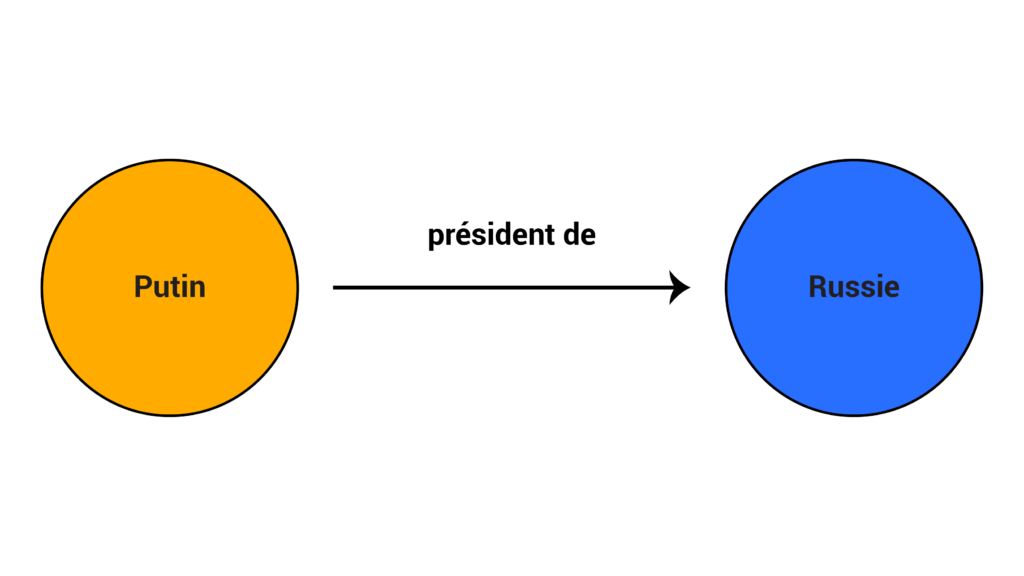
You can also say subject -> verb -> object
Or even Subject -> verb -> Subject
Wait. Let me provide you with examples.
What Is an Entity?
An entity can be a name, a date, an event, and anything at all as long as it has an identifier on Wikidata or a Wikipedia page.
We generally talk about entities to designate the nodes of the Google Knowledge Graph. Most KG entities come from Wikipedia and Wikidata.
Example of Triple Writing
An example of a semantic triple is:
« Tom Hanks is an actor »
or « Tom Hanks knows Rila Wilson ».
This is an example I extracted from a real Google patent. It is called “Generating Insightful Connections Between Entities in the Graph”.
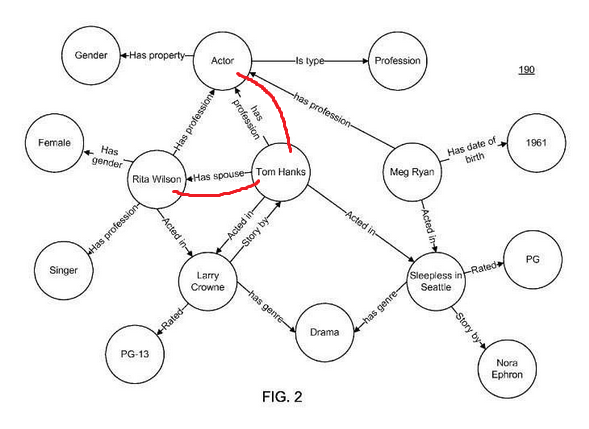
In this case, knowing that Tom Hanks is connected to Rila Wilson allows search engines (here Google) to do things like this:

Google extracts this unstructured information from texts across the entire Web and can verify the accuracy of your information.
Thinking about semantic writing is a genuine mindset to adopt, and not merely settling for saying that your content is comprehensible for search engines when it is not!
Historically, the components of a triplet, such as “The sky has the colour blue”, consist of:
- a Subject (“the sky”)
- a Predicate (“has the colour”),
- and an object (“blue”)
This is similar to the classic notation of an entity-attribute-value model in object-oriented design, where this example would be expressed as:
- an Entity (sky),
- an Attribute (colour)
- and a value (blue).
An example that might speak more to you in the SEO field is:
Word2vec allows Google to understand the meaning of words through vector spaces (word embedding + tfidf).
Whereas a triple writing approach would rather resemble a sentence beginning like this:
Thomas Mikolov is the inventor of Word2vec, […]
In this example, we have a triple writing with an entity, a verb, an entity. (In reality the verb is also an entity — https://en.wikipedia.org/wiki/Inventor).
Thus, Google can better understand your content, better extract your sentences for its featured snippets, and many other things.
Such writing for semantic SEO content is ideal.
Clarifying Entity Mentions in Your Text
Triple writing allows Google to identify that you are mentioning an entity in an unstructured way. But you can also clarify the entity your text refers to in different ways, or by combining several techniques.
Clarifying entities from your text in your structured data (JSON-LD schema):
<script type="application/ld+json"> {
"@context": "https://schema.org",
"@type": "WebPage",
"headline": "The Works of Thomas Mikolov",
"about": [
{"@type": "Thing","name": "SEO","sameAs": "https://en.wikipedia.org/wiki/Search_engine_optimization"}
],
"mentions": [
{"@type": "Person","name": "tomas_mikolov","sameAs": "https://en.wikipedia.org/wiki/tomas_mikolov"}
]
}
</script>
Inlinks.net automatically extracts the entities present in your pages and places them in your structured data for you.
And/or perform wikification. That is, send a link to Wikipedia so Google can disambiguate your entity/topic:
<a href="https://en.wikipedia.org/wiki/Tom%C3%A1%C5%A1_Mikolov">Thomas Mikolov</a> is the inventor […]
Finding Entities Related to a Topic
Now that you know how to write triple sentences to disambiguate your entities, you would probably like to know the relevant entities for your topics.
This can be a date, an object, a thing.
Thus, the simplest approach is to rely on the “topics” from semantic SEO tools. Otherwise you can look at a Wikipedia page and see all the related entities linked to the topic in order to identify everything that Google could actually understand. It is up to you to judge how deep you should go.
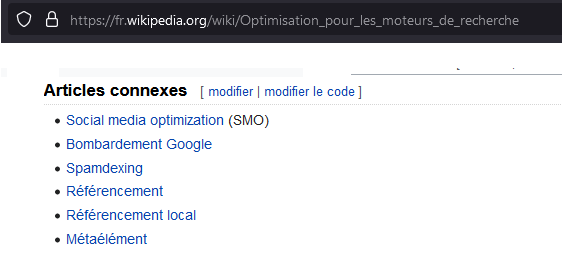
You can also try my SEO tool to discover the structure of Wikipedia:

Additional Tip for Query Entity Discovery: Use Facts
Factual content builds trust: it is preferable to provide context around certain statements and advice on the site. Include facts from authoritative sources to avoid misinformation and support your opinions.
You can use factcheck when writing.
https://toolbox.google.com/factcheck/explorer
If you wish to see more tips on Google E-A-T go to our dedicated article.
Semantic Writing SEO Tools:
Google Docs
It is possible to do semantic and entity writing from Google Docs. By clicking on the small icon at the bottom right:

Once clicked, you will have an overview of the main topics:

You can also click on “More” and browse all related topics:

Semrush SEO Writing Assistant:
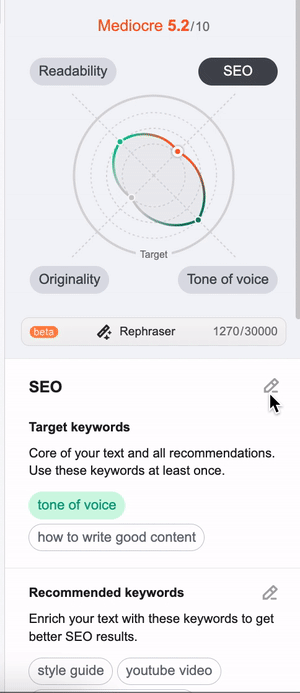
SemRush’s tool called SEO Writing Assistant packs a tonne of technology to suit semantic SEO and artificial intelligence. In addition, it exists as a plugin for Google Docs so no excuse for not integrating it into your content creation strategy! It is also available as a WordPress plugin if you write from your CMS.
A great winning duo…
InLinks
InLinks is a tool that allows many things to be done for semantic SEO, which does not exclude semantic writing:

WordLift
WordLift is a very good tool for semantic writing. It is in fact what it focuses on. It will allow you to classify your content, create and modify entities, generate structured data and other things. Ideal if you use WordPress.

What WordLift can do for your website is available here: https://wordlift.io/how-it-works/
Other Semantic Writing Tools
There are other semantic SEO writing tools, different ones, such as:
Optimise Your Content for a Topic
Writing for a topic means that you always write for keywords but rather for a set of keywords linked to a main topic. Which could clumsily be called LSI keywords (Latent Semantic Indexing), even though that is a myth and a marketer’s SEO term.
Think of it more like this.
Even if it is always essential to choose a topic and assign a main keyword to it, you must fill your text with related, synonym and complementary keywords or ones in relation to this main keyword (semantically close words, i.e. close in vector space).
This also helps to disambiguate your content for Google.
Let us take an example with the word “avocado”.
Depending on its context, it can refer to the fruit or the profession (lawyer in French).
Now, if you add a small word, you shift the semantics:
Choose a ripe avocado = fruit
Choose a specialist lawyer = profession
If we take a concrete example for this article:
An internet user searches: semantic writing
Another internet user may search: entity writing // triple writing
Besides, it is worth mentioning that this is useful for Hummingbird, for RankBrain and for BERT to rank search results. That is to say, it is sometimes unnecessary to create 3 pages if the meaning of the query is identical according to the phrasing — the SERPs will be the same.
Finding Semantic Keywords
All this is interesting but how to find a tonne of semantic keywords?
Let me (re)introduce you to a fantastic tool, InLinks and its semantic keywords.
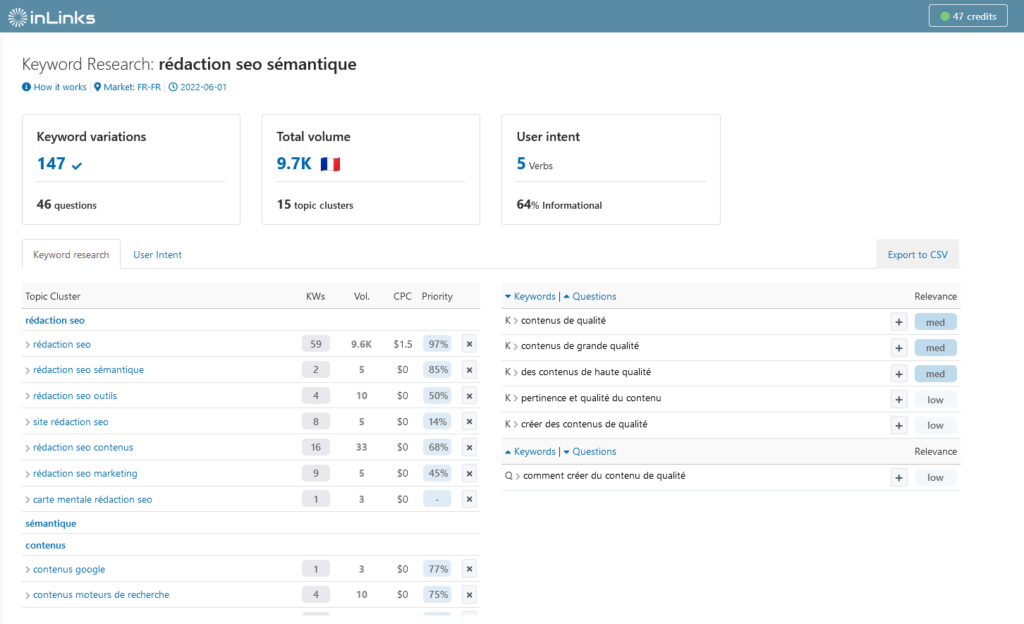
Depending on the topic, InLinks can take easily around ten minutes.
Once finished, you can see all the topics related to the main topic as you see above.
You will then have access to all searched keywords, as well as the search intent connected to a verb.
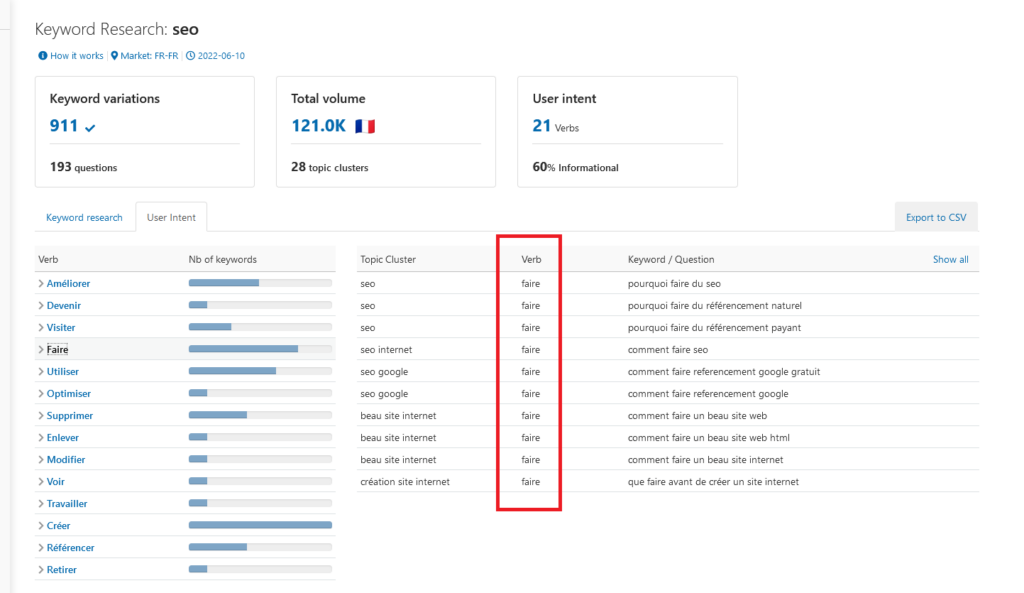
This will allow you to create a better writing plan, have an idea of advanced internal linking, of PAA…
On the content optimisation side, you will have access to an editor to increase your content score:

After clicking on the dropdown icon, you will have access to important words to place in your text as well as the Wikipedia article related to the topic:

There are plenty of other things that InLinks does; the best thing is to try it yourself.
Reminder of SEO Writing Fundamentals
Classic SEO writing as everyone knows it is obviously still very important to take into account.
- A good architecture of Hn title tags — HTML semantic elements are assigned a score by something like BM25F.
- Always think about search intent.
- With a good dose of obvious SEO writing evidence.
- Avoid placing anchor text in the first paragraph of the page.
- …
Frequently Asked Questions for Semantic SEO Writing
What Is Semantic SEO Writing For?
The overuse of a single term, called keyword stuffing or content spinning, is a thing of the past. SEO is a complex concept that extends beyond a random insertion of keywords. Lexical variation and semantic enrichment circumvent the risk of abuse. This approach therefore remains a natural and legal way of optimising content while avoiding penalties.
What Is a Lexical Field?
Lexical fields are groups of words that relate to the same idea.
Example: Holidays: Sand, sun, beach, mountain, having fun, lie-in…
SEO optimisation? Could help to disambiguate a concept for Google.
What Is a Semantic Field?
In lexicology, the semantic field of a word is the set of available meanings of that word depending on context. A semantic field is the set of polysemous words. Semantic analysis is probably a more appropriate term.
Example: Strawberry: the fruit / the dentist’s drill bit / the collar ruffle of 14th century nobles / the drill bit.
Conclusion on Semantic Writing
I would say that semantics forces us to write better than we would naturally. Think about explaining all the related topics, think about explaining things well, mention entities by writing in triples and checking factuality.
Semantic writing is goldsmithing in SEO. Few people do it, so take advantage of it.