Semantic SEO makes entities understandable and connects them to the Google Knowledge Graph.
One way to make entities understandable is to define a vocabulary for things and the contextual relationship between them — the Schema.org vocabulary founded by Google, Bing, Yahoo, and Yandex.
In this guide you will discover everything that is important to know about semantic structured data.
If your website contains a large amount of content, semantic structured data can help describe, categorise, and connect your content in a way that helps search engines better understand it.
How Semantic Structured Data Works
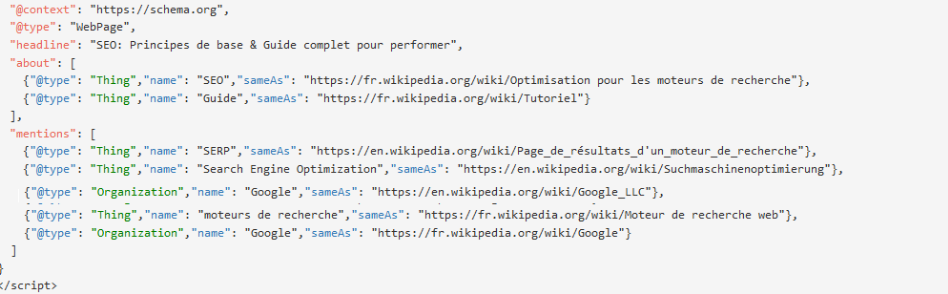
You can use the Schema.org property sameAs to reference the URLs of associated web pages. This informs search engines “this is the same thing as what you will find at this address” and helps connect entities. It provides context, and context allows Google to disambiguate multiple versions of the same entity.
InLinks is one of the only SEO tools that automatically generates and connects all related entities across your pages via structured data.
The “about” value is the most important. Indicate the main entities of your text.
The “mentions” value is less important, but it allows you to connect entities related to the main topic.
Optimising Your Semantic Structured Data for SEO
- Be precise: The more precise you are, the better.
- Add as much as possible: when describing an entity on your website, the more information you provide, the better it is for SEO. Just make sure all the data exists on your page.
- Multiple semantic elements: you could for example link your semantic structured data with a breadcrumb that also connects your entities in addition to doing so at the internal linking level.
Define your main entity using mainEntity and describe its relationships with other entities using URL, sameAs, and About.
- Define your main entity: to define your main entity, the mainEntity property allows you to explicitly express the relationship between the page and the main entity. For example, use mainEntity to clarify which of several entities is the primary one for this page.
- Use URL: the URL property should be reserved for referencing more official or authoritative web pages, such as the official website of the item.
- Link your data: the sameAs property also associates a thing with a page that indirectly identifies it. Such as a Wikipedia page or, for a product, sameAs can be the manufacturer’s official website with specifications.
- About vs mainEntity: about is similar to mainEntity, with two key differences. First, about can refer to multiple entities/topics, while mainEntity should only be used for the primary one. Second, some pages have a main entity that describes another entity. For example, a web page may display a news article about a particular person. Another page may represent a product review for a particular product. In these cases, mainEntity for the pages should refer to the news article or the review respectively, while about would more correctly refer to the person or the product.
Why Semantic Structured Data Matters for SEO
Structured data is important for SEO because it allows Google to more easily understand what your pages, services, and website are about.
The benefits of using structured data include, among others, increasing your organic traffic, increasing click-through rates, greater search visibility, faster indexation, and feeding the Google Knowledge Graph.
Currently, to my knowledge, barely 50,000 domains use this semantic structured data strategy. This means it is your opportunity to make a difference with a semantic SEO strategy.
Here is a non-exhaustive list of the benefits of this strategy.
1. Increase Your Organic Click-Through Rate (CTR)
Structured data can make you appear in rich results. One of the advantages of rich results is that they increase your website’s click-through rate because you do not need to be on the first page of Google to appear there. Rich results can include carousels, images, reviews, Q&As, or other elements that classic search results do not have.
2. Faster Indexation
Structured data can help Google crawl your website more easily and index it more quickly. Crawling is expensive, and there is a lot of duplicate and low-quality content that the search engine wants to keep out of its index, so make sure to optimise your crawl budget.
3. Connect to the Google Knowledge Graph
Structured data provides the Google Knowledge Graph with relevant information about you, your business, and your website.
The Knowledge Graph is a database connecting all kinds of data that Google finds on the Web. This data is created from both structured and unstructured data.
By using what Google has decided is important to place in its knowledge base, you become more relevant. It also helps Google understand your web pages because it has already understood what you are referring to.
If you do not yet know what entities, the Google Knowledge Graph, and semantics are, you should come back to this article later and carefully read the articles above it.
Conclusion
Use structured data to describe your content.
Write in a way that translates into structured data. That is, link your structured data with semantic writing and therefore triple semantic writing. You can also create semantic internal linking, always on this principle of grouping entities in a relevant way.
To optimise your schema markups for SEO, it is recommended to:
- Choose the right schema type.
- Define a main entity using mainEntity and describe its relationships with other entities using URL, sameAs, and About.
- Assemble a schema ID with the HTML identification tag of your entity.
To optimise your structured data for semantic SEO, it is recommended to:
- Link your entities to authority websites to provide context.
- Nest your entities with other relevant entities to describe their relationships.
- Build semantic networks.
- Make your site appear in Christmas trees (rich results on SERPs).