
Semantic search is different from a simple keyword search because it studies the meaning of the query and its search intent.
Before information retrieval systems such as Hummingbird, RankBrain, and BERT (for Google) were introduced, search was essentially lexical search.
That is, search engines looked primarily for character-string matches and their frequencies between the query and the corpus (N-gram analysis, TF-IDF, and so on).
Today, search engines look at character strings but also at meaning and entities.
Concretely, what does this change?
Consider a query like: “When does it get dark?” and “What time is sunset?”. These sentences have the same meaning, but the words are completely different. That is precisely the value of semantic understanding for search engines — both queries should return the same results.
But that is not all. Semantic search engines now focus on the user’s “intent” and aim to go beyond the dictionary meaning of a word.
Knowledge Graph, Hummingbird, RankBrain, BERT, Neural Matching and semantic search
When Google announced the Knowledge Graph in 2012, it began profiling people, songs, places, countries, nations, and events (these are what are known as entities).
Hummingbird replaces individual words and understands full phrases — it analyses long-tail queries as a single unified component rather than as a sequence of separate words.
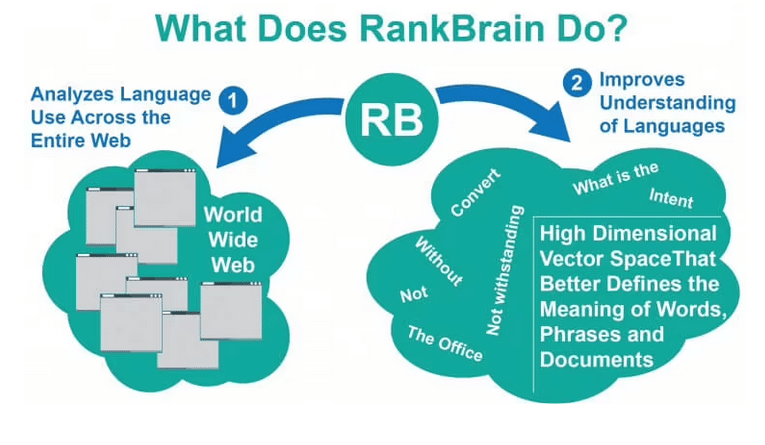
RankBrain measures whether a document can provide a successful and reliable search result for a given query.
With the BERT algorithm (Bidirectional Encoder Representations of Transformers), Google began reading content from right to left and from left to right, thereby better matching queries to content and capturing search intent.
Neural matching performs Query/Document matching by measuring what a query means, attempting to capture meaning and concepts.
But there are many others, less well known, such as Google’s patent on semantic keywords (semantic relationship graph), which describes a method for ranking keywords using a semantic graph.
The semantic graph is a graphical representation that connects keywords to each other based on their semantic relationships. Keywords are represented as nodes in the graph, while semantic relationships are represented as edges between nodes.
Google’s patent describes how to use this semantic graph to rank keywords by their relevance to a particular search query. By using the semantic graph, Google can determine the semantic relationships between keywords in a query and use this information to refine search results.
The aim of this approach is to provide more relevant search results by understanding the underlying meaning of the keywords used in the query. For example, if someone searches “apartment to rent in Paris”, Google can use the semantic graph to understand that “apartment”, “rent” and “Paris” are connected by a real-estate rental relationship, and refine the results accordingly.
This patent is an example of how Google uses semantics to improve search results and provide a more useful and relevant search experience to users.

You can find a wealth of Google patents on semantics on the SEO By the Sea website.
Hummingbird and semantic search
The Google Hummingbird algorithm detects and includes connections between queries in context in order to better satisfy users.
With the Hummingbird algorithm, Google began focusing on “phrases” rather than individual words.
The Hummingbird algorithm also helps reconcile synonyms and similar queries. As a result, Google began favouring long-form content with better comprehensiveness and more information over time. Because long-form content has more “associated words” and “synonyms”, it carries more “semantic queries” and “associated information” for search intent. Thus, with fewer pages, Google creates a more effective search engine results page.
Consequently, the search engine uses different concepts such as “Query Rewrite”, “Dominant Search Intent”, “Canonical Query” and “Sub Search Intents” — all intimately linked to Hummingbird and its related algorithms.
RankBrain and semantic search
RankBrain consists in understanding first-instance queries and linking them with associated concepts and phrases, as well as synonyms. Associated terms and synonyms within a contextual relevance help create a more semantic search experience.
BERT and semantic search
BERT (Bidirectional Encoder Representations from Transformers) is a highly important Google algorithm for semantics.
It enables better understanding of content (polysemous words, for example), extracts information, detects entities and their relationships, and greatly improves the ability to capture a user’s search intent.
Neural Matching and semantic search
This method connects words to concepts.
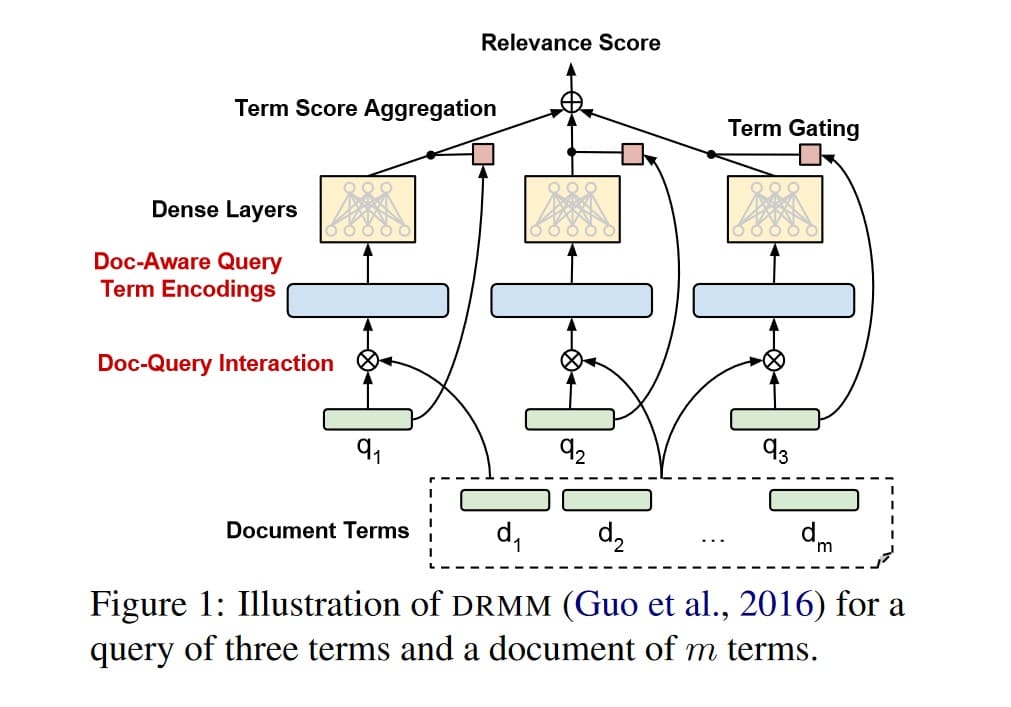
This technique uses classic ad-hoc extraction such as TF-IDF and the Salton cosine to match sentences in documents against needs expressed in searches. Supported by the Deep Relevance Matching Model (DRMM) for ad-hoc retrieval, the neural matching algorithm thereby achieves a better understanding of the meaning behind queries.
https://arxiv.org/pdf/1711.08611.pdf
https://www2.aueb.gr/users/ion/docs/emnlp2018.pdf
Semantic search results
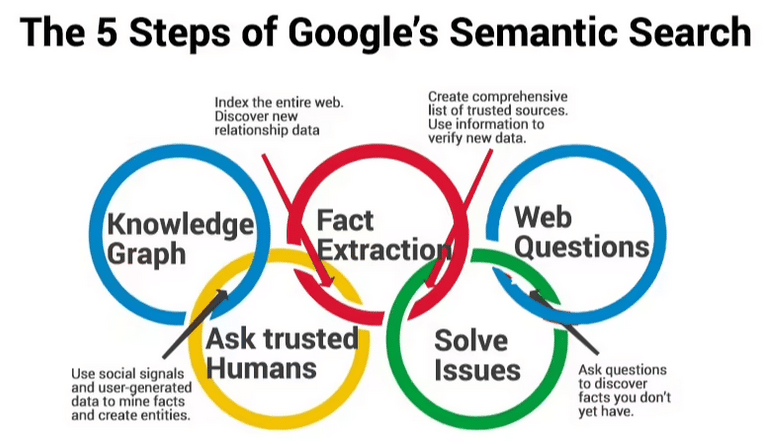
Search engines such as Google and Bing store billions of “facts” and “millions of entities” in their knowledge bases, while also recording the connection between each entity. Entity search queries, canonical queries, and query rewriting methods allow information to be delivered to users in the most complete format possible.
Here is a short infographic summary of possible stages in semantic search:
Dynamic multi-intent search results
Dynamic search results are the fruit of semantic search.
If a user searches with a local intent, the SERP will include a Google Maps panel and Google Business Profile listings.
More interestingly, if a user searches for “t-shirts”, a semantic search engine will display semantic search results — that is, results related to the query by relevance. This will include results linked to t-shirts but also to the most probable semantic intents relative to the query, such as polo shirts.

These are nothing more and nothing less than “semantic bubbles”, more broadly called “query refinement bubbles”.
Semantic search also displays different types of search intent based on user profiles.
It can also adapt when there are fluctuations in specific search demand (breaking news, events, and so on).
Whether on Google or Bing, you can also obtain sidebars to refine the “context of your search”.
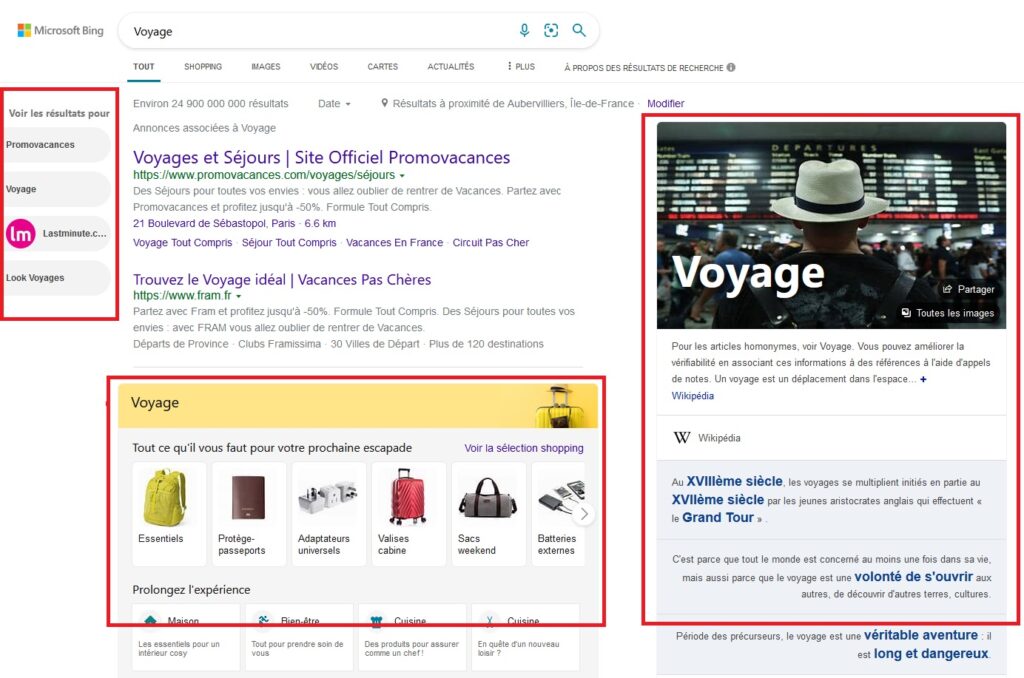
The dynamic SERP content and the search context refinement sidebar show that search engines group content on the web based on its context.
Thus, creating different verticals for different contexts within SERPs allows search engines to display content that is more tailored to users based on their intents and search behaviours.
Indeed, rather than choosing “the dominant search intent” and “the most dominant source for a specific topic”, diversifying the SERP with different contexts can help search engines surface more content.
A recent patent, published on 4 January 2022 (US-11,216,503), shows that Google may not sort results by the quality of matching documents for query terms, but rather groups topics and relationships between entities as part of its decision on what to include in the SERPs.
Search results linked to Knowledge Graph entities
What is also impressive and very important for an SEO professional is the link between Knowledge Graph entities and semantic search results — and thus semantic search itself.
For example, if we enter “shoe” in the Google Knowledge Graph API, we get back the following:
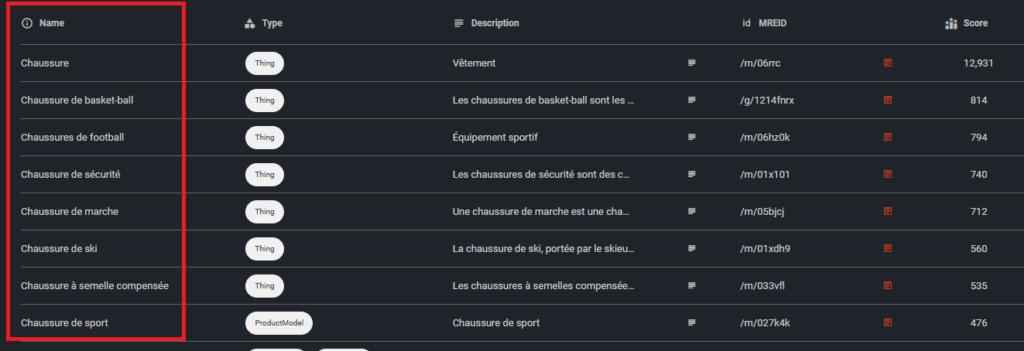
If you type “shoes” on Google and go to the Shopping tab, you will see this:

It is important to realise that KG entities are not necessarily just people or “entities” in the traditional sense — they can ultimately be many different things, helping Google improve its understanding through semantics in order to feed its search results and be even more relevant.
Semantic SEO for semantic search
Semantic SEO aims to ensure that a website has a semantic content network by analysing the connection between concepts, entities, and ultimately all other notions related to semantics such as meaning or search intent.
Semantic SEO therefore deals with all aspects of a topic: rather than focusing on queries, it focuses on concepts, their connections, topics, intent, and entities.
The first step is semantic analysis.
That said, nothing prevents you from also applying a basic analysis such as TF-IDF to maximise your chances of ranking for your content.
Semantic search criteria for semantic SEO
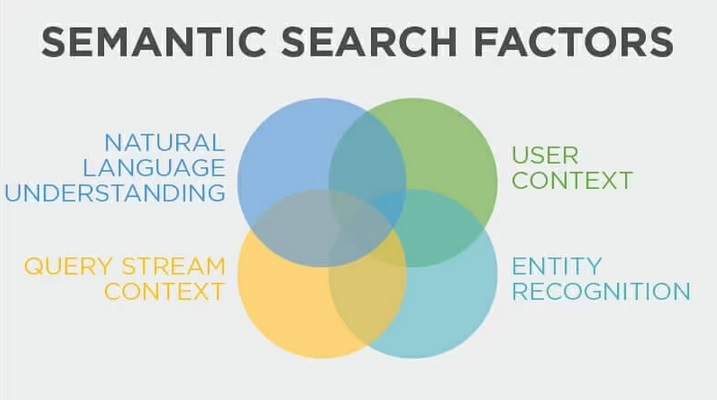
Exploring, evaluating and understanding the semantic web is far easier than the chaotic web. Thus, the principles of semantic search allow search engines to be more efficient, faster, and results-oriented when organising information on the web.
Semantic search and semantic SEO are related concepts.
Semantic SEO is the management of an SEO project while being aware of the features of the semantic and structured search engine, knowing what type of website, URL categorisation and breadcrumb structure, and internal link network you want to see for a given query network. Content format, content type, context, and page design are also organised within the framework of the semantic SEO concept.