
Have you read Google’s EAT guidelines?
Search intent is mentioned as the primary criterion for human raters.
Here is the extract:
“Understanding the query is the first step in the task evaluation. If you do not understand the query or the user’s intent, perform a web search using the Google search engine or an online dictionary or encyclopaedia. If you still do not understand the query or the user’s intent, please release the task.”
It is clear that Google truly emphasises search intent when ranking web pages.
A Taxonomy for Search
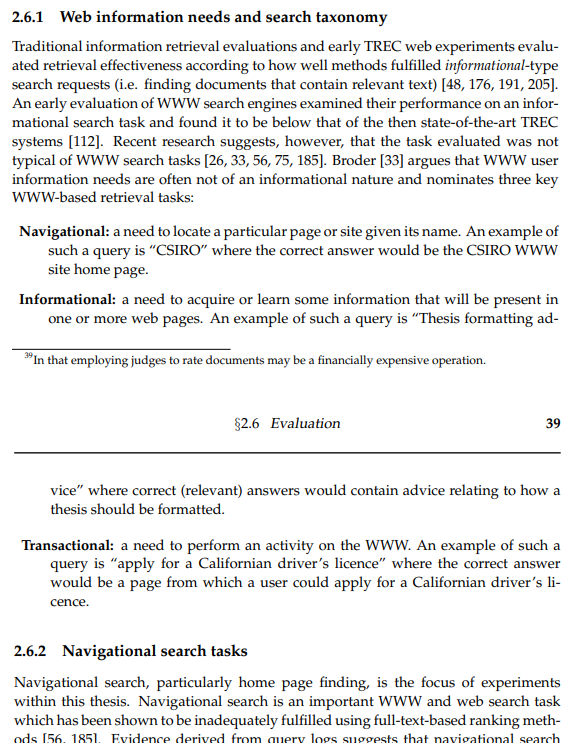
The concept of user intent is very old. User intent in information retrieval systems (IRS) has been observed for many decades. There are also early adaptations in web search research, as in this article by Andrei Broder, who worked at Altavista.

Trystan Upstill also discusses this very well in his 2005 thesis.
Classic Search Intents
The classic search intents are well known in SEO, such as:
- Informational
- Transactional & Commercial
- Navigational
- Brand
- Local
Transactional and commercial can be combined, as the two are similar in terms of user intent.
Google classifies intents into keywords in its EAT evaluation guidelines, such as:
- Do = transactional
- Know = informational
- Go = navigational
For example, if the query is transactional, think about adding the word “Buy” in your H1 tag.
In 2015, Google also introduced another class for Know keywords with Know Simple.
For these simple queries, Google provides a knowledge panel to directly display the answer from their search results:

Search Intent and Machine Learning: A Logical Synergy
Systems now use machine learning algorithms such as BERT that enable the detection of search intent through verbs.
Indeed, as we saw previously, Google uses verbs to understand intent. For example, “how to make an apple pie”.
But search intent is not limited to just a few verbs to understand a searcher’s intent.
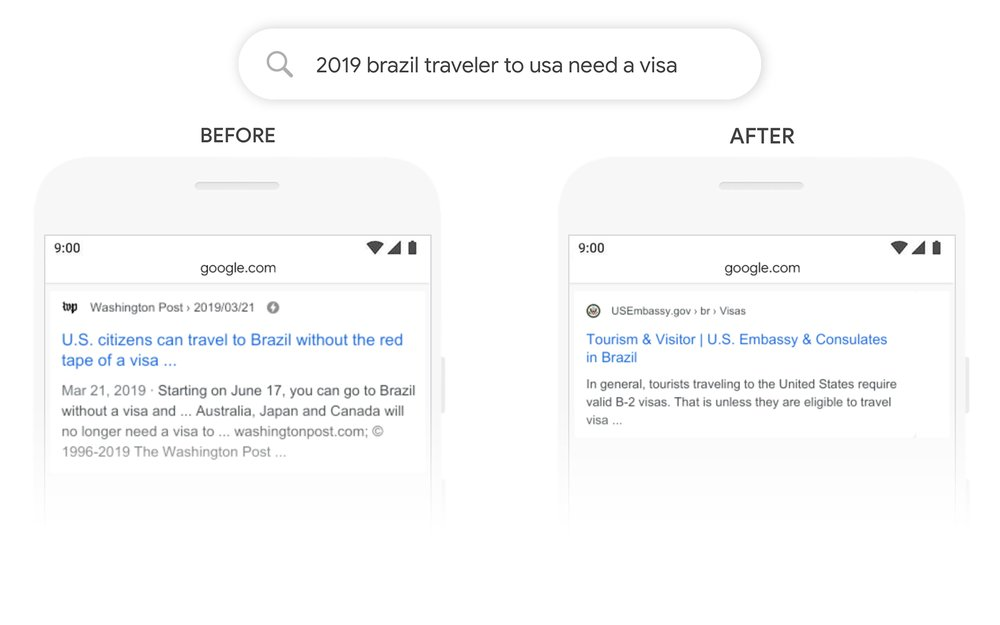
Here is an example from Google’s blog explaining BERT and its impact on search intent:
Here are some of the examples that showed our evaluation process demonstrating BERT’s ability to understand the intent behind your search.
Here is a search for “2019 brazil traveler to usa need a visa”. The word “to” and its relationship with the other words in the query are particularly important for understanding its meaning. It is about a Brazilian travelling to the USA, not the other way around. Previously, our algorithms did not understand the importance of this connection, and we returned results about US citizens travelling to Brazil. With BERT, Search is able to grasp this nuance and understand that the very common word “to” matters a lot here, and we can provide a much more relevant result for this query.
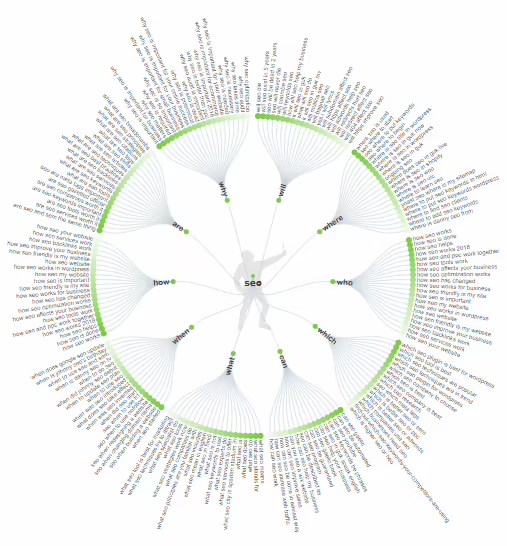
That is why I strongly recommend using a semantic SEO tool such as InLinks, because that is precisely what they do. During a semantic keyword analysis, they help you find search intent through verbs.
Indeed, they use verbs in the context of the keyword/topic to suggest guides to you.

Canonical Search Intent and Ranking Signal Dilution
Push your content above the fold
Ranking signal dilution can occur when two web pages compete for the same canonical query and the same canonical search intent with similar content and common elements. It is therefore essential to create distinct web pages with equally distinctive content for completely different search intents with a certain contextual hierarchy in order to prevent ranking signal dilution.
That is why internal links and thematic connections are important.
Canonical Query is an important patent. It enables “query rewriting”.
Query rewriting is the process of rewriting users’ queries to serve better search results. Users may use different queries for the same search intent; the best version of the query is the “canonical query”. And, in the initial contact section of the content, the canonical query and its “variants” should be included for better “Neural Matching”.
For example, in Evaluating semantic interpretations of a search query — US Patent: 10,353,964 — it is mentioned that the query “How long is Harry Potter?” is an ambiguous query.
To try to understand the intent behind the query, Google must interpret what the person who entered this ambiguous query might have meant and find the right words.
Depending on the internet user, a different interpretation of the search intent may apply.
For example:
Original ambiguous query: how long is Harry Potter?
Semantic interpretation: How long is the Harry Potter book?
Semantic interpretation: How long is the Harry Potter film?
Semantic interpretation: How tall is the Harry Potter character?
Semantic interpretation: How old is the Harry Potter character?
Covering Search Intent in the Right Order
Google’s Query Refinements based on Inferred Intent patent works through query groups and intent models with semantic connections. You can experience this at different taxonomy levels of phrases.
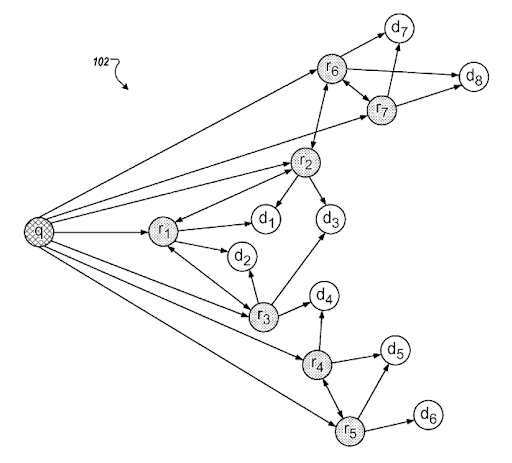
The patent explains the appropriate links between different “query paths” and “context changes”.
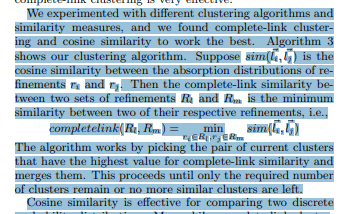
US patent: US9582766B2
Micro Search Intents
Basic search intents ultimately say very little about the content users wish to find. That is why we can list examples of micro search intents, as they are more revealing of users’ needs.
Informational micro-intents:
- Entertainment
- Definition
- Expansional: users wish to deepen a topic in their online research. They need detailed content that sheds light on as many things as possible. The content must comprehensively describe a topic and answer multiple questions. Pillar pages are a judicious approach for meeting this search intent.
- Enablement: Users who want to empower themselves to do something need specific advice. Content designed to meet this search intent should answer the question “How can I…?” step by step.
- Aggregation/overview: Similar to the expansional search intent, the user is concerned with obtaining a neutral overview of a topic. However, the content should be as short and clear as possible (for example, in the form of tables, infographics, etc.).
Navigational micro-intents:
- Support: The user needs service content for the use of an ordered product. Here, usage instructions for the product and related FAQs are of interest as content.
- Location: the user wishes to find a nearby location or a place with the intention of visiting it.
- Website: the user wishes to access a specific area of a website.
Transactional/commercial micro-intents:
- Comparison
- Category / selection: With this search intent, there is a specific interest in products and services. The user roughly knows which solution is right for them, but is not yet sure which variant of a service or product group suits them. Classic shop category pages or service overview pages are ideal for this search intent. Products and/or services should be the main content (MC), possibly accompanied by information to simplify the decision on a variant.
- Service / Product: The user knows roughly exactly what they want or which solution suits them. They are about to place a request/order and want to learn more about the properties, price, delivery, delivery costs, guarantees… in detail. Service detail pages and product detail pages make sense for meeting this search intent.
- Brand: In addition to the classic brand search intent, another micro intent can be mentioned. This may be the user’s need to learn more about the brand or the supplier in order to establish trust. Typical content types here are customer testimonials.
Search Intent Reflects Content Format

The semantic search engine organises elements on the Web based on their types, attributes, and meanings. An organised web structure also requires certain types of content formats linked to certain types of entities and their query types.
For example, a certain type of content with a certain type of words. Such as “best”, “fastest”, “cheapest”, “freshest”, etc.
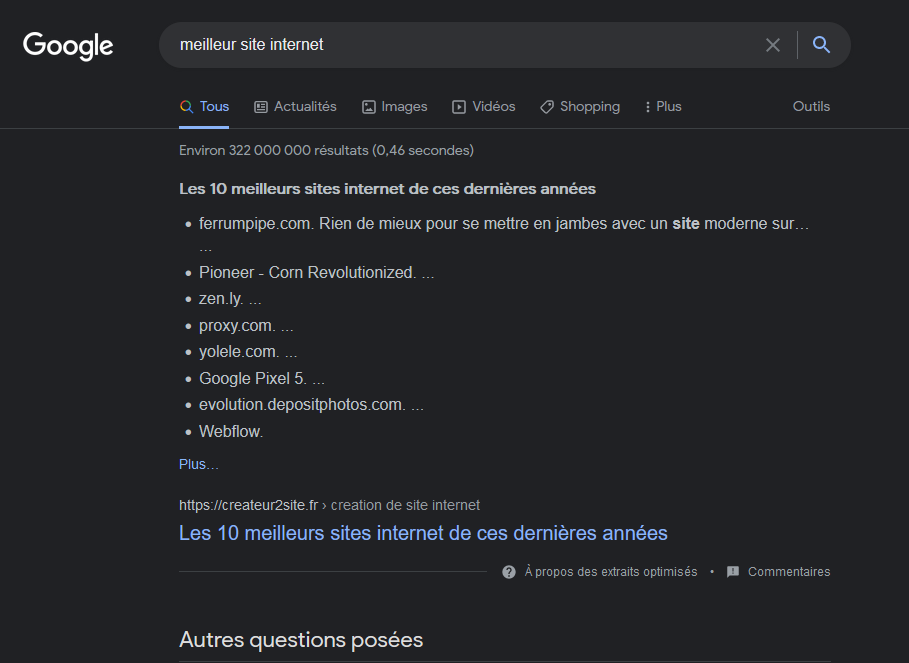
Summary
Content formats should be used multiple times for a content type. Because it cannot be said that a search engine query designates only one search intent.
Thus, synergy effects can be used and the different preferences of users will be taken into account. You should therefore target a main keyword and place appropriate verbs in your secondary title tags, as these are other search intents.
This can be thought of as a conversion funnel because certain types and formats of content work differently at different stages of the customer journey.
Also, consumption habits differ depending on industries, target groups, personas, and context.